
Recent Developments in Ceuta's Migrant Influx
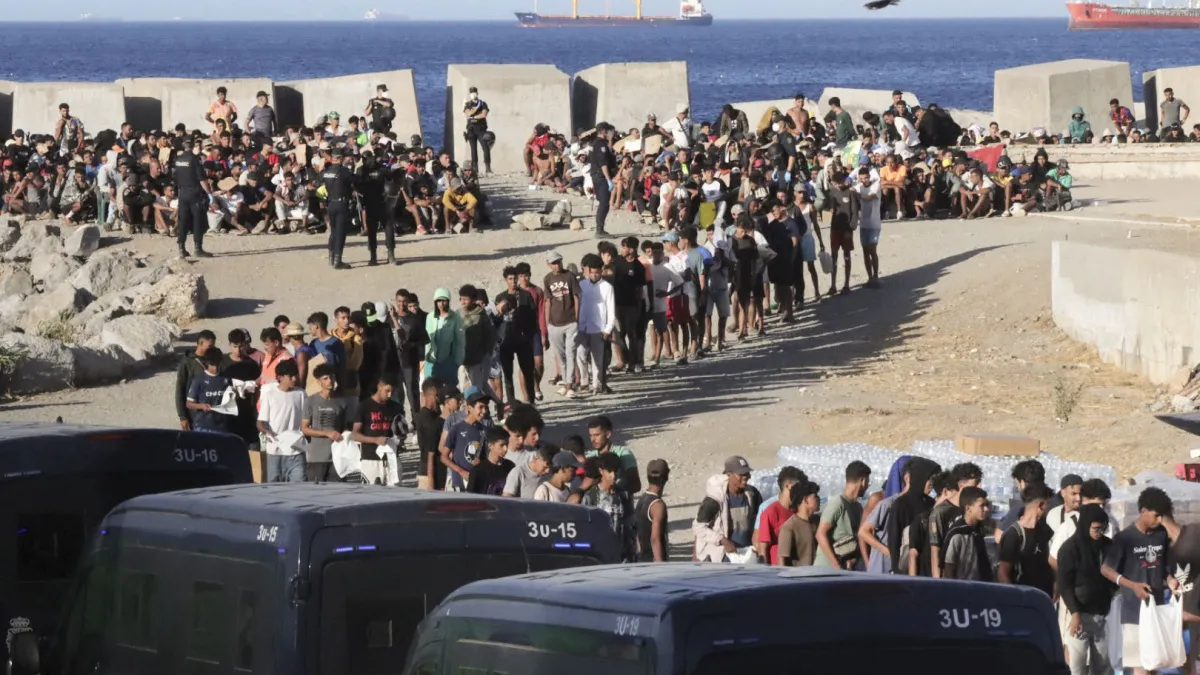
It has been almost a month since an unprecedented mass entry of migrants from Morocco into Ceuta occurred. From the onset, the government led by Pedro Sánchez has refrained from attributing responsibility to its neighboring country, whether through action or inaction, for what has been described as a "violation of Spain's territorial integrity" by the president himself. In his only public address throughout this month, Sánchez praised the cooperation with Morocco, labeling it as an "ally". The political and media memory harkened back to a similar crisis in 2021, albeit with significantly fewer people crossing into Ceuta, which was linked to Spain's stance on Western Sahara and the hosting of Brahim Gali, the leader of the Polisario Front, in a hospital in Logroño.
Government sources have emphasized that during that time, relations and communication with Morocco were quite strained. This stands in stark contrast to the arguments presented in recent weeks from Moncloa. From the very first day, the collaboration was evident through repatriation operations, as asserted by the government. They reiterated that Morocco was unaware of the situation, just as Spain was. However, that same afternoon, Morocco made gestures to assist, leading officials to reflect on the absence of a clear "conspiracy theory" suggesting that Morocco had deliberately orchestrated the crisis.
Political Reactions and Debates in Congress
Against this backdrop, various ministers have appeared before Congress this week, with Moncloa seeking to counter the narratives from the opposition Popular Party (PP) using "facts and data". The role of Morocco has also been a focal point of criticism from left-wing political parties. The differing perspectives were starkly evident during the nearly four-hour session of the Joint Commission on National Security, where Félix Bolaños, the Minister of the Presidency and Justice, ardently defended Morocco's role and collaboration amidst widespread criticism from almost all political factions.
Bolaños firmly stated, "There is no evidence that Morocco facilitated the border entry into Ceuta." He insisted that Morocco did not lead the situation, focusing particularly on responses to the PP and Vox, while acknowledging that criticisms of Morocco also came from other parties, including Sumar, Compromís, EH Bildu, ERC, PNV, and Junts. He chastised the PP for casting aspersions on the government and Morocco, suggesting they needed a basic course in diplomacy to avoid disrespectful accusations without evidence. In contrast, leading figures from Sumar described Morocco as a "despotic regime," emphasizing that Spain's shift in stance on Western Sahara has resulted in continued economic strife for Ceuta.
The political discourse surrounding this issue is underscored by various accusations and calls for accountability regarding Morocco's actions, with some lawmakers questioning the Spanish government's approach and its implications for future relations. The debate continues to unfold as the government seeks to maintain its diplomatic ties while addressing the pressing concerns of migration and territorial integrity.
As reported by publico.es.