
The Remarkable Find of the Dom van Keulen
For three decades, an archaeological enigma lay beneath the waves off the southern coast of England, where divers unearthed a shipwreck containing over 400 gold coins. The identity of this vessel remained a mystery, sparking theories and speculation among historians and archaeologists alike. Recent research, coordinated by Bournemouth University, the British Museum, and the Southwest Maritime Archaeology Group, has finally resolved this long-standing question: the ship is identified as the Dom van Keulen, a Dutch merchant vessel that set sail from Morocco to the Netherlands in 1633, only to succumb to a storm and sink.
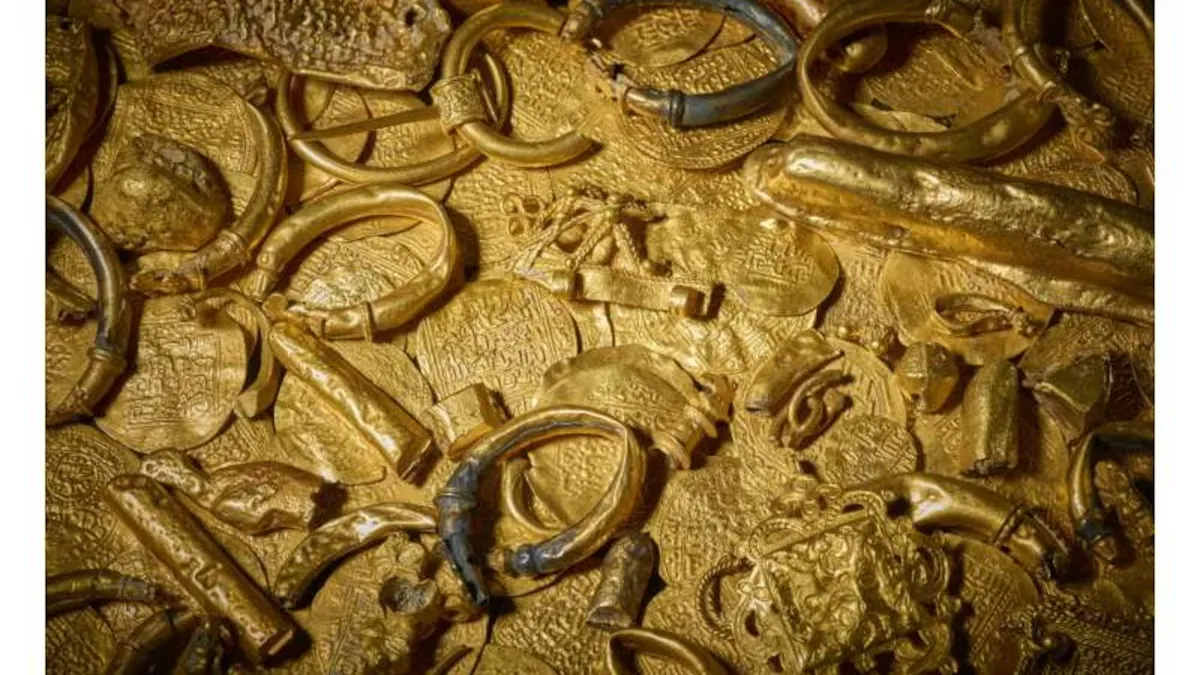
The revelation concerning the Dom van Keulen not only concludes a nearly thirty-year search but also sheds light on 17th-century international trade. The ship was carrying a valuable cargo that included 150 bags of gum arabic, 64 bags of saltpeter, 320 goat skins, and approximately 9,000 Berber ducats. These Moroccan gold coins were highly esteemed in their time for their purity and value. According to Dave Parham, a maritime archaeology professor at Bournemouth University, “Most of the cargo is believed to have been recovered at the time, but over 400 coins remained on the seabed until discovered by the Southwest Maritime Archaeology Group in 1995.”
Historical Context and Significance
The gold sourced from the Barbary Coast, now present-day Morocco, was a crucial driver of trade between Africa, Europe, and the Middle East. Parham emphasized, “This provides important context for the wealth and architecture of the Saadian sharifs, African gold trade, and tangible evidence of the thriving maritime commerce of the 17th century that connected Morocco, the Netherlands, and Britain.” This discovery helps illustrate how African gold circulated and its impact on European economies.
The Dom van Keulen embarked on its journey from Morocco in the autumn of 1633, with a crew that, according to documents found by independent historian Ian Friel at the British National Archives, faced tempestuous weather. The ship began taking on water and ultimately sank near Salcombe in Devon. Fortunately, the entire crew survived, as noted in the Bournemouth University report. The wreck, measuring approximately 30 meters in length and lying at a depth of 18 meters, includes cannons, anchors, and various cargo items.
Among the artifacts recovered, which are now part of the British Museum collection, are a pewter bowl, a spoon, gold jewelry, a fish-shaped sounding weight, a seal, ceramics, and a gold nugget shaped like a finger. “The discovery of African gold beneath the sea off the coast of Devon was an astonishing find that raised many questions about its origin,” stated Jeremy D. Hill, head of research at the British Museum. He added, “Addressing those questions required collaborative efforts from a team of experts. Now we can tell the story of how a Dutch ship carrying gold from North Africa sank off the English coast, turning this discovery into one of international significance.”
During the 16th and 17th centuries, Dutch traders maintained an active exchange with Morocco, acquiring gold in exchange for manufactured goods. This gold, known as Berber ducats, was so pure that it was often melted down in Europe to mint new Dutch coins, which circulated widely as an international trade currency. The significance of these findings lies in their ability to reconstruct the routes and key players involved in this global trade. The artifacts recovered, currently exhibited at the British Museum, represent one of the largest collections of Moroccan gold coins found in British waters, thereby enhancing the understanding of the scale of exchanges and the flow of precious metals between Africa and Europe.
The wreck site is protected under the 1973 Protection of Wrecks Act, and access is limited to licensed divers authorized by the British government. Surveillance of the site is managed by the National Coastwatch Institution at Prawle Point and the maritime police of Devon and Cornwall, under Operation Birdie, a national initiative to prevent the illegal manipulation of submerged historical sites.
“The story can now be told accurately thanks to the collaboration of archaeologists, historians, and numismatic experts,” highlights the Bournemouth University report. The book “From Morocco to the Coast of England: The Story of the Dom van Keulen and Its Extraordinary Cargo” provides an in-depth look at the findings and their historical significance. The case of the Dom van Keulen not only resolves a mystery in nautical archaeology but also illustrates how African gold shaped the European economy and how maritime routes of the past still hold secrets waiting to be uncovered beneath the sea.
As reported by infobae.com.