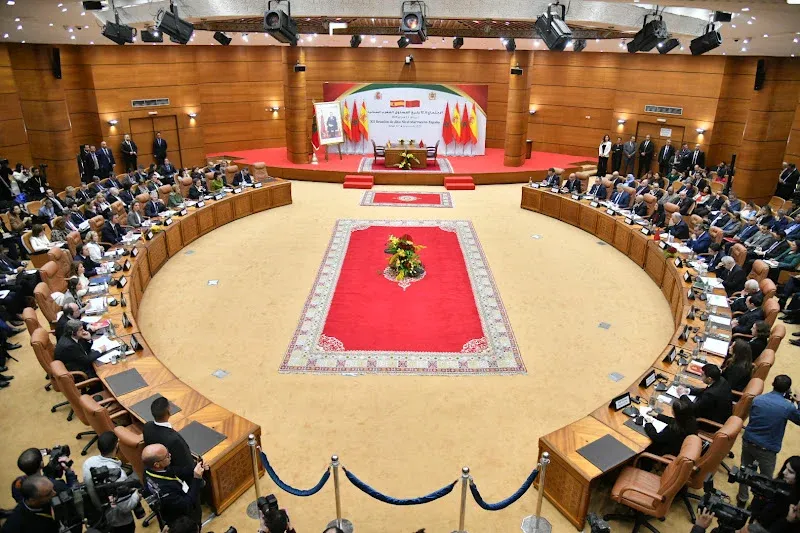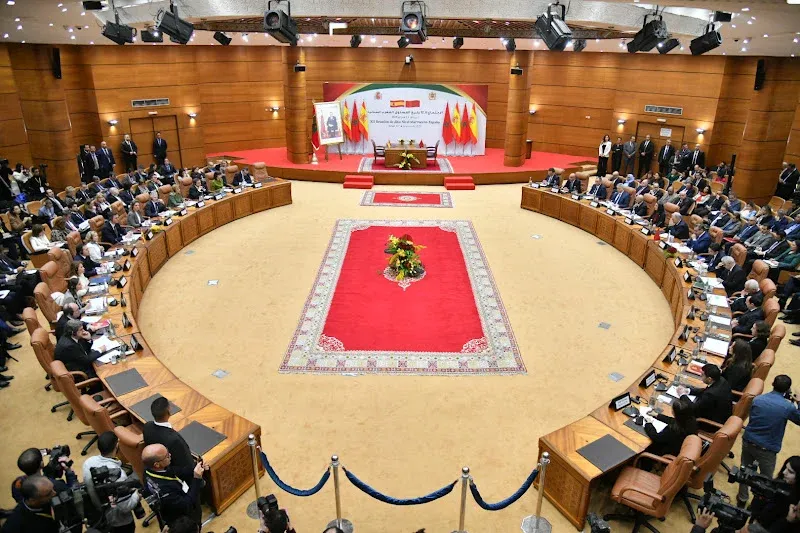

In recent years, the commercial and economic relations between Morocco and Spain have witnessed significant progress. This development has been underscored by the support from the Moncloa Palace for Rabat’s stance on the Western Sahara issue, which has contributed to exceeding bilateral trade volumes of over 22 billion euros last year. Furthermore, Spanish exports to Morocco have grown by 3.5% during the first half of this year, reaching more than 6.4 billion euros, while imports from Morocco to Spain have experienced a similar increase of approximately 4.1%, culminating in over 5.7 billion euros.
In connection with these figures, a study released by the Spanish Institute for Trade and Investment revealed that Morocco's total imports from abroad surpassed 88 billion US dollars last year, with 14% originating from Spain. Meanwhile, Morocco's total exports exceeded 50 billion dollars, with around 22% directed towards the Spanish market. These statistics highlight the importance of understanding the intricate nature of the industrial sectors involved in this bilateral relationship, particularly the automotive industry.
The Automotive Industry: A Model of Industrial Interconnection
The significance of trade relations between these neighboring countries becomes evident when examining sector-specific data, particularly in the automotive sector. Recent figures from the Spanish Association of Automotive Component Suppliers and Manufacturers indicate that Morocco imported components for vehicle manufacturing from Spain valued at 1.038 billion euros last year, positioning Morocco as the second-largest destination for Spanish automotive components outside the European Union, following the United Kingdom. Moreover, a report from the Economic and Commercial Office of the Spanish Embassy in Rabat stated that Morocco's automotive manufacturing and export sector achieved revenues of approximately 15 billion euros by the end of 2025, with Spain accounting for about 20% of Moroccan exports in this area.
This data underscores the fact that economic relations between Rabat and Madrid have evolved from traditional trade exchanges to a genuine intertwining of value chains. Although Morocco's import of automotive components from Spain, exceeding 1 billion euros, represents only a moderate percentage of Morocco's overall component bill—which is sourced from various suppliers—the Moroccan strategy has become increasingly clear in recent years, focusing on diversifying trade portfolios, sourcing, and export destinations. This diversification serves as a solid foundation for managing relationships with partners, including Spain, from a position of equality rather than dependency.
On the flip side, exporting one-fifth of Morocco's vehicle production to the Spanish market provides Morocco with substantial negotiating power, as it constitutes a significant portion of Spain's demand for affordable vehicles. Additionally, the presence of numerous Spanish companies that rely on Morocco for local automotive manufacturing indicates a horizontal integration that ensures these companies remain invested in the ongoing success of the Moroccan industry. Any decline in Moroccan production would risk losing a key customer that purchases their components.
A Resilient Partnership Amidst Challenges
This intersection of interests is precisely what sustains the partnership between Rabat and Madrid, founded on mutual dependence. Neither party can impose its conditions on the other without jeopardizing its own interests, even during crises and amidst contentious issues that are sensitive to both sides, such as the situations in Ceuta and Melilla. Discourse surrounding the nature of the Moroccan-Spanish partnership resurfaced following the mass crossing of migrants into Ceuta in late July, where calls emerged from certain political and media circles in Spain to reevaluate this partnership and even to economically “punish” Morocco. However, these calls face the undeniable reality that the relationship with Rabat has long transcended colonial logic, evolving into a comprehensive partnership that is indispensable for Spain in the Mediterranean region. Any infringement on Moroccan economic interests would effectively be a self-inflicted wound to the heart of the Spanish economy, particularly in a context of intricate economic and international dynamics.
The significance of relations with Morocco is affirmed not only by statistical data but also by the statements of Spanish political leaders and economic actors. Antonio Garamendi, President of the Spanish Confederation of Business Organizations (CEOE), emphasized during the opening of the "Investment in Morocco" forum in May 2023 in Madrid that “Morocco is the main gateway for Spain to access the African continent, just as Spain serves as a direct platform for Morocco towards Europe and Latin America.”
José Luis Bonet, President of the Spanish Chamber of Commerce, also remarked at the same forum that “Morocco is the primary destination for Spanish exports and investments, with Spanish companies operating there demonstrating a high level of commitment to the country. Consequently, professional organizations representing businesspeople are fully convinced of the importance of leveraging integration around a common agenda that is digital, green, and inclusive, with a readiness to mobilize more companies, particularly small and medium-sized enterprises.”
This economic interdependence is further complemented by the presence of several Spanish companies operating in Morocco, such as Gestamp and Antolin, which specialize in automotive components, as well as Inditex in the textile sector, among others like Romo, Recaryon, and Poluda Corporation Maritima, and Expo Logistics. Furthermore, Manuel Antonio Fernández-Viacanas, an economic analyst and professor at EAE Business School, stated to the EFE agency that “Morocco has heavily relied on its industrial growth through integration with Europe via Spain.” He cautioned that “any disruption in trade relations would entail costs for both parties; Spain would lose an important market for its exporters, but it possesses a much broader capacity for absorption due to its size and geographical diversity. Conversely, Morocco would face more structural impacts on industrial employment and its perception as a manufacturing platform aimed at the European market.”
As reported by hespress.com.