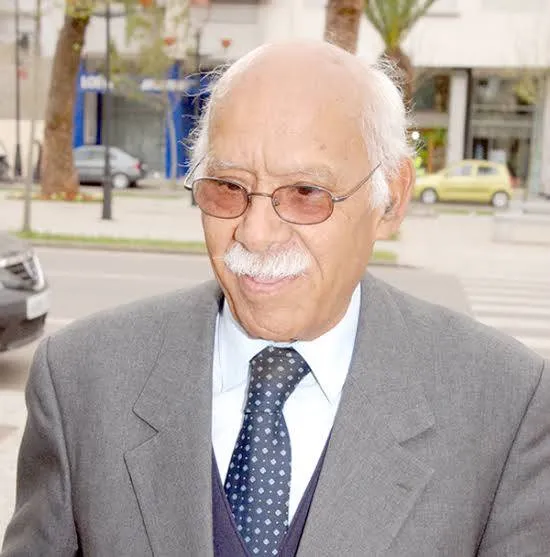

It is challenging for me to express the departure of the venerable and esteemed poet Mohammed Serghini using traditional eulogistic language. The man, who expertly navigated the complexities of language and transformed poetry into a realm of inquiry, ambiguity, and experimentation, cannot be reduced to mere words of condolence. Reflecting on his memory today, I realize that I am not just bidding farewell to a poet; rather, I am parting with a fragment of modern Moroccan poetic memory, along with one of the voices that contributed significantly to our poetry's evolution from the comfort of expression to the unease of meaning, from the familiar to the adventurous use of language.
Remembering a Poet's Journey and Philosophical Reflections
As I reminisce about Mohammed Serghini, I recall our conversations in Fez, a city that held a deep significance for him as a place of origin, despite his cultural geography expanding to places like Al-Qarawiyyin, Baghdad, Rabat, and Paris. I particularly remember two interviews I had the honor of conducting with him, one for the Moroccan Internet Writers Union magazine and another for the "Al-Quds Al-Arabi" newspaper. Yet, the dialogue that resonates with me today is the one where Serghini spoke at length about death, confronting it through his writing, and the impact a cultured individual should leave behind after their demise.
I did not realize at the time, as I listened to him, that some of his insights would take years to unveil their deeper meanings. He once told me, a phrase that has lingered in my memory: "I wish to die in full integrity." This statement now feels like a final signature from a poet who was committed to the idea that one should reach the end of their life while maintaining mental clarity, dignity, and the ability to think critically. Serghini did not approach death with a sense of resignation; instead, he examined it as a poet would a challenging metaphor: deconstructing it, sometimes mocking it, philosophically testing it, and returning it to the realm of inquiry.
On that day, he was engrossed in writing a lengthy piece centered on death. He spoke of the human experience—eating, drinking, and walking on earth—only to find oneself suddenly beneath it. In his words, there was no morbid fascination with demise but an acute awareness that as time advances, death becomes ever more present within the horizon of thought, intensifying the urgency of the writing question: What can a writer leave behind? What remains of a person when their features fade, yet their impact lingers?
These questions serve as an excellent entry point for understanding the entirety of Mohammed Serghini's experience. For him, poetry was not merely a linguistic craft or a pathway to fame; it was a form of human existence within the world. He viewed writing as a means of engaging with existence, resulting in a heightened sensitivity towards anything that reduced literature to a mere social facade or a quest for recognition. He believed that a true intellectual only puts words on paper after thoroughly examining their responsibility, and as one matures, they must reflect on what they have contributed to public life, culture, and knowledge.
This ethical perspective on writing, in my opinion, explains a significant aspect of the strictness of his work. Mohammed Serghini was not a poet who found comfort in what he had accomplished to merely replicate it in another form. He was a poet in constant flux within language; whenever he reached a new understanding, he would leave it for another, and once he settled into a poetic form, he would begin to destabilize it. Perhaps this creative anxiety is what made his experience one of the most experimental in Moroccan poetry.
For Serghini, poetry was not a window opening onto a clear landscape but a multi-layered construction. Stepping into it, one encounters Arab heritage, mysticism, mythology, philosophy, comparative literature, and both individual and collective memory, all while discovering a poetic self that continually questions language itself. Thus, his poetry was not easily traversed. His verses demanded a reader willing to participate in the creation of meaning, rather than a reader expecting the words to reveal themselves fully upon the first reading. This approach may have appeared as obscurity to some readers, but it was fundamentally a natural outcome of a poet who refused to reside within the comforting confines of language.
I saw him as a poet who sometimes made ambiguity a testing ground for meaning, rather than an unnecessary barrier between the text and the reader. For him, poetry did not explain the world; instead, it made it beautifully ambiguous, not shutting down inquiry but opening it to other possibilities. Even the titles of his collections seem to embody this poetic strategy: "The Burning of His Coming Names," "The Seas of Mount Qaf," "The Being of the Specter," "Who Did This to Your Skulls?" and "From Beneath the Ruins from Above the Ruins." These are titles that do not settle within a singular meaning but invite the reader into realms where mythology, symbolism, existential angst, and cultural history intersect.
For me, Mohammed Serghini was one of those who transformed the nature of poetic sensibility in Morocco. He did not merely modernize form; he re-examined the function of imagery, the relationship of poetry to knowledge, and the boundaries of poetic vocabulary itself. In his view, poetry could incorporate numerous elements from outside its traditional confines without losing its poetic density. His diverse culture, shaped by his studies in Al-Qarawiyyin, Baghdad, Rabat, and the Sorbonne, did not merely remain as academic capital behind the poem but infiltrated its fabric, granting it a depth that transcends immediate occasions and emotions.
Therefore, I cannot separate his identity as a poet from that of an educator and researcher. He was as much a teacher of generations as he was a great poet. At the Faculty of Arts in Fez, he left an impact that extended beyond the university lecture to a broader understanding of cultural formation. Some names merely teach knowledge, while others make their presence a part of that knowledge. I believe Serghini belonged to the latter category.
During our conversations, he did not speak from a pedestal of complete wisdom; rather, he maintained a spirit of inquiry. Even as he advanced in age, he continued to regard writing as an open project and his experience as something yet to be completed. Perhaps that is why his perspective on autobiography captivated me. He did not believe that a biography should merely recount personal stories; instead, he posited that the fundamental question one must ask is: What have I accomplished? What have I created during these years? What idea or movement have I contributed to building and developing?
Today, I find that this very question is the best way to receive his passing. What did Mohammed Serghini accomplish? He left behind poetry that demands rediscovery beyond mere occasions. He left a legacy deserving of fresh critical readings, not only as a document of Moroccan poetic modernity but as a text still capable of posing present-day questions. He left an academic and cultural impact, and for generations of poets and researchers, he embodied the image of an intellectual who did not separate writing from knowledge.
As for me, I will always remember those gatherings in the Fez café at Place Floransa, where I engaged with a man who spoke to me about death and then laughed. I now interpret that laughter differently. Perhaps it was his way of diminishing the authority of mortality over him, or perhaps it was a final poetic defense of life, or maybe he understood, with a poet's intuition, that while death can halt the heartbeat, it cannot stop the movement of poetry in time.
Thus, the poet departs, yet his poetry does not leave with him. It allows him to traverse alone, while remaining in our hands, like a footprint on a long road, telling us that someone passed through here, and they were not just a passerby.
As reported by lakome2.com.