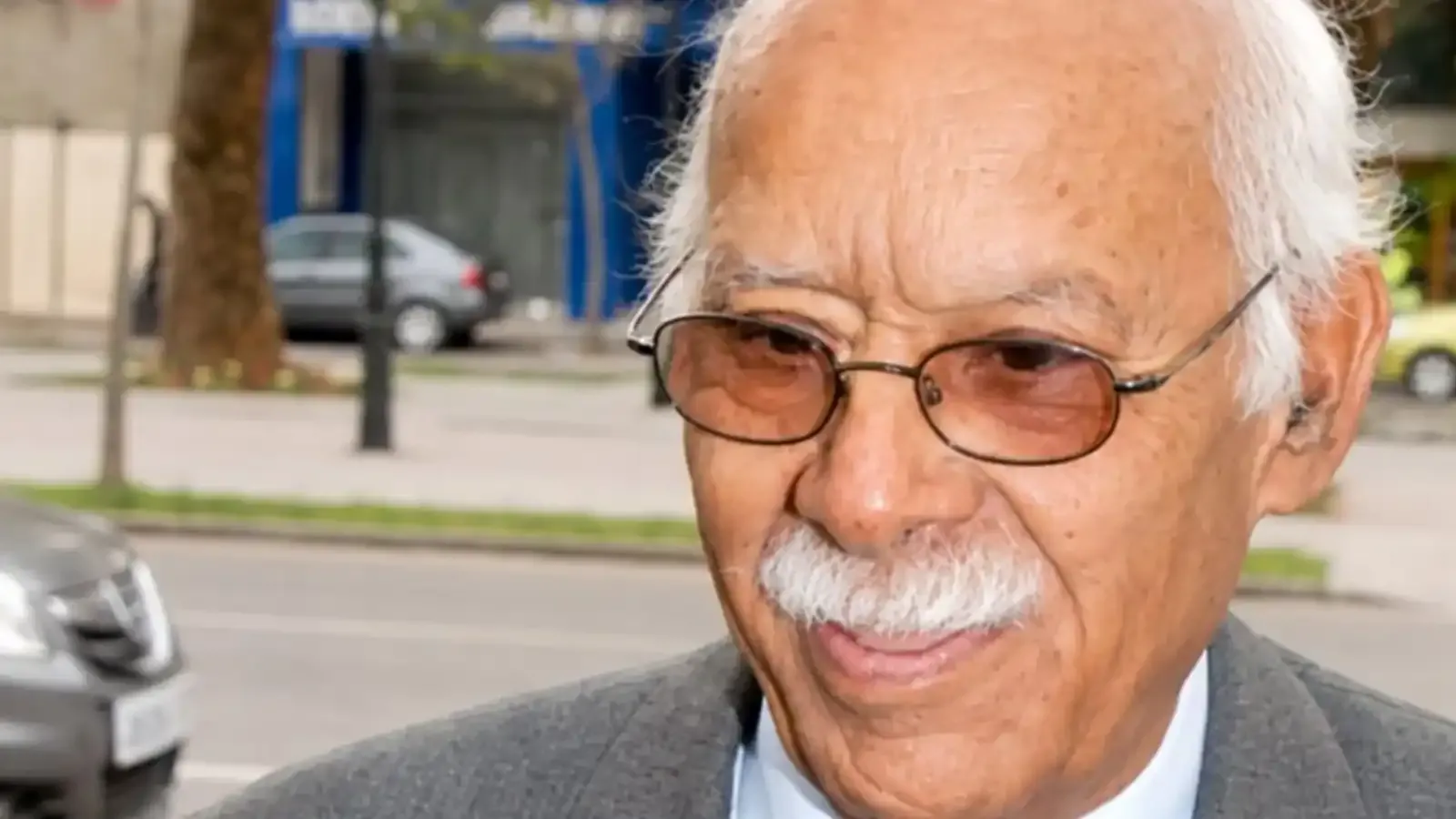

On Friday, August 14, 2026, the Moroccan poet Mohammed Serghini passed away at the age of 96, leaving behind an extensive literary and academic legacy that spanned decades. His contributions were instrumental in establishing the modern characteristics of Moroccan and Arabic poetry, marking him as a pivotal figure in the evolution of contemporary literature.
Serghini's rich experience encompassed poetry, criticism, and academic research, culminating in 2004 when he was awarded the prestigious Global Arkan Poetry Prize in recognition of his significant role in the advancement of modern Moroccan poetry.
The Life and Works of Mohammed Serghini
Beginning his literary journey in the 1950s, Mohammed Serghini emerged as a leading voice in the realm of Moroccan poetry. Throughout his career, he produced a diverse array of poetic texts characterized by their rich thematic variety and mystical undertones, contributing to the collective memory of modern Moroccan poetry and the broader Arabic literary scene.
In 2004, Serghini's creative path was honored with the Global Arkan Poetry Prize, acknowledging his efforts to enrich the landscape of modern Moroccan poetry and enhance the Arabic poetic experience.
From Al-Qarawiyyin to the Sorbonne: An Academic Journey
Born in Fez in 1930, Mohammed Serghini began his education at Al-Qarawiyyin University before moving to Iraq to further his studies. He earned a Bachelor’s degree in Literature from Baghdad University in 1959, returning to Morocco to obtain a degree in Comparative Literature from Mohammed V University in Rabat in 1963.
Serghini continued his academic endeavors in France, where he received his Ph.D. from the Sorbonne in Paris in 1970, followed by a Doctorate State from the same institution in 1985.
In addition to his poetic output, Serghini served as a professor at the Faculty of Arts and Humanities in Fez from the 1960s until the 1990s, balancing teaching, academic research, and creative projects. He was known for his mystical inclinations and his engagement with a wide range of intellectual and literary issues, beginning his contributions to cultural journalism early in his career. His writings and translations appeared in numerous Moroccan and Arabic journals.
Serghini's first poetry collection, "The Burning of His Coming Names," was published in 1987, followed by several other works that solidified his presence within the Moroccan poetic landscape. Some of his notable publications include "Sailors of Mount Qaf" in 1991, "The Sabian Being," "I Found You in This Archipelago" in 1992, "Who Did This to Your Skulls?" in 1994, "Reserve of Ivory and the Highest Peaks of Fraud" in 2000, and "Under the Rubble, Above the Rubble" in 2012.
In addition to his poetry and academic research, Serghini's influence extended into cultural journalism, where he actively participated in the movement, publishing his writings and translations in various Arabic and Moroccan periodicals. He contributed to the Iraqi magazine "Al-Anis" under the pseudonym "Mohammed Naseem," and also published in the Moroccan journals "National Education" and "Pens."
With his passing, Moroccan literature loses one of its most significant voices, a figure who profoundly influenced the transformations of modern poetry through his multifaceted contributions to poetic creativity, criticism, academic research, and cultural work.
As reported by foochia.com.