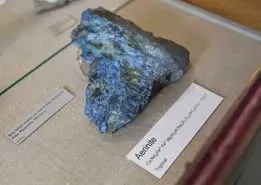

A Journey from a Simple Stall to a Museum Exhibit
For over three decades, a captivating blue mineral has piqued the interest of scientists after being showcased at the Natural History Museum in London. This intriguing tale began with a simple stall in Morocco and has evolved into a scientific mystery that continues to baffle experts. The story traces back to 1980, when geologist Anna Grayson purchased a blue stone from a vendor near Fez. Despite the vendor's claim that the stone was 'lapis lazuli', Grayson observed that its color changed with the angle of view, raising her suspicion that it was a different mineral altogether.
Unraveling the Secrets of the Color-Changing Mineral
This peculiar color shift was not merely a trivial detail; it indicated that the stone possessed unusual properties, prompting Grayson to keep it for further scientific investigation. Years later, the sample was presented at a scientific event at the museum, where it caught the attention of a team of researchers led by scientist Gordon Creasy. This sparked a meticulous analysis that lasted over a year, employing advanced analytical techniques, including synchrotron X-ray diffraction, to explore the atomic structure of the mineral in quest of its nature.
The results revealed that the stone was not a new mineral as initially thought, but rather a rare mineral called aerenite, known since the 19th century. The uniqueness of aerenite lies in its intricate composition, consisting of microscopic crystalline fibers containing iron ions, allowing for electron transfer between them, which explains the color change depending on the viewing angle. After more than thirty years, this sample has returned to the scientific spotlight, aiding in a deeper understanding of aerenite's properties and contributing to the identification of other enigmatic mineral samples within the museum. Visitors can now view this rare specimen, which has transitioned from a simple purchase at a small stall to a significant scientific artifact in one of the world's most prestigious museums.
As reported by masrawy.com.