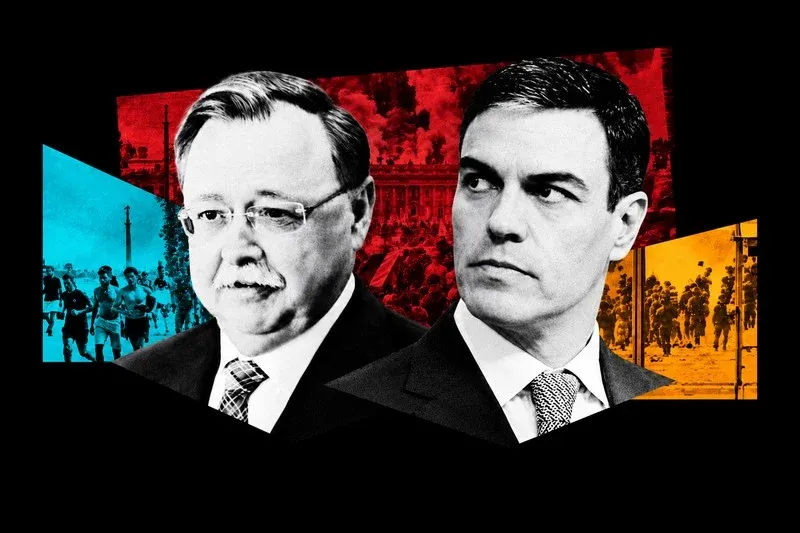

The contemporary political landscape in Spain is marked by a significant tendency for border crises to extend beyond their geographical and humanitarian confines, swiftly becoming central to party conflicts in Madrid and serving as fuel for open political battles. This phenomenon is starkly illustrated by the contrasting narratives presented by Spanish Prime Minister Pedro Sánchez and the leader of the so-called local government of Ceuta, Juan Jesús Vivas. The current migration crisis has evolved from a complex security and humanitarian issue into a weapon wielded for internal political reckoning, reshaping the dynamics of political opposition ahead of upcoming electoral contests.
In analyzing the substantive content of the recent televised interviews, a clear political strategy emerges that positions the Kingdom of Morocco as a focal point in Spain's internal disputes. This strategic move channels attention toward Rabat, despite the underlying confrontation being predominantly between the government and opposition in Madrid. Consequently, Morocco is manipulated within party rhetoric as a 'Trojan Horse,' utilized to undermine political adversaries rather than to address the multifaceted realities of the migration crisis itself.
Juan Jesús Vivas, the mayor of Ceuta and a member of the People's Party, chose the popular program 'El Hormiguero' on Antena 3 to launch a vehement attack against Morocco. His rhetoric transcended conventional security descriptions, venturing into a lexicon more aligned with political and military mobilization. He characterized the arrival of approximately 13,000 individuals, including minors, as an 'invasion' and a 'hybrid attack' targeting the city. This portrayal fails to recognize the complexities of migration as a social, economic, and security phenomenon, instead framing it as an organized hostile act that places primary blame on Morocco, labeling it a 'unreliable partner' while simultaneously urging Spain and the European Union to shoulder greater responsibility for border protection.
However, Vivas's assault was not limited to Morocco; he seized the crisis to question the credibility of Sánchez's government, accusing it of 'inaction,' 'irresponsibility,' and an overabundance of caution in the face of potential provocations from Morocco. He invoked the May 2021 crisis and warnings from Spanish intelligence to paint a picture of a hesitant and ineffective central government incapable of assertively managing border issues. In this context, Morocco becomes a tool in political discourse aimed more at discrediting the government than addressing the realities of the situation on the ground.
This narrative is not in pursuit of structural solutions to a complicated crisis, but rather aims to embarrass the ruling coalition and depict it as incapable of safeguarding borders and sovereignty. The shift of the crisis discourse from security management to the language of 'invasion' and 'attack' provides the opposition with more politically mobilizable material, particularly in light of competition with the far-right Vox party, which has made immigration a central theme of its platform. Thus, it is challenging to disentangle the heightened rhetoric against Morocco from the electoral strategies of the People's Party as they seek to regain momentum against more extreme right factions.
Conversely, Prime Minister Pedro Sánchez appeared on La Sexta to offer a fundamentally different narrative. He refrained from assigning blame to Morocco for the crisis or reducing the situation to ready-made political accusations. Instead, he defended his government’s handling of the issue as a complex humanitarian and security crisis requiring legal firmness, field coordination, and respect for human rights, firmly opposing the notion of casting Rabat as a scapegoat for political struggles within Spain.
Notably, Sánchez directly countered the narrative of 'Moroccan complicity or laxity' during the events of late July, asserting that Moroccan authorities were not passive bystanders; rather, they alerted the Spanish side and attempted to manage the crowds to avert a humanitarian disaster, deploying significant security reinforcements and ensuring the majority of migrants were returned. This testimony directly undermines the narrative that seeks to portray every border crisis as a result of deliberate Moroccan action designed to exert pressure on Madrid.
These developments contextualize the political discourse within its true framework, as the official acknowledgment of Moroccan field cooperation complicates the portrayal of Morocco as an 'unreliable partner' propagated by Sánchez's adversaries. It also highlights the gap between security realities on the ground and the rhetoric employed in political battles, which requires a clear adversary and a straightforward narrative easily marketable to voters, even when the migration crisis is far too intricate to be reduced to a single narrative or perspective.
Sánchez also traced the roots of the crisis to factors extending beyond the bilateral relationship with Morocco, discussing smuggling networks and the misinformation rampant across social media platforms, especially concerning the Supreme Court's decision on July 8, along with the economic disparity between the two shores of the Mediterranean. He confronted smear campaigns and conspiracy theories related to the Pegasus program, dismissing suggestions from opposition leader Alberto Núñez Feijóo and others as scenarios suitable for 'Netflix series,' indicating what he perceives as politically motivated accusations aimed at undermining his relationship with Rabat.
By underscoring that relations with Morocco are a 'strategic necessity' for Spain, Sánchez shifted the discussion from partisan posturing to a rationale centered on enduring interests. Issues such as immigration, combating human trafficking networks, security, border monitoring, and economic cooperation are challenging for Madrid to manage without continuous coordination with Rabat. Hence, introducing this relationship into electoral calculations poses risks that extend beyond the impact on a single government to the collaborative framework between two nations that are intertwined through geography and overlapping security and economic interests.
This dynamic elucidates the nature of the political war surrounding Ceuta, as Sánchez perceives Vivas's shift in stance on migration, particularly regarding accommodation and treatment, as inseparable from the pressures exerted by the national leadership of the People's Party and the rise of the Vox party's rhetoric. In this context, terms like 'invasion' transition from descriptors of events to electoral tools, while Morocco becomes a means to breach the defenses of the central government; ultimately, the target is not just Rabat, but Sánchez and his position within the Spanish power equation.
Ironically, Ceuta itself lies at the heart of a network of daily interests intertwined with Morocco, complicating the narrative of open confrontation beyond mere slogans that can be touted in a television studio. Geography does not conform to electoral calculations, borders are not managed solely through speeches, and security cooperation in the Ceuta and Strait of Gibraltar region necessitates communication channels capable of functioning even amidst heightened political animosity in Madrid.
The juxtaposition of Vivas's and Sánchez’s speeches reveals a profound divergence in their perceptions of the relationship with the southern neighbor. The former invokes threatening language and integrates migration crises as part of internal mobilization, while the latter views partnership with Rabat as a Spanish interest that should not be sacrificed in electoral conflicts. This does not imply the absence of disagreements between the two countries or the nonexistence of sensitive issues; rather, it signifies that the management of these issues is fundamentally different from using them as fodder for party propaganda.
The Ceuta crisis has transformed into a testing ground for Spanish political conflict and a mirror reflecting how a sensitive issue like migration can transition within days from border discussions to television studios, and from security reports to party campaigns, while Morocco finds itself at the center of a domestic propaganda effort that does not always reflect the nature of existing cooperation nor the realities acknowledged by the Spanish government itself.
The more alarming aspect is that converting a strategic neighbor into a perpetual source of internal conflict may yield short-term electoral gains for certain political factions, yet it jeopardizes Spain’s interests in favor of short-sighted calculations. According to the narrative presented by the Spanish Prime Minister himself, Morocco has been a collaborative party in mitigating the crisis rather than a bystander. Thus, the battle revealed by the events in Ceuta is fundamentally Spanish in essence, while Morocco has once again found its name embroiled in a partisan confrontation where migration is weaponized against opponents in Madrid rather than aimed at understanding the developments at the border.
As reported by hespress.com.