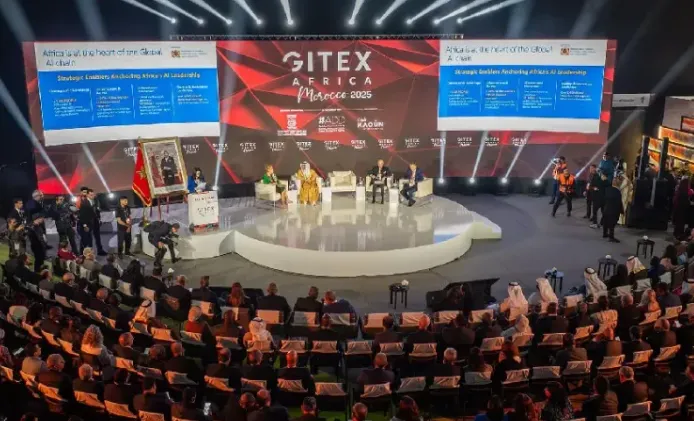
The Evolution of GITEX Africa Morocco 2026
GITEX Africa Morocco 2026 has transcended the role of a mere technology exhibition; it has emerged as a significant indicator of the digital transformation sweeping across the African continent. The event highlights Morocco's growing ambition to establish itself as a regional digital platform. The record figures from this fourth edition showcase the scale of this transformation, revealing an unprecedented dynamism in the realms of innovation and technology.
This year's GITEX has set new attendance records, confirming its status as a pivotal event in Africa, with unparalleled participation from countries, companies, institutions, investors, and, of course, visitors. The following statistics underscore Morocco's desire to become a technological hub in Africa:
- Over 55,000 visitors from around the world, with some reports suggesting attendance could reach 70,000, compared to 45,000 in 2025 and 40,000 in 2024.
- More than 1,500 exhibiting companies.
- Attendance of over 400 international investors.
- Representatives from 130 countries took part.
- Over 650 government and institutional delegations were involved.
- Approximately 700 international speakers and experts contributed to the event.
This growth illustrates that GITEX Africa is experiencing remarkable annual expansion, both in participant numbers and company size, solidifying its position as the largest technology exhibition on the continent. However, despite these successes reflected in the statistics, it is crucial to address the organizational challenges faced on the first day, which revealed a clear lack of coordination affecting the smooth entry of both company representatives and visitors.
Addressing Organizational Challenges
The entry process for visitors on the inaugural day stood out as the sole negative aspect in the organization over the three-day event. It is perplexing to utilize advanced digital tools that allow thousands of visitors to pass through in under two minutes—where a QR code is scanned to generate a badge—only to find that reaching these digital facilities entails navigating through a crowded space filled with pedestrians and cars, culminating at a small entrance where overwhelmed organizers attempt to manage the chaos. This scenario highlights a reliance on partial digital solutions while still clinging to bureaucratic mindsets, a contradiction that does not align with the demands of the digital age and artificial intelligence. Successful digital transformation cannot thrive in an environment resistant to digitization and AI solutions.
If organizers had considered two key aspects, the reception on the first day could have matched the technological advancements showcased: the first concern pertains to the ministerial delegation present at the opening, led by the Prime Minister. It was unreasonable for each minister to arrive in individual cars accompanied by numerous vehicles carrying just one or two staff members. This excess of official vehicles led to significant confusion at an exhibition accommodating over 55,000 participants, particularly in the absence of adequate parking facilities. A simple solution would have been for the official delegation to arrive on a single bus, transporting all ministers and their aides together.
The second recommendation involves shedding bureaucratic attitudes that hinder digital progress. Instead of forcing visitors to traverse a significant distance amidst heavy traffic and potential hazards from vehicles, organizers should have allowed direct access for visitors to the scanning area. Each visitor could display their QR code for entry in under two minutes, as was successfully implemented on the event's second and third days. This exemplifies the true benefit of digitization.
We note these observations to ensure they are considered for future editions, allowing for an organization that truly reflects a premier digital exhibition. Beyond these challenges, the event achieved notable success, and our country is in urgent need of continuing to host future editions. GITEX presents significant advantages across various sectors. For instance, studies indicate that the digital economy in Africa is projected to reach approximately $2.9 trillion by 2030. Furthermore, the African artificial intelligence market is expected to grow from $4.5 billion to $16.5 billion, while the telecommunications market is anticipated to exceed $66 billion. These figures solidify GITEX's role as a strategic platform connecting investors with startups and emerging markets.
Hosting this event in Marrakech embodies Morocco's commitment to investing in Africa and aligns with a strategic vision aimed at:
- Positioning Morocco as a leading digital hub in Africa.
- Attracting global technological investments.
- Supporting Moroccan startups (with over 300 participating startups).
- Enhancing partnerships between governments and the private sector.
Although these statistics are important, they do not solely reflect the event's value. The essence lies in the volume of ideas exchanged, the number of partnerships established, the funding opportunities available to African youth, and ultimately, Africa's transition from being a consumer of technology to becoming a producer and innovator in this field.
What distinguished the fourth edition of GITEX was the caliber of speakers and experts in digitalization, artificial intelligence, and the Internet of Things. These three themes dominated all discussions at the Moroccan African exhibition. The event also showcased the success stories of young Moroccan entrepreneurs who have established startups thriving in Morocco and expanding across Africa, presenting their technological innovations on the continent. This creative youth, distinct from the formalities of ministers and public institution directors—sporting sneakers instead of shiny shoes, wearing shirts without ties, and carrying backpacks instead of traditional briefcases—awaits governmental acknowledgment to invest in their capabilities and talents for growth in Morocco and expansion in Africa.
The fourth edition of GITEX highlighted the capabilities and competencies of Africans, indicating that African youth are poised to enter the realms of digitization and artificial intelligence, transforming their continent from a consumer to a producer of AI and digital knowledge in general.
GITEX 2026 has proven that Africa is advancing with its talents and determination, as it has yet to make its mark in the realm of artificial intelligence.
In conclusion, the statistics from GITEX Africa Morocco 2026 confirm that Africa has truly entered the digital revolution, with Morocco firmly positioning itself at the heart of this transformation. It is not merely an exhibition but a strategic platform that outlines the future landscape of the digital economy in Africa, where numbers evolve into indicators of strength, and ambitions transform into tangible projects.
As reported by pjd.ma.