
Understanding the Price Disparity in Tomato Sales
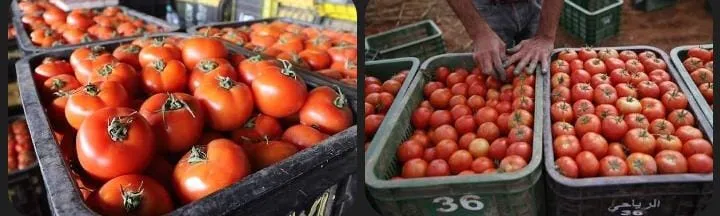
At the break of dawn, Abdul Salam completed the sale of three tons of tomatoes from his farm near Chichaoua at a price of 2.70 dirhams per kilogram. Just 48 hours later, those same tomatoes were being sold in a popular market in Marrakech for a staggering 9 dirhams per kilogram. This price difference is not merely a numerical anomaly; it represents a chasm between two distinct worlds: the farmer who sells under the duress of perishability and the consumer who purchases under the strain of rising costs. Our investigation did not stop at tracking a single shipment; rather, we monitored the sales dynamics within Marrakech's wholesale fruit and vegetable market over three days, collecting purchase invoices and listening to farmers, intermediaries, retailers, and value chain experts. The findings reveal a convoluted chain where profit margins accumulate in unseen points, establishing a 'reference price' that is formed in critical moments each morning.
The Dynamics of Supply and Demand
On the first day of our investigation in Chichaoua, the supply was abundant. Three farmers confirmed that the selling price for that week fluctuated between 2.50 and 3 dirhams per kilogram. The urgency was palpable; if they didn’t sell today, tomorrow's price would likely drop even further. With production costs estimated at around 2 to 2.30 dirhams per kilogram—including seeds, fertilizers, water, labor, and initial transportation—the profit margin for farmers in the best-case scenario barely exceeds half a dirham. Farmers have no luxury of negotiation or storage; time is not on their side, and their products are perishable. Hence, they are compelled to sell.
On the second day, we observed the rapid-fire negotiations taking place at the entrance of the wholesale market, where entry fees and service charges apply, alongside brokerage commissions ranging from 5% to 7%. By 7:30 AM, the price of tomatoes settled at 4.10 dirhams per kilogram after swift bargaining. As one trader noted, 'the price is dictated by supply and demand, and today’s demand was moderate.' However, farmers spoke of 'unwritten agreements' that emerge in the initial moments of trading, where the price established in those first few minutes becomes the day's reference for all transactions. There is no public platform providing real-time updates on the tonnage entering the market or the details of each transaction; hence, the reference price forms within the market, in a narrow time window, away from the eyes of both producers and consumers.
The investigation revealed that the journey of Abdul Salam’s tomatoes unfolded as follows: from the farm at 2.70 dirhams, after initial transport and potential losses, around 3.10 dirhams; within the wholesale market at 4.10 dirhams; plus commissions and fees of approximately 0.35 dirhams; short transport and storage at 0.40 dirhams; the wholesale exit price at around 6 dirhams; and daily spoilage during transport to retailers at about 0.50 dirhams, culminating in a final retail price of 9 dirhams. The overall increase amounted to 6.30 dirhams, equating to an astonishing 233% markup from the farm to the retail market. While there are legitimate costs at each stage, part of this margin is attributed to the ability of certain players to control timing and quantities.
In a refrigerated storage facility on the outskirts of the city, part of the shipment was stored for one day before being reintroduced to the market. 'We only provide storage services; we don’t intervene in price setting,' stated the warehouse operator. Yet, a retailer admitted, 'if the supply diminishes in the market for a day, prices rise swiftly. Those with stock benefit.' The absence of a national tracking system for stored quantities in real-time paves the way for opportunistic gains during any daily supply downturn, even when overall production remains plentiful for the week.
The small farmer does not have the luxury of waiting. The intermediary with liquidity and storage capabilities can afford to delay. In a rapidly perishable market, time transforms into a powerful pricing tool. An expert in agricultural value chains commented, 'The issue is not the existence of margins, but the imbalance of power within the chain. When storage capability and liquidity concentrate in one link, their share of value inflates.' While monitoring mechanisms exist in principle, a professional source confirmed that there is no electronic board displaying the daily tonnage entering the market, average transaction prices, or price fluctuations hour by hour. In the absence of such data, it becomes challenging to ascertain whether price hikes stem from actual supply shortages or daily management of quantities within the market.
The truth burdening households is not just a matter of numbers but also the absence of effective organization within the domestic market and the structure of wholesale markets and distribution channels. This void permits the proliferation of intermediaries and speculators, directly impacting the purchasing power of everyday consumers and placing a heavy burden on farmers, particularly smaller ones, who have no alternative but to rely on the domestic market for their produce. These farmers bear market entry fees that can reach 7% of their transaction value, without receiving a commensurate level of services within these markets, along with a VAT burden of 20%. At the end of the chain, it becomes evident that both small farmers and consumers are the most adversely affected by this system, while intermediaries and speculators remain the primary beneficiaries of market discrepancies.
The consumer's voice, the final link in this chain, is succinctly captured by Fatima, a housewife: 'If the farmer sold for 2 dirhams, how did we get to 9? Something is not clear.' Consumers do not track commissions or transportation costs; they only see the price on the scale. With repeated large discrepancies, trust in the system erodes. Our investigation concludes that the reference price forms within a narrow time window in the early morning hours, becoming the determinant for the rest of the day’s transactions amid limited transparency that does not allow for detailed and immediate reporting of all completed transactions. Furthermore, it is evident that possessing storage capabilities and financial liquidity grants certain actors greater control over the timing of product availability, which, in a rapidly perishable market, translates into real pricing power. Conversely, the proliferation of intermediary channels leads to the accumulation of margins, some tied to actual costs and others situational, making them difficult to distinguish or regulate without precise and comprehensive tracking mechanisms. We are not casting baseless accusations against any one party; rather, we are illuminating a gray area where prices are established away from the scrutiny of producers and consumers. When the price jumps by 233% between the field and the scale, the issue at hand transcends mere expenses and delves into who holds the keys to timing and quantities. Abdul Salam succinctly summarizes it: 'If the market were transparent, we would accept the price. We just want to know how it is determined.' In the quest for food justice, transparency is not a technical detail but a fundamental requirement to restore balance between those who cultivate, those who sell, and those who buy.
As reported by klamkom.com.