
The Significance of Bahaa Faisal's Call-Up to the Jordanian National Team
In an exciting development within the realm of Jordanian football, the recent inclusion of Bahaa Faisal, a forward playing for Al-Wahda Club in Qatar, into the national team has garnered substantial acclaim from a significant segment of the Jordanian fan base. Social media platforms have been abuzz with support for Faisal's return to the "Nashama" squad after a considerable hiatus from international duty. His call-up comes ahead of an upcoming training camp scheduled for the end of this month, which is part of the preparations for pivotal tournaments, including the much-anticipated 2026 World Cup qualifiers.
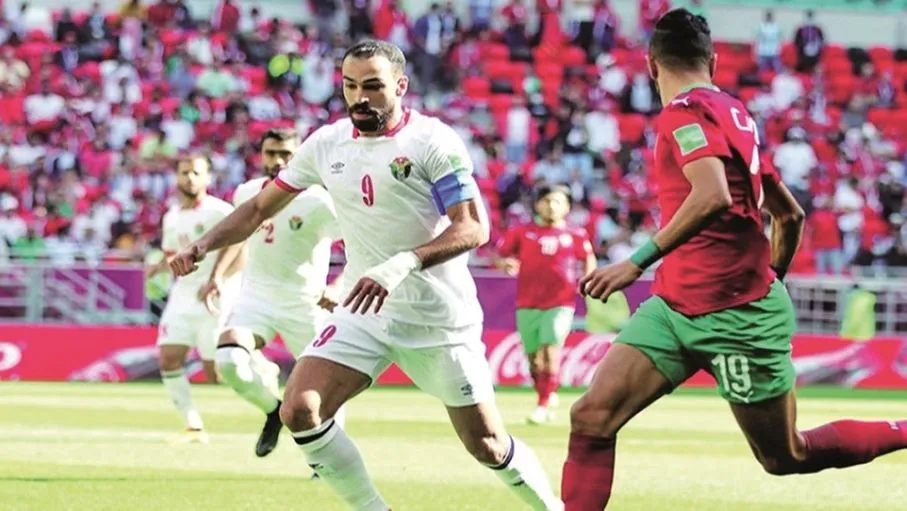
Faisal's last appearance for the national team was during the Arab Cup in 2021, where he faced a severe injury to his anterior cruciate ligament in a group stage match against Morocco. This injury sidelined him for an extended period, limiting his availability for selection by the national team coaches. The recent announcement from Al-Wahda regarding his inclusion has raised questions among supporters. Some speculate whether his return is a direct response to the injury sustained by fellow forward Yazan Al-Naimat, which could hinder his participation in upcoming matches. Others believe that Faisal's exceptional performance in the Qatari league has rightly earned him a spot in the national team, especially given the pressing need for additional offensive options.
Coaches' Perspectives on Faisal's Return
National coach Othman Al-Hassanat expressed that Faisal's call-up, while welcome, comes a bit late. He emphasized that the player deserved to be part of the national team in previous matches. Al-Hassanat mentioned that bringing Faisal onboard earlier would have facilitated better integration with the team and allowed him to adapt more swiftly to the tactical approaches and playing style favored by the coaching staff. Similarly, sports analyst Raef Al-Abadi noted that Faisal’s inclusion reflects the coaching staff's efforts to explore alternative attacking strategies in light of Al-Naimat’s injury. Al-Abadi described Faisal as a traditional striker capable of playing a pivotal role in the penalty area, even if his playing style may not fully align with the coach's usual 3-4-3 formation. Nonetheless, he highlighted Faisal's technical abilities and the noteworthy performances he has delivered for his club in Qatar, advocating for his place in the national squad.
Al-Abadi further pointed out that the timing of Faisal's recall could have been improved, as he was available for selection during the last Arab Cup, where the "Nashama" secured a runner-up position. Meanwhile, fellow coach Mohammad Al-Ababneh reiterated that Faisal's selection was indeed influenced by Al-Naimat's injury. He stressed that a player of Faisal's caliber should have been integrated into the national team much earlier, even if just as a bench option. Al-Ababneh believes that Faisal can easily adapt to the coach's preferred tactics and that his inclusion would provide the national team with valuable offensive depth.
As the national team gears up for a new training camp in the latter part of this month, they are set to engage in friendly matches against Costa Rica and Nigeria. This period will be crucial for assessing the team's dynamics and building a robust squad capable of tackling the challenges ahead.
As reported by alghad.com.