
When the final whistle sounded in Boston, marking France's 2-0 victory over Morocco in the quarterfinals, it signified not only the end of Morocco's remarkable journey at the 2026 FIFA World Cup but also the conclusion of the Arab nations' campaign in this prestigious tournament. For the second consecutive time, the Atlas Lions bore the aspirations of millions across the Arab world as they triumphed over the Netherlands in a gripping penalty shootout and convincingly defeated Canada with a score of 3-0, before ultimately succumbing to one of the tournament favorites. However, the end of Morocco's campaign does not diminish the significant strides Arab football has made over the last two World Cups. It is crucial to recognize that the achievements of the Arab teams extend beyond Morocco's exit, as the 2026 World Cup saw a record eight Arabic-speaking nations participating, marking a pivotal moment for Arab football which has transitioned from seeking validation to asserting its rightful place in the sport.
Morocco's exit came at the hands of a well-disciplined French team that effectively capitalized on its scoring opportunities while restricting the Atlas Lions' offensive threats. Despite the disappointment of the 2-0 defeat, Morocco's journey over the preceding weeks remains a source of pride. After eliminating the Netherlands and securing a decisive victory against Canada, Morocco achieved the quarterfinals for the second consecutive tournament, a feat that few national teams outside of the traditional football powerhouses have been able to replicate. Rather than being viewed as a mere Cinderella story, Morocco has firmly established itself as one of the world’s most respected national teams in football.
Meanwhile, Egypt also made significant strides during the tournament, rewriting its own history. For 92 long years, the Pharaohs had been burdened by a World Cup curse, having failed to secure a single victory since their inaugural appearance in 1934. However, in Vancouver, they shattered this long-standing jinx by coming from behind to defeat New Zealand 3-1, with goals scored by Mostafa Ziko, Mohamed Salah, and Trezeguet. Egypt's achievements extended beyond merely breaking the curse; the team advanced from Group G alongside Belgium, triumphed over Australia in a penalty shootout in the Round of 32, and pushed the defending champions, Argentina, to their limits in an exhilarating 3-2 defeat in the Round of 16. Collectively, Egypt and Morocco demonstrated that the strongest teams from the Arab world no longer settle for mere qualification; they now possess the confidence and capability to compete at the highest levels of the knockout stages.
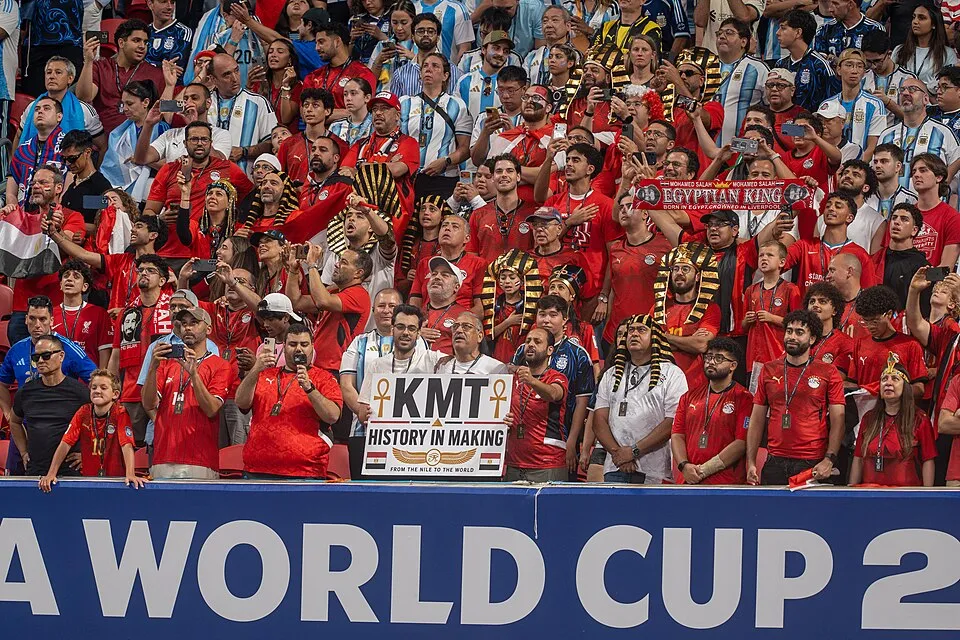
The narrative of Arab football at the 2026 World Cup transcended mere results on the pitch; it was also vividly illustrated in the stands. Supporters brought a vibrant atmosphere to stadiums across North America, showcasing their flags, drums, and chants, which fostered a sense of shared identity among the fans. In Dallas, Egyptian fans transformed their match against Australia into a jubilant celebration reminiscent of Cairo, while Moroccan supporters generated a similar electric atmosphere in Monterrey and Houston as the Atlas Lions progressed deep into the tournament. Each Arab team, whether it was Algeria battling through a tough group, Jordan making a return to the World Cup, or Iraq re-establishing its presence on the global stage, provided fans with ample reasons to celebrate. Even after the elimination of other Arab teams, their supporters continued to rally behind Morocco and Egypt, viewing them as representatives of a broader Arab identity. This sense of unity resonated deeply, particularly for Arab Americans, as they witnessed teams that connected them to their heritage, languages, and cultures competing on the world stage. The tournament thus offered a unique opportunity for Arab identity to be visible, confident, and celebrated publicly.
Looking ahead, the 2026 World Cup may have concluded the Arab campaign in North America, but it also set the stage for future endeavors. In 2030, Morocco is set to co-host the World Cup alongside Spain and Portugal, marking the return of the tournament to Arab soil for the second time in just eight years. This resurgence of Moroccan football is no coincidence; it results from strategic investments in youth development, enhanced training facilities, and an overall stronger football infrastructure, positioning the national team to compete consistently against the best in the world. Hosting the World Cup in 2030 will provide Morocco with another chance to build upon its progress, both on and off the field. The experiences gained during the 2026 tournament should elevate expectations throughout the region, as Egypt aims to build on its historic breakthrough, and Morocco strives to prove that its success in 2022 was not just a fleeting moment. By 2030, expectations will be at an all-time high, with Morocco welcoming the world and Arab football poised to demonstrate that its rise is not merely a narrative of potential, but a story of sustained progress.
As reported by arabamerica.com.