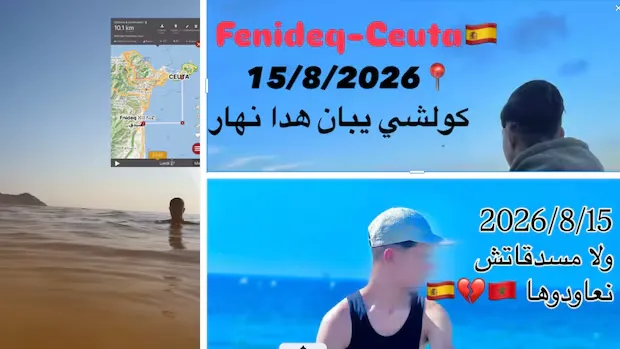

In the lead-up to one of the most significant mass migrations to Europe in recent years, a compelling video shared on Instagram captured the attention of millions, amassing 1.4 million views. The footage features a young man standing neck-deep in water, with the camera panning to reveal land in the distance. A map traced a perilous sea route from Fnideq, Morocco, to Ceuta, a Spanish enclave situated at the northern tip of Africa. The individual behind the account later responded to comments by stating, "we've arrived," further fueling the excitement and anticipation surrounding the migration.
This video was not an isolated incident; it was part of a broader wave of viral posts circulating across platforms like Instagram and TikTok, which seemingly mobilized at least two major waves of irregular migration from Morocco to Ceuta. The most recent attempt occurred on August 15, resulting in numerous arrests and heightened tensions at the border.
These viral posts belong to various online communities connected to a larger ecosystem that encompasses migration-related culture, including music, memes, and imagery. Many of these accounts seem to exploit the desperation of predominantly African and Middle Eastern youth who are in pursuit of better lives abroad. Despite ongoing debates among governments and organizations regarding whether a central entity orchestrated the events in Ceuta or whether migration was manipulated for geopolitical purposes, it is evident that misinformation, amplified by multiple online communities, played a substantial role in driving this summer's migration waves.

According to an investigation by CBC's visual team, in collaboration with Sebastian Vandermeersch from the investigative collective Bellingcat, several social media accounts were identified as being particularly active ahead of the first wave of migration that occurred on July 30. The surge in posts was initially sparked by misinformation regarding a Spanish court ruling that suggested the country would no longer reject migrants arriving by sea. This led to numerous faceless accounts promoting the notion that crossing into Ceuta was feasible, utilizing similar language and imagery, with some posts racking up millions of views.
The ripple effects of this misinformation were profound, as over 72,000 migrants crossed the border on July 30 alone, overwhelming local authorities and precipitating a political crisis within Europe. Although the majority of those who crossed have since returned to Morocco, at least 5,000 individuals remain in Ceuta, many enduring harsh conditions on the beach while receiving aid from charities. Tragically, nearly 100 individuals lost their lives attempting the crossing.
As noted by Moustafa Ayad, executive director for Africa, the Middle East, and Asia at the Institute for Strategic Dialogue, this situation starkly illustrates how misinformation and online manipulation can lead to significant real-world consequences, particularly when directed at individuals in desperate circumstances. His team has been monitoring the uptick in social media activity surrounding this issue.

Some social media accounts directed followers to WhatsApp groups where users exchanged information about crossing strategies and shared advice on reaching Ceuta. For instance, one Instagram video titled "the shortest distance," which attracted over 320,000 views, illustrated a heavily fortified fence topped with barbed wire, marking the Spanish and Moroccan sides with their respective flags while highlighting a specific section of the fence as the optimal crossing point. Another report revealed that a BBC journalist engaged in private messages with anonymous accounts that offered guidance on entering Ceuta for a fee, which in one case amounted to approximately $750 upfront.
In response to the escalating crisis, platforms like Meta and TikTok committed to fact-checking posts in an effort to curb the exploitation of migrants by criminal organizations that leverage misinformation. However, as a new wave of posts began to emerge ahead of the August 15 crossing, heralded as another opportunity for entry into Spain, it became evident that some of the same accounts that had previously mobilized the July 30 crossing were still active, alongside new accounts that sprouted just days prior to the event.
Reports emerging from Morocco indicated that hundreds of individuals were making their way to the border on August 15. This time, authorities were prepared; thousands of police were deployed on both sides of the border, resulting in the arrest of nearly 300 migrants that Saturday.
In the wake of the July 30 crossing, the Spanish government observed the circulation of social media posts encouraging crossings and pledged to take action against those responsible. Several accounts implicated in the previous events have since been disabled.
The success of previous crossings contributed to the urgency of these online messages. According to research by the Mixed Migration Centre, Ceuta had become the most sought-after entry point into Spain in the first quarter of the year, with the Spanish government reporting that over 2,200 people entered by land by the end of May—three times the number from the same period the previous year. While the exact reasons for this increase remain unclear, it may involve heightened patrols on alternative migration routes.
Experts caution against attributing the surge solely to social media influence, emphasizing that the desire to migrate is deeply rooted and pre-existing. Many of the accounts analyzed by CBC reflect a pervasive sense of disillusionment and desperation among the youth in North Africa, employing aspirational imagery and messaging that romanticizes migration. The responses to these posts highlight the profound level of desperation felt by many.

Given the high unemployment rates, which can reach 40% among youth in Morocco, coupled with a lack of political agency or respect for their rights, the influx of migration-related content resonates powerfully, signaling to many that "now is the time" to make their move. Ceuta and Melilla, the only land borders between Africa and a European country, have become focal points for this migration trend, with many accounts originating from North African nations, though some also appear to be based in Italy and Turkey.
Some posts utilize European or EU flags and reference various potential European destinations without explicitly stating they are offering a means of travel. One account posted a picture of the Eiffel Tower with the caption "Leaving has become our only concern," while another displayed a map of the swimming route from Fnideq to Ceuta, suggesting a collective dream of reaching Europe.
This account has changed its username multiple times, indicating a level of obfuscation, yet it has existed since June 2025, with all recent posts dated August 3. The use of popular Arabic hashtags referencing countries such as Germany, Belgium, and Italy underscores the longing for a better life abroad.
Ultimately, while immigration is often framed as an act of desperation, it is increasingly viewed as a pursuit of opportunity. Influencer-style accounts promoting themes of departure attract thousands of followers, featuring images of individuals in wetsuits or navigating through water, echoing the perilous journey from Fnideq to Ceuta. Despite efforts to engage with these accounts, CBC received no responses.
As reported by cbc.ca.