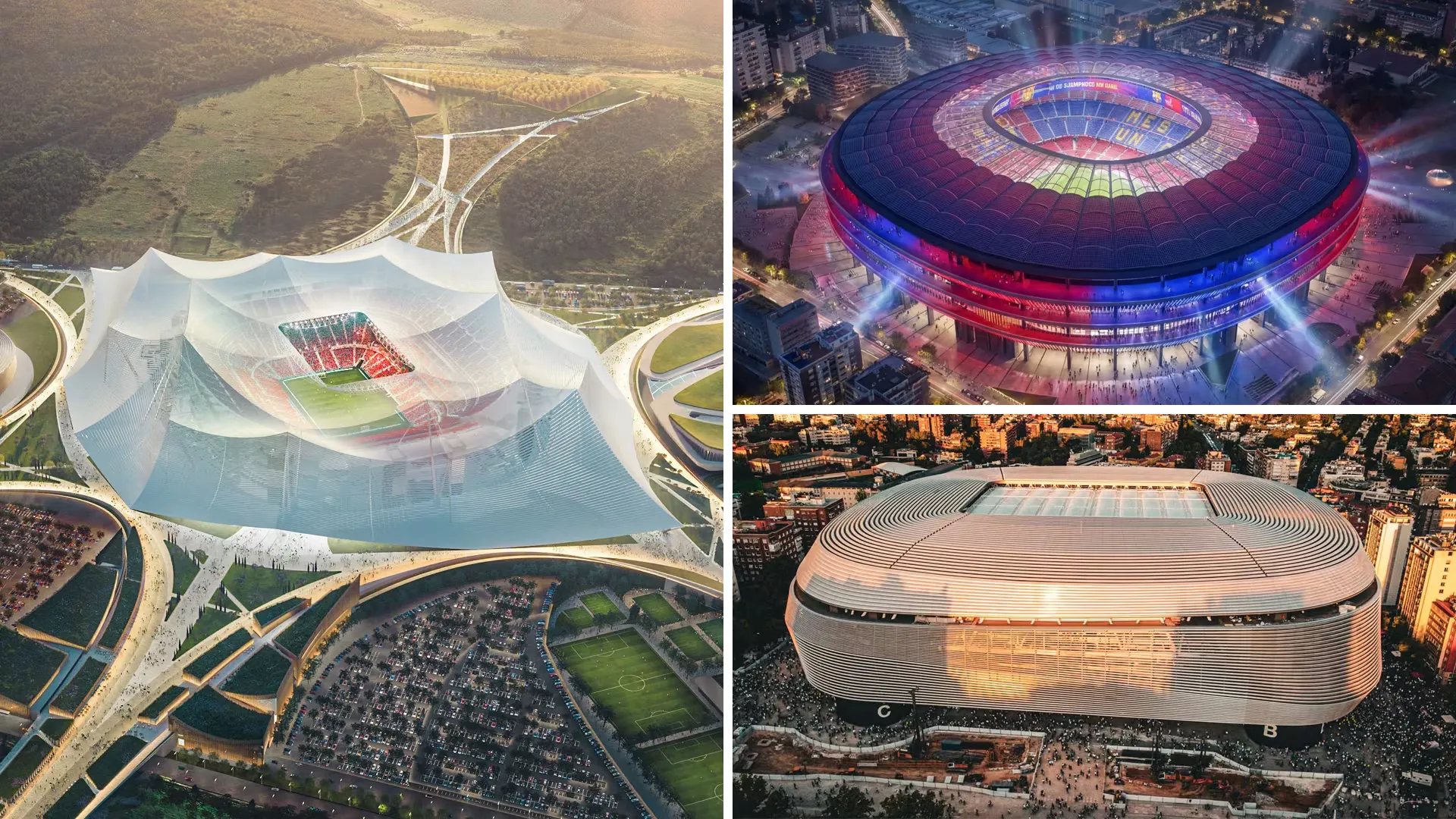

The Emerging Rivalry for the 2030 World Cup Final
As the narrative unfolds in Spain, the contest for the 2030 World Cup final seems to have crystallized into two distinct factions: Spain, a powerhouse in football that feels entitled to host the prestigious match, and Morocco, an ambitious neighbor suspected of vying to snatch the most coveted event of the tournament. This scenario is undeniably convenient for Spain, as the focus shifts towards Casablanca, diverting attention from the intense competition brewing between Madrid and Barcelona.
The initial skirmish in Spain is already underway, with Madrid championing the Santiago Bernabéu Stadium and Barcelona advocating for the Camp Nou. Beyond these two iconic venues lies a rivalry that encompasses not just football but also deep political and economic interests that are far from interchangeable. The candidacy of Barcelona is not merely ceremonial; FC Barcelona and the city’s municipality have officially expressed their desire to host the final, bolstered by the support of the Catalan Government. Conversely, Madrid is highlighting its extensive experience, robust infrastructure, and a Bernabéu that has undergone significant modernization. This is where Casablanca’s role becomes particularly intriguing.
Casablanca has emerged as a credible contender, offering Spain a common rival and a narrative that is far more palatable than a renewed Madrid-Barcelona feud. Spain has adopted a formula that seems to placate both sides: "The final must be held in Spain." This statement garners consensus from both Madrid and Barcelona, yet it cleverly sidesteps the contentious question of where exactly it should take place.
The Stakes of the Moroccan Challenge
Rafael Louzán, the president of the Spanish Football Federation, is treading carefully on this delicate line. He advocates for a final in Spain without alienating either Madrid or Barcelona, praising the merits of the Bernabéu while acknowledging Camp Nou’s advantages, ultimately leaving the decision to FIFA. To prematurely favor Madrid would provoke Barcelona, while choosing Barcelona would mean confronting Madrid. By defending the notion of "Spain," Louzán successfully keeps both cities united for a common cause.
As the credibility of Casablanca grows, it serves as a unifying adversary, allowing Spanish stakeholders to sidestep the daunting prospect of a direct Madrid-Barcelona conflict. Should Casablanca be eliminated from contention, the Bernabéu would not automatically reclaim the final, leaving the Camp Nou still in the running. Barcelona’s significant advantage lies in its capacity; the new Camp Nou is expected to accommodate over 100,000 spectators, compared to the Bernabéu’s less than 80,000 in its current evaluation. Louzán himself has recognized this crucial disparity.
Madrid counters with a nearly completed stadium, proven organizational capabilities, and a capital well-versed in hosting major events. Barcelona, however, presents a larger venue and a metropolitan area equipped with all the necessary attributes. Even without Casablanca, Spain faces a substantial issue to resolve—one that is anything but trivial.
Moreover, the language surrounding the Moroccan bid warrants scrutiny. With constant references to Spain needing to "retain" or "defend" the final, one might forget the fundamental truth: FIFA has not yet awarded it to anyone. Morocco is not attempting to claim a match that belongs to Spain; it is a co-host of the 2030 World Cup and Casablanca is vying for the final just like the two Spanish cities.
With its anticipated 115,000-seat Grand Stade Hassan II, Morocco is not seeking to merely participate passively. The country is investing heavily in its stadiums, transportation, airports, and infrastructure, with the clear ambition of hosting the marquee events of 2030, including the final. Why should it feel compelled to apologize for its aspirations? Spain undoubtedly has considerable strengths, yet its organizational structure is fragmented among the Federation, central government, municipalities, autonomous communities, and clubs that own the major venues. While everyone is eager to ensure the World Cup is a success, not everyone shares the same vision.
Morocco benefits from a more centralized organizational approach around its major projects and the Morocco 2030 Foundation. This does not guarantee victory for Casablanca, but it does render its proposal clearer. Casablanca is intent on hosting the final, whereas Spain seems primarily focused on preventing it from taking place in Casablanca. The subtlety of this rivalry is indeed intriguing.
The rise of Casablanca has also sparked references in some Spanish media to a supposed "Moroccan lobby." However, what does Madrid do when it advocates for the Bernabéu? What does Barcelona do when it pushes for the Camp Nou? They are doing exactly what Casablanca is doing: defending their own interests.
Constructing the largest stadium in the world, modernizing infrastructure, and persuading FIFA do not constitute lobbying for Morocco any more than they do for Madrid or Barcelona when they present their own cases. The distinction lies primarily in the narrative. What is considered sports diplomacy from the Spanish perspective can easily be perceived as an offensive when it originates from Morocco. This differential treatment exposes a new reality: Casablanca has gained credibility.
For a long time, it appeared that the final would be settled between Madrid and Barcelona. The Grand Stade Hassan II has disrupted this implicit hierarchy, transforming the Spanish duel into a genuine three-way race. Consequently, Madrid and Barcelona can temporarily sheath their knives. As long as Casablanca remains in contention, a shared priority unites them: keeping the final in Spain.
However, if FIFA were to exclude Morocco, the landscape would change instantaneously. The carefully sidestepped question of Madrid or Barcelona would finally need to be addressed, revealing that beneath the facade of Spanish unity against Moroccan ambitions lies a more ancient rivalry. Spain has discovered its common "enemy"; it remains to be seen who, within its borders, is truly its adversary.
As reported by sport.le360.ma.