
The Evolution of the Hospitality Landscape in Morocco
The recent transition of the Pullman Mazagan Royal Golf & Spa to Hyatt Regency Mazagan reflects a significant transformation within the Moroccan hospitality sector, characterized by a deeper and still poorly mapped reconfiguration. This development highlights a growing disconnect between ownership, operational management, and brand strength within the industry. The critical question arises: who holds the property, who manages the operations, and who captures the symbolic value? This inquiry is vital for shaping the tourism strategy as we look towards 2030. It is not intended as a warning or accusation but rather serves as an objective diagnosis of the current state of affairs. It appears that the Moroccan hotel value chain is experiencing a partial de-nationalization, particularly in the higher-end segments, even as the country aims to bolster its tourism sovereignty.
Currently, the dominant model in Morocco, much like in other parts of the globe, has shifted towards an asset-light approach adopted by major international hotel groups. This model typically comprises three components: property ownership, often held by investment funds, real estate holdings, or Moroccan groups; management, conducted by international operators under management contracts such as Hyatt, Marriott, Accor, and Hilton; and branding, which serves as the primary distribution channel alongside standards and yield management.
Case Studies Illustrating the Shift
Several emblematic cases illustrate this trend across different regions in Morocco. In Casablanca and Rabat, for instance, we find the Four Seasons Hotel Casablanca, owned by a mixed-capital Moroccan fund, managed under a contract with Four Seasons, and positioned as a premium international brand. Similarly, the Sofitel Casablanca Tour Blanche is owned by a Moroccan group focusing on real estate and tourism, managed by Accor, and is identified as a French brand. The Fairmont La Marina Rabat-Salé operates under a consortium of Moroccan and institutional ownership, managed by Accor (Fairmont), again emphasizing international branding.
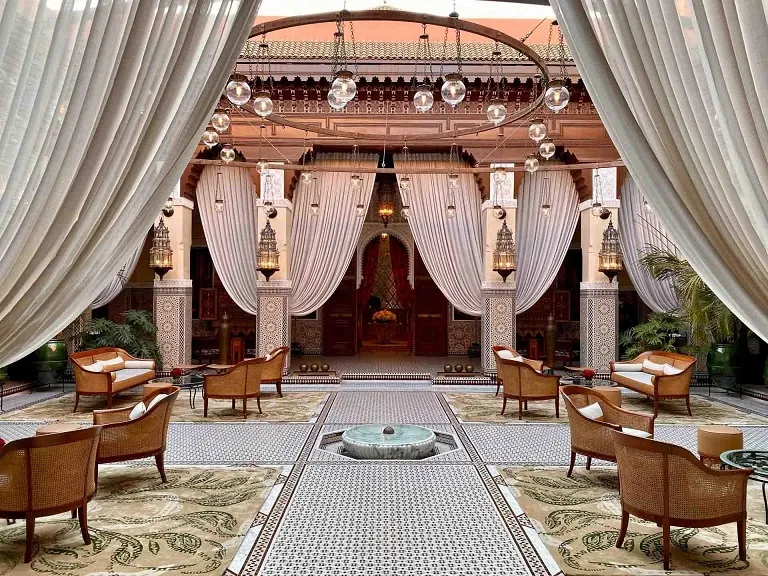
Turning to Marrakech, we see a more hybrid model where property ownership is frequently local, yet global distribution is facilitated through international brands. For instance, the Royal Mansour Marrakech is state-owned and managed internally, presenting a high-end Moroccan branding. In contrast, the Mandarin Oriental Marrakech is owned by private Moroccan investors, while the Park Hyatt Marrakech is owned by a Moroccan real estate group and managed by Hyatt, illustrating the complexity of ownership versus operational management.
Along the Atlantic coast and in beach resorts, we observe a structural presence of Spanish and international operators since the early 2000s. The Mazagan Beach & Golf Resort is owned by sovereign funds and an international consortium, managed by an international operator, while the Hilton Taghazout Bay Beach Resort & Spa is owned by a Moroccan public-private developer and managed by Hilton. Notably, the Riu Palace Tikida Agadir is a joint venture between Moroccan and Spanish entities. This landscape reveals that while Morocco retains significant ownership of its hospitality infrastructure, there is a marked reliance on foreign brands, especially in the luxury segment.
The overall trend indicates that while Morocco still possesses much of its hospitality infrastructure, it increasingly outsources intangible value through global distribution channels, operational standards, pricing, and customer relationship management. This shift raises questions about the potential numeric and managerial superiority of international groups over local entities.
Comparatively, other nations like Turkey, Spain, and Egypt showcase different trajectories. Turkey boasts powerful local chains supported by the state and a substantial domestic market. Spain features national groups that have achieved global status, while Egypt maintains a strong foreign presence alongside visible national brands in the resort sector. In Morocco, there are noteworthy successes such as the Royal Mansour Collection, La Mamounia, and rising national hotel groups. However, the absence of a Moroccan international chain capable of expanding beyond its borders with consistent standards remains evident.
The Kenzi Hotels Group serves as a prime example of a fully Moroccan operator, having been founded by entrepreneur Abdellatif Kabbaj. With over 2,100 rooms across various properties, including the Kenzi Tower Hotel Casablanca and Kenzi Menara Palace Marrakech, the group demonstrates the capability of operating four and five-star establishments in accordance with international standards while infusing a distinctly Moroccan touch into the guest experience. Another crucial player often overlooked is Valeria Hotels & Resorts, a subsidiary of Investour Holding. Specializing in all-inclusive club and resort segments, Valeria operates several key resorts in Morocco, showcasing advanced operational mastery of the resort model historically introduced by major European tour operators.
The recent rebranding of the Pullman to Hyatt underscores a broader trend where assets are changing brands more rapidly than ownership shifts, indicating a movement of value towards global management and distribution. While Morocco is not stripped of its hospitality sector, it increasingly shares governance with international entities. This situation prompts critical questions regarding national branding strategies, local champions, and negotiation capabilities with global operators. The concept of "Made in Morocco" branding is not impossible; it is merely still a work in progress.
As reported by premiumtravelnews.com.