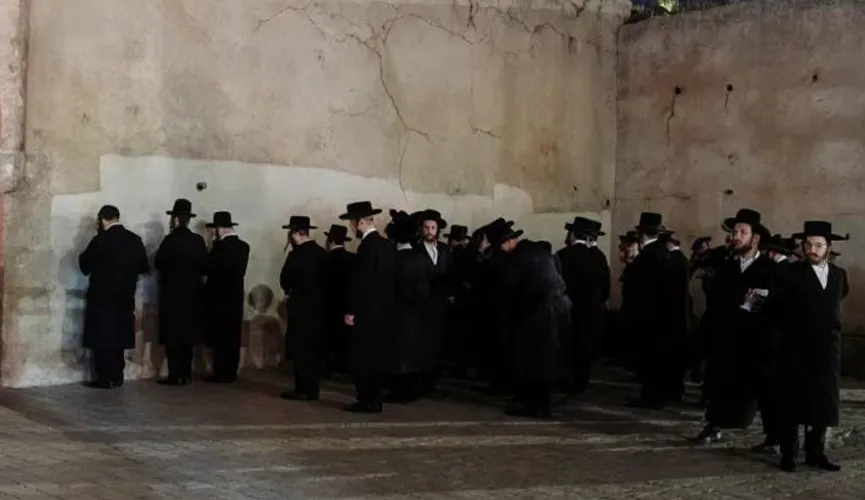
A Historic Reflection on Jewish Prayer Practices in Marrakech
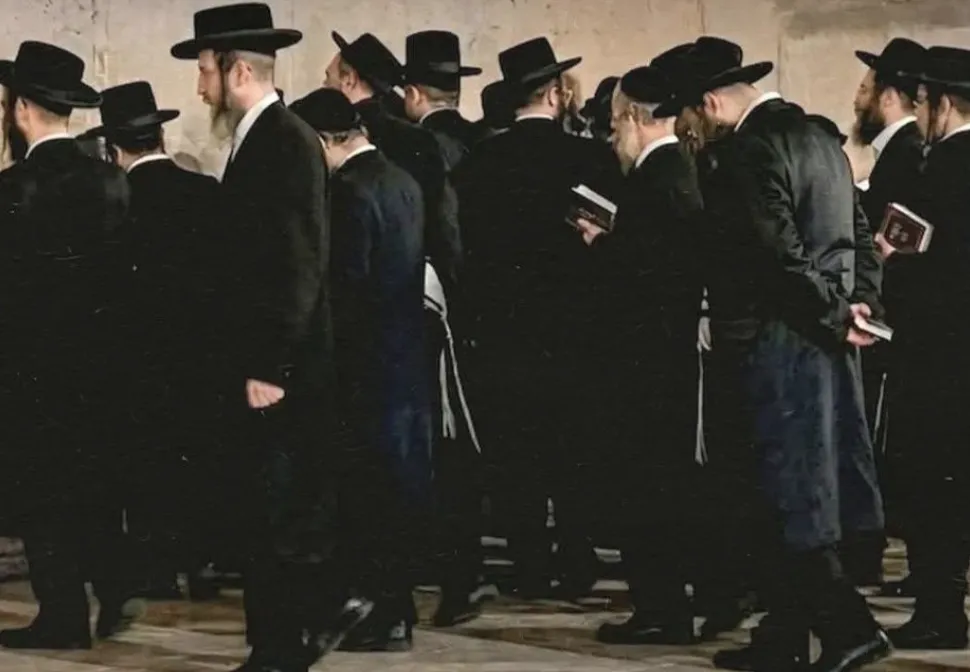
The scene of the Haredi Jews praying before the walls of Bab Doukkala in Marrakech during the spring of 2026 cannot merely be interpreted as a fleeting tourist event or a spontaneous act of religious freedom. Rather, it symbolizes a pivotal moment—the "zero hour"—which encapsulates centuries of political and social engineering that dates back to 1666. During this year, the founder of the Alaouite dynasty, Sultan Rashid, decided to commence his reign from the heart of the "Mellah" in Fez, taking refuge in the homes of legendary Jewish financiers. This move was not just a quest for shelter; it was an early declaration of a "founding contract" that tied the continuity of the throne to an alliance with Jewish financial and security powers, all while disregarding the aspirations of the subjects, who were forcibly cloaked in a false garment of sanctity and noble lineage to justify their absolute subjugation.
This "historical deception," wherein religion and lineage were wielded as tools to numb public consciousness, enabled the regime (Makhzen) throughout the centuries to engage in the most egregious forms of political and religious oppression. It exploited the suffering of neighboring populations, notably undermining Algerian resistance movements, as seen in the example of Prince Abdelkader.
In the 1950s, Moroccans were asked to believe in fantastical miracles—from the Sultan appearing on the moon's surface to filling airplane tanks with "blessings" and liberating the homeland through the revolution of the king and the people. The regime engaged in black pragmatism, selling Jewish subjects for dollars to the Zionist entity in the 1960s while surrendering sovereignty to Mossad at the 1965 Rabat summit and manufacturing crises with revolutionary Algeria to ensure that the "subjects" remained trapped in ignorance and fear.
Today, the scene in Marrakech reflects a bitter reality resulting from King Hassan II's alleged blunders, now manifesting under his son Mohammed VI. The open presence of Zionism at the gates of Marrakech and the protection of Haredi rituals amid bustling crowds signify the actual inauguration of a "replacement homeland." This clearly indicates that the historic alliance with the Mellah established in 1666 has transitioned from shadowy backroom dealings to open public displays by 2026, forcing Moroccan citizens out of their lands and homes to make way for investors and settlers from the Zionist entity, all under the watchful gaze of security forces that ensure the subjects remain in a state of dulled awareness, applauding their oppressors while believing that the "occupation of public space" represents a strategic victory for the throne.
The Significance of Bab Doukkala in Contemporary Moroccan Politics
Today, the "Wall of Doukkala" in Marrakech is not merely a historical barrier; it stands as a testament to a political lineage that has chosen to embrace the foreign since 1666, transforming Morocco from a kingdom into a functional feudal state serving agendas disconnected from the interests of its people. The performance of Haredi Jews conducting their collective rituals before the walls of Bab Doukkala—echoing the symbolism of the Western Wall—marks a profound transformation in the structure of the Makhzen state. The gap between Hassan II's famous phrase about "marrying Jewish genius with Arab wealth" and the reality of Morocco under Mohammed VI is no longer merely temporal; it signifies a fundamental shift from secret diplomacy to institutional and spatial integration.
Hassan II established the narrative of "exceptional Morocco" as a protector of its Jewish subjects as a means of international leverage, but the current regime appears to exceed the role of guardian to that of a structural partner. Historic public spaces are now being opened to serve as a stage for the inauguration of a new visual and religious identity. In this context, the subjects are no longer mere spectators; they are witnessing how the symbolism of their ancient city walls is being reshaped to accommodate an assumed second homeland, wherein tourists become claimants and prayers at the wall transition from acts of worship to overt political declarations that cement a reality in which sovereignty is dictated by major strategic relationships, while the Moroccan remains entrapped in a narrative that sanctifies the throne and grants it absolute authority to redefine geography and people.
The act of cleaning carried out by the free citizens of Marrakech following the desecration of Bab Doukkala by the Zionists was not merely a superficial cleaning; it was, at its core, a silent condemnation and a deafening cry of impotence emanating from the depths of the subjects who have had their will usurped over the centuries. The Moroccan's recourse to cleaning products to erase the traces of Haredi rituals represents a tragic embodiment of the chasm between the emotions of the subjects and the encroachments of power. They scrub the pavement because they lack the ability to cleanse institutions, purifying the stones because they realize—albeit subconsciously—that political decisions have been tainted by Zionist dependency that has obliterated Moroccan sovereignty.
This symbolic act confronts us with a bitter truth: the corruption that permeates the body of the Moroccan kingdom is not merely administrative deviations but structural corruption wherein the Makhzen serves as both the head and the heart. Since the moment Sultan Rashid's regime became beholden to money and narrow interests in the Mellah in 1666, the Moroccan kingdom has devolved into a functional estate where people are herded as "subjects" under the influence of religious sedatives and mythical tales, while real decisions are made in shadowy rooms to serve the survival of the throne and its dubious alliances. Merely cleansing the pavements is an implicit acknowledgment that the head of corruption possesses the security force and false sanctity necessary to render it immune to cleansing, as long as collective awareness remains trapped between slogans of absolute loyalty and the reality of succumbing to Zionism.
The genuine cleansing that Morocco requires today does not start from the walls of Marrakech; it begins with uprooting the roots of despotism that have turned Morocco into an open space for Zionists while reducing the "subjects" to mere beings with dulled awareness, content with erasing the traces of footsteps, while treachery has settled at the pinnacle of the political hierarchy. As long as the Makhzen is the one opening the doors and suppressing voices, all efforts to clean the place will remain mere attempts to beautify the face of a grim reality, a reality that proves day by day that the greater corruption lies not in the remnants of a strange prayer but in a regime that has sold its history, its neighbors, and its sovereignty for the promise of a mythical "blessing" that does not nourish or satisfy hunger.
Before concluding, I invite readers to explore the book "Bibi... Destruction at the Door" by Dr. Ahmed Wihman, the head of the Moroccan Observatory for Anti-Normalization in Morocco. This book provides a critical analytical reading of the political and social reality in the Kingdom of Morocco, warning of external and internal dangers threatening the unity and stability of the country. It encapsulates key ideas such as:
- The significance of the title "Bibi": A call for help or a warning in Amazigh, indicating imminent danger or disaster requiring immediate intervention. The author uses this title to signal that Morocco is undergoing grave circumstances.
- The diagnosis of the ruling system: The book criticizes the structure of the Moroccan state, describing it as "new neopatrimonialism," where public affairs are intertwined with private interests, transforming the state into a political enterprise dominated by the ruler and his entourage, leading to widespread corruption and lack of accountability.
- The scheme of fragmentation and division: The author warns against what he calls a "destructive scheme" orchestrated by colonial and Zionist forces to divide Morocco into smaller entities based on ethnic and regional lines, pointing out plans to create six hypothetical "republics" (like the Republic of Riff, the Republic of Asamer, and the Republic of Sous) to undermine the unity of the central state.
- The phenomenon of "Zionization" and Zionist infiltration: The book intensively focuses on what it describes as the "Zionization" of society and the state, combining Zionism with the exploitation of identity (Amazigh or Hebrew), asserting that there are widespread Zionist infiltrations in agriculture, tourism, education, and even security through what is known as the "fifth column" or "the Hyathim."
- The targeting of identity and language: The book harshly criticizes the so-called "Aiyashia" (referring to Nour al-Din Ayouch), a trend the author accuses of marginalizing the Arabic language in administration and education while promoting dialect and French to sever the ties of future generations with their Arab-Islamic heritage.
- The mobilization and armed struggle: The book points to the danger of some factions linked to external entities transitioning from cultural work to advocating armed action and forming militias under the guise of "self-defense," warning of potential civil war or ethnic conflicts.
- The proposed solution: The author believes the only way out is to establish a "front for popular will" or a "historical bloc" uniting various active forces to confront the regime of despotism and corruption, achieving a true democratic transition that protects the country from foreign infiltration and internal fragmentation.
This tragic embodiment of the distance between the subjects' emotions and the encroachment of power highlights the urgent need for a profound awakening and structural change in Morocco, as the nation grapples with its historical alliances and the implications they hold for its future.
As reported by echoroukonline.com.