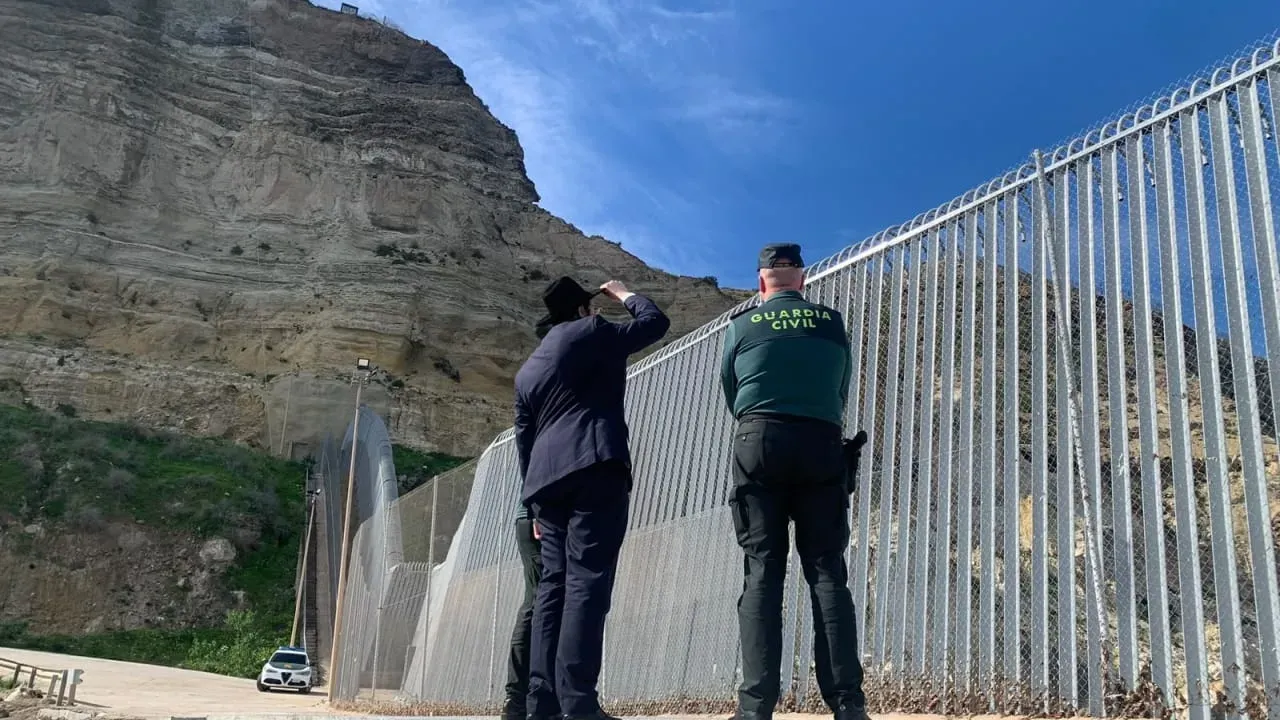

Every year, Rabbi Aaron Peretz embarks on a unique journey, climbing into a Spanish Civil Guard patrol vehicle to inspect the 12-kilometer steel fence that delineates the Spanish city of Melilla from Morocco. While many perceive this barrier as one of Europe’s most recognized frontiers, designed to deter illegal migration into the European Union, Rabbi Peretz views it through a different lens. With a warm smile, he explains that the security fence also functions as the city’s _eruv_, a halachic boundary that permits Jews to carry items on Shabbat. Thus, his annual inspection is not merely about immigration; it is about ensuring that a significant aspect of Jewish religious life remains intact. This intriguing duality highlights a unique aspect of Melilla: infrastructure originally designed for security has seamlessly woven itself into the fabric of Jewish cultural and religious life.
In the backdrop of this annual ritual lies a complex narrative that extends beyond the spiritual significance of the fence. Just days before Rabbi Peretz’s inspection, another crisis erupted in Ceuta, a neighboring Spanish city, when tens of thousands of Moroccan nationals breached its borders, marking one of the most significant border crises Spain has witnessed in decades. The shocking images of this event reverberated across Europe, prompting the Spanish government to deploy additional security forces. However, for the residents of Ceuta and Melilla, these incidents evoke deeper concerns about their cities' vulnerabilities and the precarious balance between security and migration.
As one navigates through the compact center of Melilla, it becomes evident that the city is a rich tapestry of multicultural coexistence. Catholic churches, mosques, Hindu temples, and synagogues stand in close proximity, reflecting over a century of harmonious living among diverse communities. Among these architectural treasures is the Or Zaruah Synagogue, an elegant structure completed in 1925, which serves as a vibrant center of Jewish life. Historically, Melilla’s Jewish community flourished following the Hispano-Moroccan War, with nearly 7,000 Jews residing in the city by World War II. Although the contemporary Jewish population has dwindled to about 1,000, Melilla remains one of Spain’s most dynamic Jewish centers outside of Madrid and Barcelona, preserving a heritage that is intricately woven into its multicultural identity.
Despite the vibrant coexistence, the geopolitical tensions surrounding Ceuta and Melilla are palpable. These cities, integral parts of Spain and the European Union, are embroiled in a complex sovereignty dispute with Morocco. While Spain maintains that these territories rightfully belong to it, Morocco continues to challenge this claim. The delicate balance of cross-border relations has been further strained by recent developments, leading many residents to suspect that the mass crossing into Ceuta was not merely a spontaneous event but perhaps a calculated move reflecting broader political motives. The situation raises profound questions about the security of Spain's southern border and the implications for its relationship with Morocco.
In the wake of the crisis, the humanitarian consequences were severe, with reports of over 100 individuals drowning in their attempts to reach Spanish territory, while others faced lengthy legal battles for repatriation. The political discourse surrounding the crisis has intensified, with opposition parties criticizing the government for perceived weaknesses in border control, while the government emphasizes its commitment to European laws and cooperation with Morocco. Amidst this turmoil, the narrative surrounding Ceuta and Melilla often overlooks their rich cultural heritage, defined not solely by their fences but by their historical and spiritual intersections.
As Rabbi Peretz prepares for his next inspection of the _eruv_, the juxtaposition of the fence as both a security measure and a religious boundary serves as a poignant reminder of the complexities inherent in Melilla’s identity. The same structure that dominates headlines across Europe also facilitates the observance of Shabbat for the city’s Jewish community, illustrating the paradox of life in these border cities. As the dynamics between Spain and Morocco evolve, and as migration crises continue to unfold, the future remains uncertain. Yet, one thing is clear: the intricate tapestry of cultures, religions, and histories in Ceuta and Melilla will continue to shape the narrative of this unique intersection of Europe and Africa.
As reported by jpost.com.