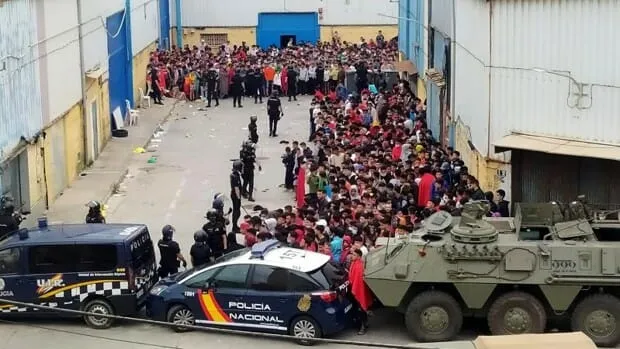

A Heart-Wrenching Situation at the Morocco-Ceuta Border
The area surrounding the border crossing between Morocco and the city of Ceuta has transformed into a heart-wrenching waiting area filled with despair. Mothers weep, fathers clutch their phones displaying pictures of their children, and siblings chase after every returnee from Ceuta, asking a singular and haunting question: **“Have you seen this young man? Do you know where he is?”** Families have traveled from Tangier, Fes, Casablanca, and other Moroccan cities, having lost contact with their sons who ventured towards the coastal town of Fnideq, believing that the route to Ceuta had opened up.
However, the journey that began with the promise of a new opportunity, which spread through social media, ended in a heavy humanitarian tragedy, with reports indicating at least 72 confirmed fatalities, and the number of missing persons remains unknown. Rescue teams are tirelessly searching the waters, as families cling to any information that might confirm their loved ones are still alive, as reported by 20 Minutos.
The Personal Stories Behind the Tragedy
Among the anxious crowd is Ibrahim, a father searching for his 17-year-old son who left Fes on Thursday, taking only the clothes on his back and 400 Dirhams he had saved for new clothes. Since that day, the family has received no word from him. His father has scoured hospitals and inquired about detainees and victims, yet his son's name has not appeared on any list. Meanwhile, his mother clings to her husband’s arm, weeping as they wait at the border for news that could end their hours of fear and uncertainty.
In the same place, Zahra, a pseudonym, searches for her brother Abdel Nabi, aged 23, who was a university student and had a job, leaving his family puzzled as to why he would risk his life to enter the sea. The tragedy raises serious questions not only about the motivations of the youth but also puts the Moroccan authorities in a position of political, security, and moral responsibility that cannot be ignored. How did such a large number of citizens manage to reach Fnideq and gather near the border? How were minors and young adults from cities hundreds of kilometers away allowed to approach the sea and jump into the water in such a perilous mass exodus?
The ongoing events have raised alarms regarding the lack of adequate preventive measures from the authorities tasked with overseeing this sensitive border area. Eyewitness testimonies do not provide conclusive evidence that Moroccan authorities intentionally allowed citizens to cross, but the scale of the movement, the number of participants, and the continuous attempts to enter warrant a transparent investigation into whether there were security lapses, a deliberate withdrawal from certain areas, or failures in managing the rumors that drove thousands to the sea. A state that usually monitors its borders with precision must explain how the beaches of Fnideq transformed into a collective launching point towards death within hours.
Survivors recount harrowing scenes encountered in the waters, with hundreds swimming simultaneously; some clinging to rocks, while others pushed each other in a desperate bid to stay afloat. Jalil, a Sudanese citizen working in construction in Casablanca, shared that he received a call informing him that the route to Ceuta was open. He headed to Fnideq and jumped into the water with seven friends. His companions managed to reach safety, but he decided to return after injuring his leg. When recounting the journey, he painfully summed it up with the words: **“There were many dead.”** Ayoub returned with injuries to his arm and leg, admitting he believed the circulating messages about the open borders, only to realize he had fallen into a trap. Despite his injuries and trauma, he maintains that he might attempt to reach Spain again.
The harsh reality remains that dozens of families have found no clear center providing accurate information about the missing. Some roam hospitals, while others wait at the border, showing photos in the hope that someone will recognize a lost son or brother. As the city of Fnideq attempts to return to normalcy, rescue boats and patrols remain visible on the beach, searching for bodies or survivors. For the families who have not had their loved ones return, nothing feels normal again. This tragedy did not commence in Spanish waters; it began the moment thousands of individuals reached the Moroccan coast, believing they could cross the sea without repercussions. Thus, it is insufficient to merely discuss social media rumors or place the blame solely on the youth for what transpired. It is crucial to identify who propagated the calls, why they were not curtailed in a timely manner, and how such large numbers were allowed to reach a heavily monitored border area.
As the search for the missing continues, the question that cannot be buried alongside the victims remains: **Who permitted the Moroccan coast to become a collective gateway to death?**
As reported by espanaenarabe.com.