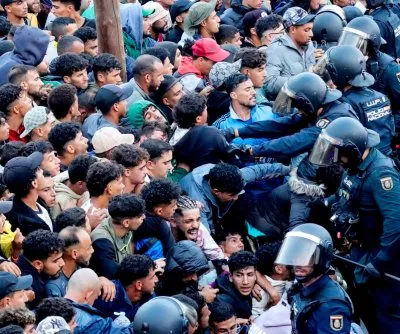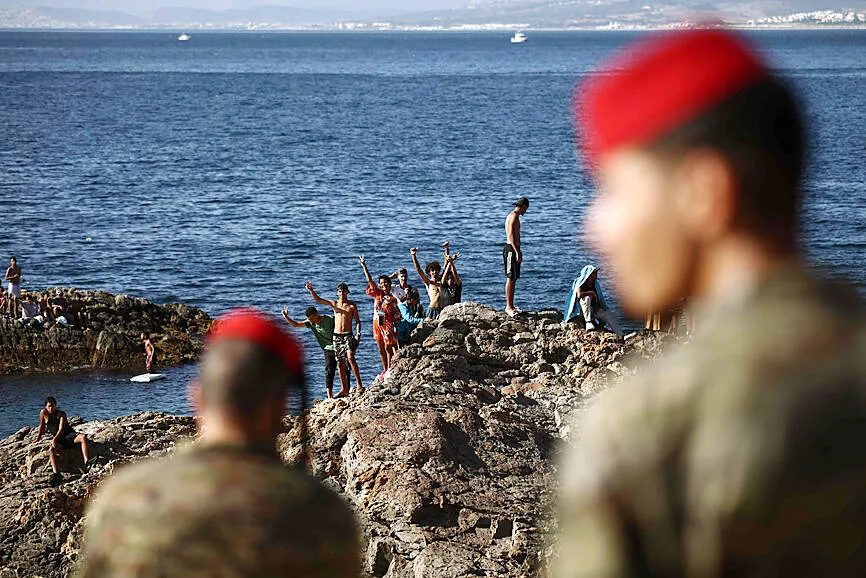

In a heart-wrenching incident, Spanish officials reported that at least 72 individuals lost their lives during a massive influx of migrants into Spain's Ceuta enclave from Morocco. This surge, which saw around 60,000 people attempt to enter the Spanish territory, primarily through swimming, has marked the largest mass migrant crossing in the region's history. In contrast, Moroccan officials provided a significantly lower death count, stating that only 11 fatalities were recorded during the perilous journey.
According to Miguel Angel Perez Triano, the Spanish government's delegate to Ceuta, the latest death toll stands at 72, an increase from a previously reported 67 casualties. As the situation unfolded, the Moroccan interior ministry's report highlighted the tragic loss of life, indicating that ten individuals drowned, while one person fell from a rocky area during the crossing.
Following the sudden influx, Spanish police and military personnel began patrolling the streets of Ceuta, which has largely returned to normal after the chaotic events that commenced last Wednesday. Most of the migrants, having crossed the border, voluntarily returned to Morocco within 48 hours, leaving only small groups still wandering the enclave. One Moroccan national, Aziz Dabch, shared his sentiments, stating, "All the children here want to go to [mainland] Spain." This sentiment underscores the desperation many feel in the face of such perilous journeys.
This unprecedented migrant rush has ignited an international crisis for Spain, prompting criticism from various EU nations regarding Madrid's immigration policies. Observations from the ground revealed Spanish soldiers detaining a group of nine migrants outside a housing project near the Port of Ceuta, all while an armored vehicle stood guard. Meanwhile, small inflatable boats from a rescue unit scoured the surrounding waters, searching for those who might still be in distress.
The Spanish Civil Guard was actively involved in escorting migrants off buses to return them to Morocco, ensuring that the border crossing remained calm. Groups of workers were seen collecting trash and personal belongings left behind during the mass crossing, highlighting the aftermath of the chaotic events.
Spain has pointed fingers at criminal organizations for allegedly spreading false rumors that a recent Supreme Court ruling would facilitate easier access for migrants, leading to the chaotic situation. Analysts suggest that Morocco may have allowed this surge as a means to exert diplomatic pressure on Spain, particularly in light of Spain's improving relations with Algeria, Morocco's historically unfriendly neighbor.
The situation is not without precedent; in 2021, approximately 10,000 migrants crossed into Ceuta when Morocco relaxed its border controls to apply pressure on Spain. Many migrants reported hearing claims that the border was open, a rumor that rapidly gained traction on social media, further complicating the crisis.
In response to this escalating situation, the European Union has announced a conference scheduled for Tuesday, spurred by a joint open letter from 22 member states calling for urgent coordination to prevent future uncontrolled crossings. Italy has also taken measures, implementing a one-month suspension of its Schengen agreement with Spain, which typically allows for free movement across borders.
Spanish Prime Minister Pedro Sanchez expressed his discontent in a letter to EU leaders, condemning the "selfish" responses from certain countries amid this humanitarian crisis. Additionally, Pope Leo XIV acknowledged the troubling circumstances in Ceuta during his Sunday prayers, expressing his concern and hope for a resolution characterized by peace, stability, and justice.
As reported by taipeitimes.com.