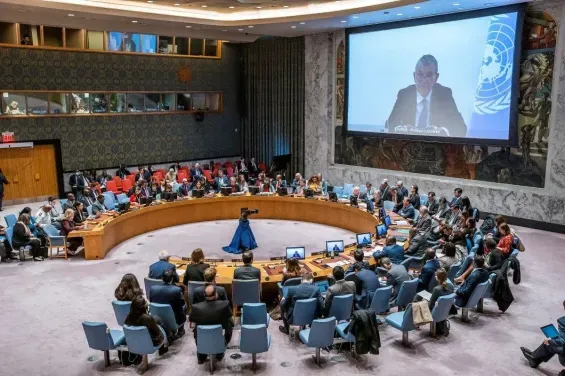

The United Nations Security Council is set to dedicate three meetings in October to discuss the ongoing situation regarding the Moroccan Sahara and the future of MINURSO (the United Nations Mission for the Referendum in Western Sahara). These discussions, beyond the routine agenda item of renewing the mission's mandate, come at a time when diplomatic backing for Morocco's autonomy initiative has notably strengthened, with several Council members now presenting it as a credible basis for resolution. This renewed focus on the Moroccan Sahara issue once again places it at the forefront of the Security Council’s agenda. The Greek presidency of the Council has scheduled the three meetings for October following the adoption of the provisional work program on October 1.
During these consultations, Council members are expected to hear a presentation regarding the annual report from the UN Secretary-General on the situation in the Moroccan Sahara. This briefing is anticipated to take place on October 7 and 8, featuring Alexander Ivanko, the Secretary-General's special representative for the Sahara and head of MINURSO, alongside Staffan de Mistura, the Secretary-General's personal envoy for the Sahara. However, the most significant event is expected to occur at the end of the month, culminating in a vote on the renewal of MINURSO's mandate, which is set to expire on October 31.
Resolution 2797, adopted on October 31, 2025, had extended the mission's mandate by one year and notably reaffirmed the Security Council's support for the Secretary-General’s efforts, alongside his personal envoy, to facilitate negotiations. It also placed Morocco's autonomy proposal at the heart of the political process, recognizing it as a basis for discussions aimed at achieving a fair, durable, and mutually acceptable solution to the dispute. This direction is a critical element in the context of the upcoming discussions in October. Furthermore, Resolution 2797 requested the Secretary-General to present a strategic review of MINURSO's future mandate, considering the developments in negotiations among the parties over a six-month period.
As a result, several scenarios remain possible. The Council might choose to extend the current mandate of MINURSO for an additional year, thereby allowing more time for the political process to develop before reviewing the mission's tasks and structure. Alternatively, a six-month extension could be implemented, enabling the Council to quickly reassess the progress made in negotiations and evaluate how those outcomes might inform the strategic review of the mission’s mandate.
However, the primary focus remains on the evolving diplomatic landscape surrounding the issue. Indeed, various Security Council members have increasingly aligned their positions with that of Rabat. The United States, which has taken the lead on the Moroccan Sahara issue within the Council, recognized Morocco's sovereignty over its Sahara in December 2020 during Donald Trump's presidency and has maintained this stance. France also supports Morocco’s claim to its Sahara, while the United Kingdom considers the Moroccan autonomy initiative as the “most credible, viable, and pragmatic basis” for achieving a lasting resolution.
This supportive dynamic extends beyond the five permanent members of the Council. Denmark regards the Moroccan autonomy plan as “a good foundation for a solution acceptable to all parties,” while Greece, currently presiding over the Security Council, describes it as a “serious and credible approach.” Among the elected members, Bahrain, the Democratic Republic of the Congo, and Liberia uphold Morocco's sovereignty over its Sahara and have opened consulates in the southern provinces. Somalia, on its part, reaffirmed its commitment to strengthen cooperation with Morocco and respect the national unity and sovereignty of each country in a statement released on December 6, 2025.
Latvia maintains a neutral stance on the dispute, whereas Panama suspended its diplomatic relations with the “pseudo RASD” in November 2024, later labeling the Moroccan autonomy proposal as “the most serious, credible, and realistic basis” for achieving a sustainable resolution. Pakistan, however, holds a distinct position, emphasizing the importance of the principle of self-determination and abstaining from the vote on Resolution 2797, primarily due to concerns that support for an autonomy framework could be leveraged by India in its own Kashmir issue.
Thus, October promises to be a particularly pivotal month for the Moroccan Sahara dossier. As discussions surrounding the effectiveness and duration of various UN missions unfold, the Security Council will need to address MINURSO while also evaluating the progress of the political process. For Rabat, the stakes extend beyond a mere administrative renewal of the mission's mandate; this sequence of events will serve as a crucial indicator of the resilience of the diplomatic momentum surrounding the autonomy initiative and its newly established prominence in Security Council discussions.
As reported by lareleve.ma.