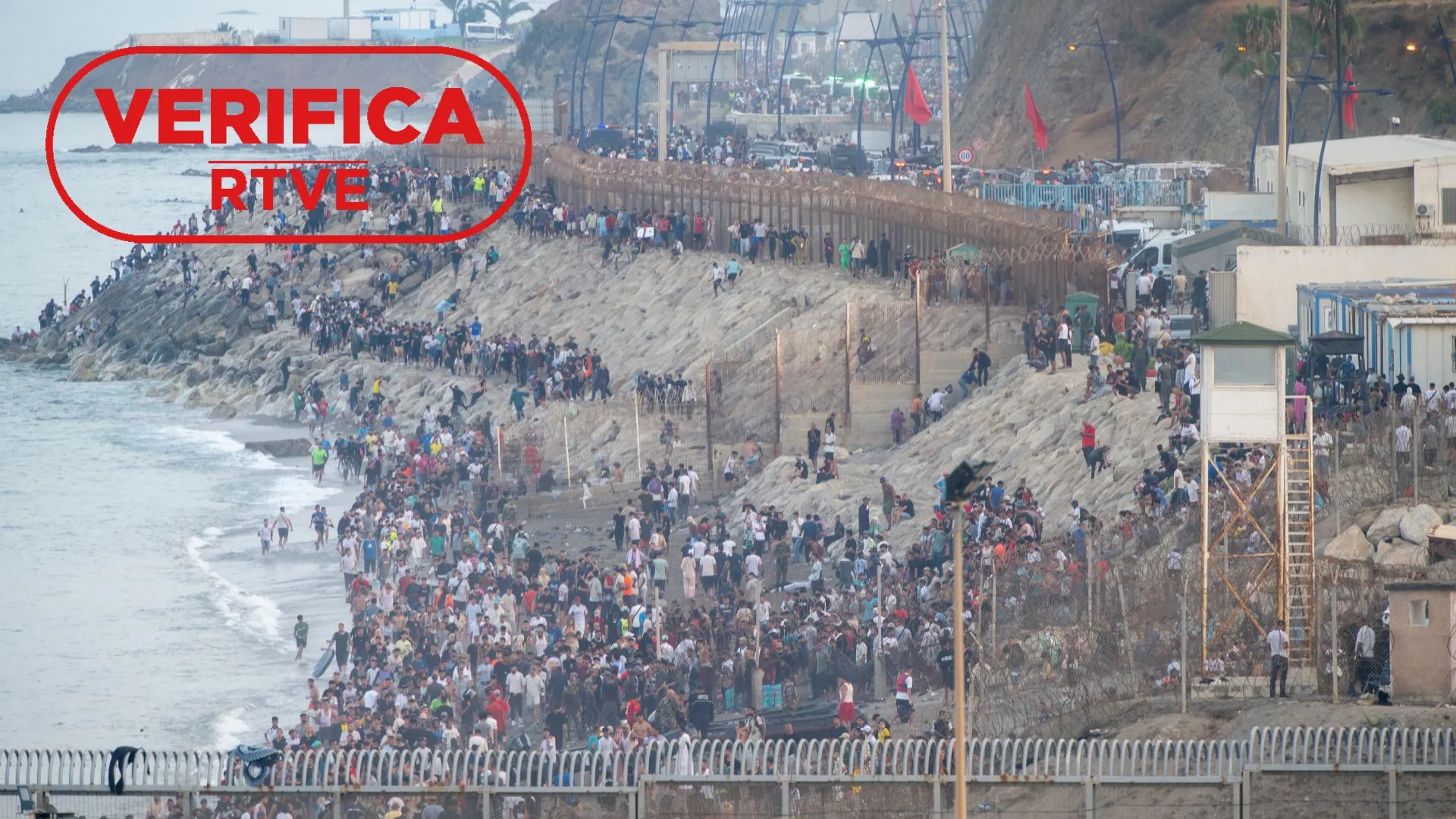
The recent mass migration crisis that unfolded in Ceuta on July 30 and 31 has raised critical questions regarding its origins and the individuals or entities responsible for instigating it. While conclusive answers remain elusive from authorities, there is ample evidence of disinformation circulating on social media platforms in the days leading up to and following the incident. This activity has been linked to Morocco's involvement and the interference of foreign powers, notably Russia and Israel. In this analysis, we delve into what has been uncovered so far.
The Role of Disinformation as a Catalyst
According to the ['Report on Irregular Mass Entry in Ceuta'](https://www.rtve.es/noticias/20260902/planificacion-guiado-activo-claves-del-informe-policia-senala-a-marruecos-entrada-masiva-ceuta/17210268.shtml) released by the National Immigration and Borders Center (CENIF), social media played an indispensable role in mobilizing a large-scale call for migration prior to the mass entry. The report indicates that the dominant narrative on social media evolved over time, initially spreading through platforms such as Facebook, Instagram, and TikTok, and later moving to closed messaging groups like WhatsApp on July 29 and 30.
The document highlights a "campaign" encouraging the crossing, capitalizing on three misleading elements: the misinterpretation of a Supreme Court ruling regarding the immediate return of migrants attempting to swim into Ceuta, the belief that police presence during Morocco's Throne Day festivities would leave the border unguarded, and the extraordinary regularization process that, although not directly applicable to those crossing during that period, was heavily publicized in a simplified and direct manner on social media. An image circulated on Facebook claimed, "In Spain, you can ultimately get papers... the final deadline is July 30," with evidence showing this misinformation was already in circulation by July 14.
As detailed in the report, during the days of mass entry, messages began to proliferate across all applications simultaneously, incorporating updates about the situation at the border and urging individuals to seize the opportunity urgently. Phrases like, "The door has opened this morning," and, "If God wills, there will be another assault tomorrow," were common, as were accounts from those who had already entered Ceuta sharing advice on how to avoid expulsion and remain in the Autonomous City.
In a subsequent analysis of over 12,000 messages, audio clips, and videos exchanged between August 4 and 13 across three WhatsApp groups, VerificaRTVE identified further false narratives, including claims about the border's opening at specific times and automatic transfer of minors to the mainland. The conversations also involved logistics regarding equipment and supplies for entering Ceuta, alongside discussions about when and how to cross.
Was this mobilization and disinformation effort spontaneous? CENIF's report asserts that it was not, indicating that it follows a pre-established pattern designed to optimize the impact of the posts and maximize dissemination among the targeted population, primarily young Moroccans from the prefectures closest to Ceuta.
The Involvement of Morocco: Passivity or Complicity?
Morocco's role in the mass entry has sparked considerable debate since the onset of the migration crisis. The government expressed gratitude to Morocco for assisting in the return of individuals who arrived during the crisis and for controlling the border afterward. However, as of Thursday, Morocco announced it is investigating the mass entry into Ceuta.
Prime Minister Pedro Sánchez has defended the stance that there is no "solid evidence" linking Morocco to the crisis, a position that has not satisfied opposition members or coalition partners. Alberto Núñez Feijóo indicated there are signs that Morocco coordinated the event, while Gabriel Rufián (ERC) accused the neighboring country of "sending 80,000 people to its border to undermine the Spanish government." Calls for Morocco to provide explanations have also surfaced from various political factions.
Experts suggest that there has been a notable "passivity" on Morocco's part. Bernabé López, a professor of Arabic Studies at the Autonomous University of Madrid, stated that although there is no tangible data regarding Morocco's involvement, it is clear that there has been "passivity that is Morocco's responsibility." Security analyst Chema Gil asserted that Morocco cannot claim ignorance of the situation, emphasizing the existence of intelligence reports indicating previous successful interventions to halt mass migrations. He insists that the evidence is so compelling that Morocco cannot dismiss its involvement by claiming they were unaware.
CENIF's report further notes a "police permissiveness in Morocco" between July 30 and 31, highlighting that videos shared in media and social networks depict behaviors consistent with facilitating irregular immigration. Interviews with migrants consistently reveal that Moroccan police not only maintained a passive stance during the attempts to enter but also provided indications on how to access Spain via specific routes.
As reported by rtve.es.