Unveiling the Riches of Aziza Cave in Eastern Morocco
Deep within the stark and rocky expanse of eastern Morocco, an extraordinary limestone cave system known as Aziza Cave, or Kef Aziza, has emerged as a crucial center of subterranean life, showcasing one of Africa’s richest reservoirs of cave-dwelling species. A comprehensive study published in the journal Subterranean Biology has identified a remarkable total of 26 unique troglobitic and stygobiotic species residing within this cave, which includes 22 terrestrial troglobionts and four aquatic stygobionts. This groundbreaking discovery not only places Aziza Cave at the forefront of subterranean biodiversity in Africa but also challenges the long-held belief that the continent is devoid of significant cave life. Among the species identified, a notable 18 are confirmed obligate cave dwellers, while eight are still undergoing verification regarding their restricted cave status.
The Geography and Unique Features of Aziza Cave
Located in the Tazzouguert Plateau of the Drâa Tafilalt region, approximately 80 kilometers from the vibrant city of Errachidia, Aziza Cave lies nestled in the Moroccan Eastern High Atlas. The surrounding terrain is characterized by its classic pre-Saharan hamada, marked by hard, rocky desert interspersed with sparse sand coverage, where rainfall varies significantly, from over 250 millimeters in the High Atlas to below 75 millimeters on the Tafilalet plain. The summer temperatures in this region can soar to 40 degrees Celsius, creating a stark contrast to the cool, humid environment found within the cave itself. The cave is situated about 30 meters above the right bank of the Guir River, intricately carved into Turonian limestone, which forms part of the expansive Guir Hamada plateau.
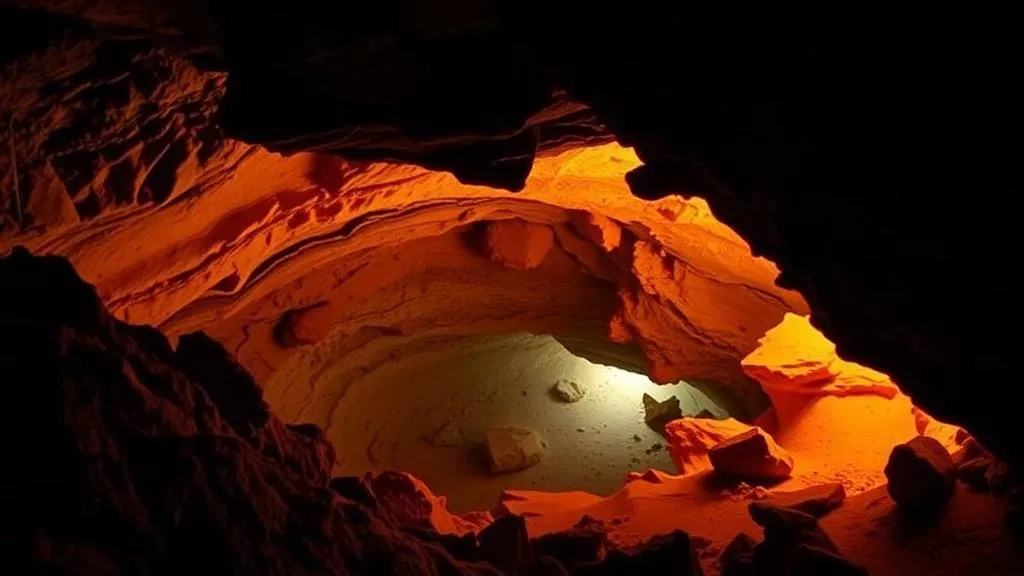
The dimensions of Aziza Cave are impressive; first explored in 1925 and gradually mapped by diverse teams from Morocco, Spain, Croatia, and Italy over the decades, the cave was measured at approximately 3,500 meters in 2003. A more recent survey in 2019 utilized advanced Disto X instruments and 3D laser mapping techniques to extend the known network to over 4,000 meters, earning it recognition as the fifth-largest cave system in Morocco and one of the ten largest in North Africa. The cave's galleries descend gently from its two entrances, characterized by one horizontal and one vertical path, leading to a vast chamber known as the Guano Room, which reaches heights of 30 meters and is home to a thriving colony of bats.
The unique geological formations within the cave are a testament to its bat inhabitants. The biogenic corrosion caused by bat excretions has significantly reshaped the cave's walls and ceilings, with mineralized urine directly attacking the limestone and ammonia from urine interacting with carbon dioxide from bat respiration to create carbonic acid, further eroding the limestone. This intricate process has resulted in the formation of bell holes, hemispherical domes, and smooth walls that obscure the cave's original features. Experts suggest that the cave was formed in two distinct phases, beginning with an ancient phreatic phase followed by a more recent vadose enlargement, classifying it as hypogenic, sustained by the Turonian aquifer that also feeds nearby springs.
Inside Aziza Cave, the climate starkly contrasts with the arid environment above. Researchers recorded average air temperatures of around 23 degrees Celsius, with humidity levels increasing from 62 percent at the entrance to an impressive 98.2 percent deep within the cave. This humid environment is essential for the eyeless, unpigmented species that inhabit the cave, as their physiology renders them incapable of surviving in the arid conditions outside. This reinforces the classification of the cave's troglomorphic species as true obligate cave dwellers, distinct from surface soil fauna.
The biodiversity inventory within Aziza Cave is notably diverse, with beetles and spiders representing the richest taxonomic groups. Among the confirmed troglobionts are unique species such as the blind spider Dysdera caeca, the linyphiid spider Lepthyphantes fadriquei, and the millipede Jeekelosoma abadi, many of which are endemic and found nowhere else on Earth. The aquatic fauna includes various isopods and gastropods, highlighting the ecological significance of the cave's unique microhabitats. Intriguingly, only about 34.6 percent of the cave-restricted species identified have been formally described, indicating that a significant number of new species are likely waiting to be discovered. The authors of the study emphasize that many areas of the cave remain biologically uncharted and that further exploration could reveal even greater biodiversity.
The implications of this research extend beyond mere cataloging of species; it sheds light on the vital need for conservation efforts in Morocco. Despite Aziza Cave's location within a UNESCO Biosphere Reserve, the cave itself is alarmingly unprotected. The entrance is easily accessible, with agricultural activities taking place in close proximity, leading to environmental degradation marked by litter and graffiti. The decline in bat populations observed over the years underscores the pressing need for protective measures. The authors advocate for a participatory approach that engages local communities in conservation efforts, highlighting the importance of safeguarding this unique ecosystem before its undocumented fauna is irreversibly lost.
As reported by bioengineer.org.