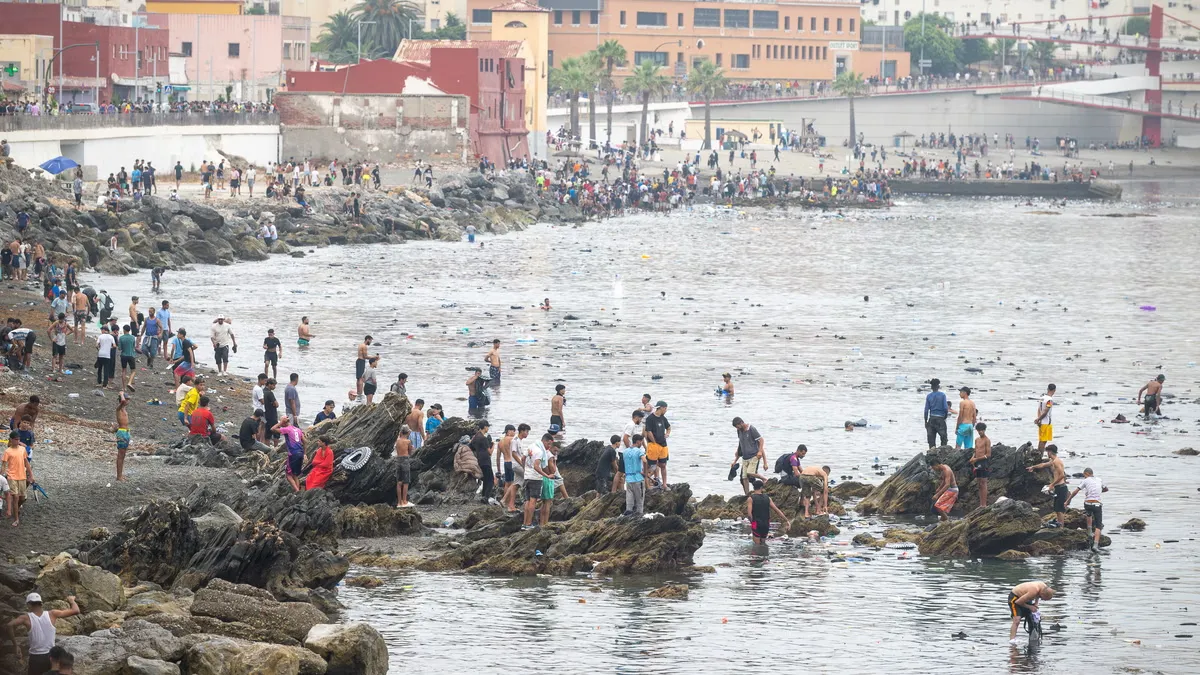

The recent maritime incursion from Morocco to Ceuta, which took place on Thursday and Friday, has resulted in **67 confirmed fatalities on the Spanish side**; however, the Moroccan Association for Human Rights estimates that approximately 130 individuals have lost their lives, including those on the Moroccan side, although this figure has not been officially verified. This tragic event has prompted 22 European Union countries to sign a **stern letter** linking the recent migratory crisis in Ceuta to the **policies of the Spanish government**. In response, Spain criticized the signatories for their **unsupportive gesture** and called for a meeting of interior ministers to address the ongoing situation.
This is not the first time Ceuta has faced a migratory crisis; in May 2021, the Moroccan government allowed around 8,000 individuals from Morocco and other African nations to enter Ceuta within just two days. This action was interpreted as a form of retaliation by Morocco against Spain for permitting a leader from **Western Sahara** to receive medical treatment in a Spanish hospital.
Underlying Causes of the Current Crisis
According to **El Orden Mundial**, this situation can be characterized as a **"hybrid threat or gray zone"**, where aggressive maneuvers aim to destabilize the opponent, making it challenging to pinpoint responsibility, similar to the complexities of cyberattacks. In this instance, the **utilization of immigration as a geopolitical weapon** is a recurrent tactic employed by Morocco toward Spain. It is evident that Morocco selectively facilitates or restricts the arrival of migrants at the Spanish border, whether by sea or through Ceuta and Melilla, as demonstrated in 2021.
Several factors may have motivated Morocco to escalate this action at this particular moment. One significant element is a recent ruling by the Spanish Supreme Court, which stated that **only those who arrived by land could be returned**, thereby generating a certain level of tension. Furthermore, following the World Cup final on July 19, **Spanish Prime Minister Pedro Sánchez's flight from New York to Algeria** marked a pivotal geopolitical move, symbolizing the **"normalization of relations"** between the two countries after a diplomatic crisis that began in 2022 due to Sánchez's acknowledgment of Morocco's autonomy plan for Western Sahara. This gesture was met with discontent in Rabat, as Algeria is Morocco's primary geopolitical rival in the Maghreb region.
Moreover, the celebration of King Mohammed VI's **Throne Day** on July 30, during which the monarch visited Tétouan and Castillejos near Ceuta, may have diverted local security resources, inadvertently easing the transition across the border. This scenario exemplifies Morocco's display of strength to reinforce its geopolitical leverage over Spain, highlighting a **dependency relationship** that has developed over time.
The Geopolitical Landscape and Future Outlook
However, it is crucial to recognize that these phenomena cannot be attributed to a single factor; various interconnected elements play a role in shaping the crisis. One potential underlying reason could be the **support from the United States and Israel** for Morocco's maneuvers, particularly in light of Spain's opposition to increased **NATO defense spending**, its stance on the **Iran war**, and its support for **Palestine**. While it cannot be definitively stated that these nations are instigating such actions, their support may be perceived as retaliatory against Spain's government positions. The situation in Ceuta is steeped in complex geopolitical dynamics.
Spain appears to be caught in a cyclical pattern where Morocco acts, and the Spanish government reacts. This has not only occurred this week but has been a recurring theme throughout history. The pressing question remains: **Can Spain break free from this cycle?** **El Orden Mundial** suggests that it is indeed possible, but certain changes must be implemented. Spain's strategy of maintaining a **"buffer of interests"**—creating a dynamic of interdependence to prevent hostile actions—can be effective. This buffer is constructed through trade (with significant imports from Morocco), investments, and cooperation in border control. While Morocco exercises control over migration from its territory, Spain contributes to that control financially. However, the disparity in this relationship is increasing, as Morocco shows little willingness to de-escalate tensions and is becoming increasingly empowered, thereby intensifying Spain's dependency.
Morocco has learned a valuable lesson over the years: when it desires something from Spain, it merely needs to apply pressure and wait, often resulting in concessions from the Spanish side. The situation is further complicated by Spain's vulnerability regarding migration, a sensitive issue that polarizes public opinion and causes instability—exactly the outcome Morocco seeks. The potential for Spain to adopt a firmer stance against Morocco exists, but it is important to acknowledge the inherent costs associated with such an approach.
As Morocco forges alliances with countries such as Israel and the United States, it becomes evident that some European partners, like France, frequently prioritize support for Morocco over Spain. Several European nations have echoed Italy's proposal to exclude Spain from the Schengen Area due to the Ceuta crisis, despite the legal limitations of such actions. Thus, while alternative approaches may be considered, the outcomes are uncertain and may not align with Spain's objectives.
Looking ahead, the implications of this crisis extend into the political landscape in Spain, particularly with the upcoming **World Cup collaboration with Morocco and Portugal** in four years, which carries symbolic weight. Notably, during the Throne Day celebrations, while Morocco escalated tensions in Ceuta, **FIFA President Gianni Infantino** was visiting the Moroccan king. Additionally, the upcoming **FIFA Annual Congress in Rabat** is set to see Infantino's reelection as president, raising questions about the potential support for venues like the Bernabéu or Camp Nou as hosts for the **2030 World Cup final**.
As reported by ondacero.es.