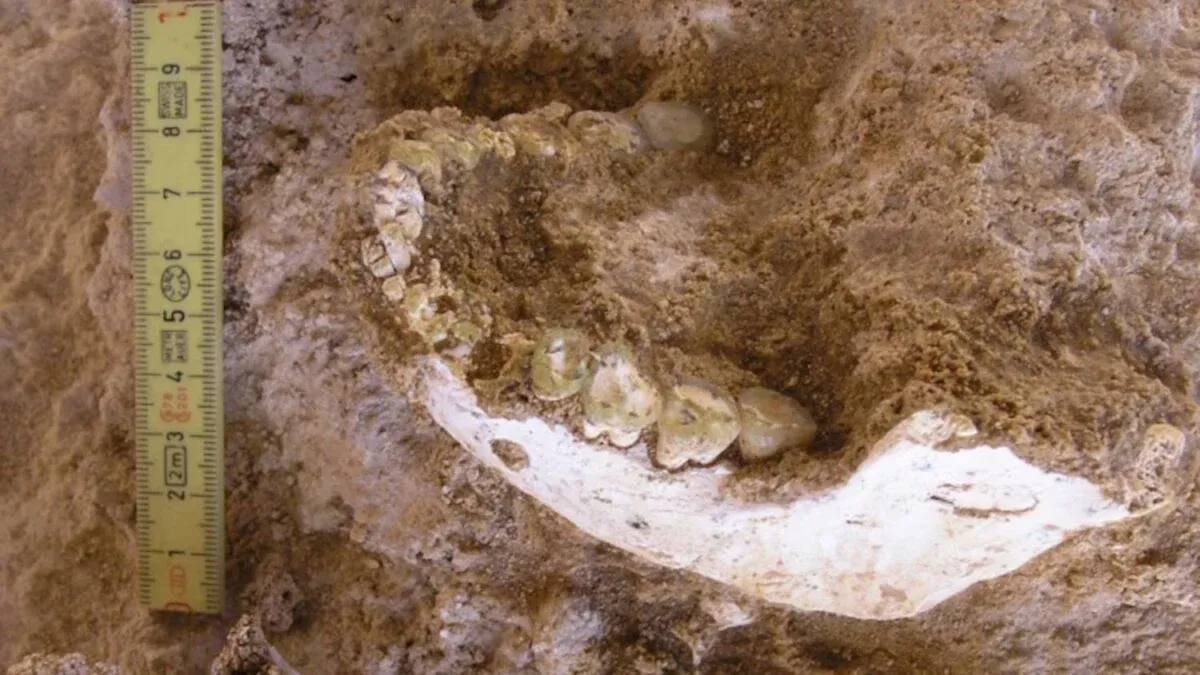

The quest to determine the true origins of humanity has long been a subject of intense scrutiny and debate among scientists and researchers. Did our story begin in East Africa, as traditional textbooks have suggested? Or perhaps in Europe, as some puzzling fossils have indicated? There are also compelling arguments for an Asian origin. Recently, a quarry on the outskirts of Casablanca has made a significant contribution to this ongoing discussion, presenting what could be groundbreaking evidence. Excavations uncovered three jawbones, several teeth, and some vertebrae, buried for an astonishing 773,000 years. These remains are now recognized as the closest known fossils to the lineage that would eventually lead to Homo sapiens, marking a pivotal moment in the study of human evolution. This discovery is not merely a footnote; it is a scientific bombshell that challenges existing paradigms.
Not Quite the Missing Link, but Close Enough
Scientists have generally moved away from the term "missing link," finding it overly simplistic and linear when describing human evolution. Instead, it resembles a tangled bush rather than a neat ladder. However, this recent find approaches the concept that researchers have pursued for over a century: the last common ancestor. This pivotal figure represents the point at which the paths of Homo sapiens, Neanderthals, and Denisovans diverged, essentially acting as our collective great-great-grandparent. According to the research team led by Jean-Jacques Hublin, these Moroccan fossils do not represent that ancestor per se, but they lie on the exclusive branch from which Homo sapiens will emerge—shortly after the evolutionary fork where our line began to separate from others. While not the ultimate origin, this discovery is intriguingly close.
Complexities and Controversies in Paleoanthropology
The jawbones unearthed are scientifically intriguing because they exhibit archaic traits characteristic of Homo erectus, yet they also display surprisingly modern features that align more closely with contemporary humans. This discordance makes them difficult to categorize, a situation that is often considered "gold" in paleoanthropology. For years, the leading candidate for our common ancestor was Homo antecessor, discovered in Atapuerca in the 1990s, a European hominid with modern traits that seemed to fit the key position well. However, the Moroccan fossils bear a resemblance to antecessor but not sufficiently enough to confirm a direct lineage. Hublin and his team argue that antecessor is more likely related to Neanderthals and Denisovans, while the Moroccan remains are already situated on the lineage leading directly to us. This reinterpretation has not gone unnoticed and has sparked significant debate within the scientific community.
Notably, figures like María Martinón-Torres and José María Bermúdez de Castro from Atapuerca have expressed skepticism regarding this new narrative. They highlight that the study does not adequately incorporate crucial Asian fossils, such as those from Harbin and Hualongdong, which exhibit remarkably modern facial features for their age. Their argument is straightforward: if hominids in Asia and Europe had features resembling modern humans during that period, why assume that our lineage originated in North Africa? Martinón has described the proposition as "convoluted," indicating that the history of human evolution remains far from settled.
Furthermore, a perplexing aspect of these Moroccan fossils is their mandibular traits, which hint at Neanderthal characteristics despite their antiquity. This raises an uncomfortable question: why would the roots of Homo sapiens exhibit Neanderthal-like features? It creates a fascinating paradox, suggesting that the branches of our evolutionary tree might have intertwined before fully separating. The narrative of human evolution is more chaotic than we often believe.
A significant gap of 400,000 years exists between these 773,000-year-old remains and the earliest Homo sapiens found in Morocco, dated to around 300,000 years ago. This temporal void represents one of the great enigmas in human evolution. What happened during this extensive period? Where were these populations? Why did they leave no trace? Our history contains missing pages, and the search for them continues.
In 2017, the same research team previously made headlines by discovering the oldest known Homo sapiens, dating back 300,000 years, in Morocco, pushing the "cradle" of our species back hundreds of thousands of years. Now, with these latest findings, it is suggested that North Africa could be crucial not just for Homo sapiens but for the deeper lineage leading to our species. This narrative shift challenges long-standing assumptions, suggesting that the origins point may not lie in Ethiopia, Europe, or Asia, but rather in Casablanca. Such revelations disrupt established narratives, making them all the more compelling.
Hublin remains cautious, acknowledging that we may never uncover a definitive fossil representing the last common ancestor. It is possible that specific pieces of this puzzle have been irretrievably lost. However, he also hints at intriguing possibilities: with new techniques such as ancient protein analysis, we may be able to reconstruct evolutionary relationships even without complete fossils. Paleoanthropology is evolving into a more forensic science, shifting away from the Indiana Jones archetype toward a more analytical approach akin to Pleistocene CSI.
Ultimately, for a long time, we sought a straightforward lineage: a clean origin from point A to point B. What we are discovering is far more complex: dispersed populations, interbreeding, divergences, and back-and-forth migrations between continents, with traits appearing and disappearing. Our history is not elegant; it is chaotic. These Moroccan bones do not close the mystery; they amplify it, reminding us of the uncomfortable yet beautiful truth: we are the product of a much more tangled story than we like to admit.
As reported by es.gizmodo.com.