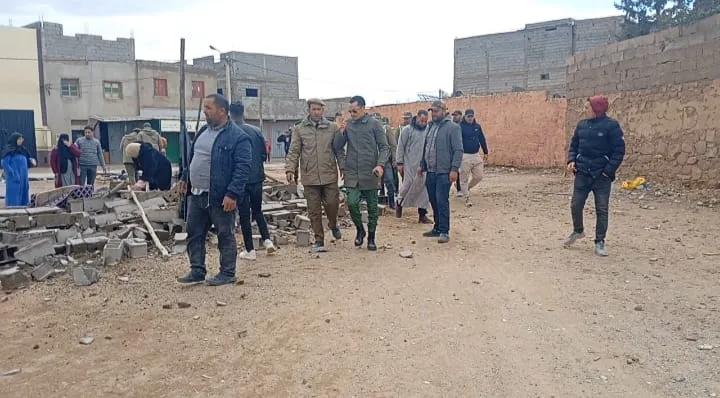

In the vicinity of Marrakech, the Harbil region has recently experienced significant field activities as part of an unprecedented campaign aimed at curbing the rampant issue of illegal construction. This initiative has specifically targeted several areas known for unauthorized building practices, including Douar Al-Qaid and Douar Ait Masoud, along with other neighborhoods within the jurisdiction of the local community. The campaign was launched in response to numerous violations that have led to notable disruptions in urban planning.
According to consistent reports, several houses constructed without proper permits have been demolished, and a number of non-compliant construction sites have been halted, including ongoing projects. These actions were conducted under the supervision of the local authority chief and in coordination with security personnel and auxiliary forces.
Abd al-Razzaq Toujani, in a statement to the newspaper "Al-Amq," indicated that this campaign is part of a broader effort to tighten regulations on urban development, especially given the increasing prevalence of informal construction and the accompanying infrastructure challenges, such as issues with water, electricity, and sewage networks. He emphasized that violations of the law directly impact the quality of life for residents and the sustainability of local projects.
Toujani noted that while these interventions have brought relief to some residents of the area, others have expressed concern over the consequences of demolition, particularly for families directly affected by these measures. He stressed that any field interventions should adhere to legal processes to ensure a balance between law enforcement and the protection of citizens' rights.
He further pointed out that current housing programs initiated by the Ministry of National Land Planning, Urbanism, Housing, and City Policy do not adequately meet the actual needs of the population, contributing to the worsening phenomenon of illegal construction. This is particularly evident in rural communities near Marrakech, where many citizens seek affordable housing, often resorting to illegal building practices, sometimes even under the cover of night to evade scrutiny.
The local authorities find themselves continuously challenged by residents, especially in communities that include numerous scattered neighborhoods, complicating the monitoring process and immediate intervention to prevent unlawful construction.
Toujani clarified that the situation in Harbil reflects a trend towards stricter enforcement of the law, while also underscoring the necessity of respecting legal procedures and ensuring fairness in addressing various cases to avoid any potential social repercussions. He affirmed that this campaign will continue, with ongoing evaluations to assess its impact on urban expansion management.
He confirmed that this ongoing campaign has sparked considerable debate at the local level, particularly as illegal construction persists in many areas, especially in rural districts associated with Marrakech. He asserted that collaborative efforts between authorities and civil society are crucial to achieving balanced urban development and improving the quality of life for the residents.
As reported by al3omk.com.