
The Complex Dynamics of the Ceuta Crisis
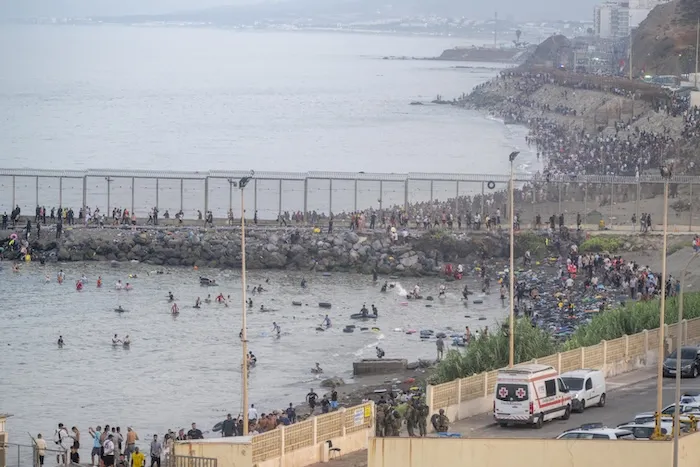
In recent discussions surrounding the Ceuta crisis, two seemingly opposing figures, Georg Restle, a prominent journalist from ARD, and Jürgen Elsässer, the right-leaning editor of "Compact", have emerged with strikingly similar narratives. Both have drawn connections to influential political leaders and nations, suggesting that figures like Donald Trump and Benjamin Netanyahu, in collaboration with Morocco, are orchestrating a larger plot involving the influx of thousands of refugees seeking entry into Europe. Ceuta, a Spanish enclave situated on the Moroccan coast, has transformed into a focal point of humanitarian and political turmoil as these refugees arrive in droves, prompting a surge of speculation regarding the motives behind these migrations.
Restle has taken to social media platform X, positing that the events unfolding in Ceuta are part of a calculated strategy by a "growing US-Israeli-Moroccan network" aimed at destabilizing progressive European governance, fracturing the unity of Europe, and undermining international law. Conversely, Elsässer confidently asserts that the "invasion" of refugees is a direct result of Trump and Netanyahu's orchestration, facilitated by Moroccan authorities. Despite their divergent political backgrounds, both men converge on a narrative that raises critical questions about the sources and accuracy of their claims.
Evaluating the Sources and Claims
The credibility of these claims rests heavily on the sources each journalist cites. While Elsässer is known for his provocative assertions, often without substantial evidence, Restle's background as a seasoned journalist lends a different weight to his conclusions. Having served as a correspondent in Moscow and currently leading the ARD office in Nairobi, Restle's approach is typically grounded in journalistic integrity. He references "The Nation", a well-established American magazine with a clear progressive stance, as a source for his claims. However, the political leanings of a publication do not inherently validate the information presented, and it remains essential to consider the motivations and biases that may influence reporting.
Historical context reveals that Morocco has previously utilized migration as a political tool against Spain, such as in 2021 when thousands were encouraged to head towards Ceuta following diplomatic tensions. This strategy has been recognized by the European Parliament as a form of political pressure. However, the leap to suggesting a coordinated effort by a US-Israeli-Moroccan alliance to manipulate refugee movements in order to achieve political ends is a significant assertion that demands robust evidence. As journalists, the responsibility lies in substantiating claims with verifiable facts rather than constructing narratives based solely on speculation and conjecture.
The role of public broadcasting institutions has been intensely scrutinized in the digital age, where platforms like X, Telegram, and TikTok often disseminate information that is unverified and rumor-driven. In contrast, traditional journalists are expected to provide thorough analysis, weighing facts and offering balanced perspectives. Unfortunately, Restle’s presentation of claims without rigorous verification undermines the very principles of journalism he is purported to uphold, as it risks amplifying unsubstantiated narratives under the guise of credible reporting.
In the end, the juxtaposition of sensational claims from both the far left and the far right leads to a troubling reality where crucial questions regarding evidence and accountability are overshadowed by the allure of conspiracy theories. The fundamental question for journalists remains: Can we substantiate these claims? The pursuit of truth should always take precedence over sensationalism, and it is this commitment to integrity that should guide public discourse.
As reported by theeuropean.de.