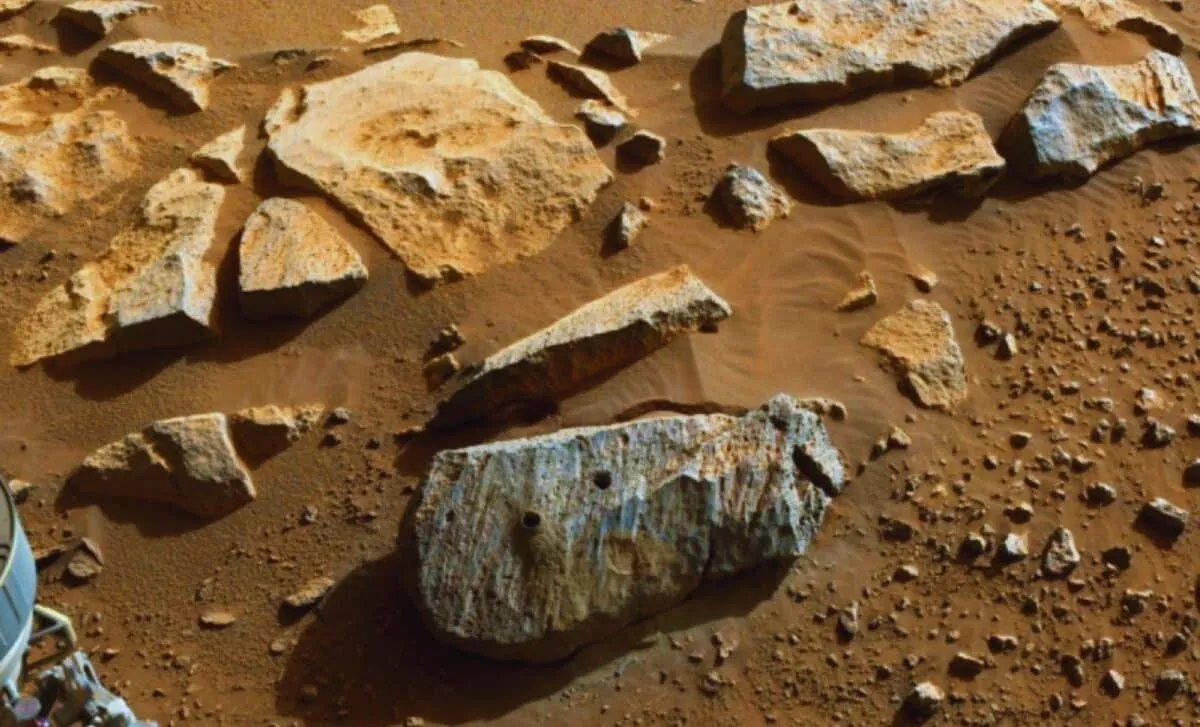

A remarkable meteorite discovered in Morocco has unveiled astonishing revelations regarding the presence of water on Mars. Dated at an impressive **2.1 billion years**, this meteorite showcases a staggering concentration of water, estimated to be ten times greater than any previously examined Martian meteorite. This discovery is particularly significant as it may represent the first confirmed sample originating from the Martian crust, a region that has been underrepresented in meteorite collections.
The journey of this meteorite began with collector _Jay Piatek_, who acquired a small stone weighing less than a pound. Upon examination by researchers at the University of New Mexico, it was determined that the meteorite did not correspond with the known composition of Martian meteorites. This discrepancy prompted scientists to conduct further comparisons with data from the **Curiosity rover** and various other missions, ultimately indicating a new origin for the rock—specifically, the **Martian crust** rather than the mantle, which had been the source of prior samples.
Rover Data Validates Unique Crustal Origin
This meteorite's classification signifies a pivotal moment in the field of planetary science. As noted in a [**NASA statement**](https://science.nasa.gov/solar-system/water-rich-meteorite-linked-to-mars-crust/), the majority of Martian meteorites studied thus far have been sourced from the planet's deeper layers. However, this particular sample aligns more closely with direct measurements obtained from Mars by robotic explorers. Analyzing the rock's chemical composition reveals that it is more akin to crustal materials rather than those derived from mantle magma.
John Grunsfeld, who previously served as the associate administrator for NASA’s Science Mission Directorate, remarked, “The contents of this meteorite may challenge many long-held notions about Martian geology. These findings also present an important reference frame for the Curiosity rover as it searches for reduced organics in the minerals exposed in the bedrock of Gale Crater.” The meteorite is primarily composed of **basaltic breccia**, characterized by a mixture of volcanic fragments that have been cemented together. This composition implies that the rock experienced rapid cooling likely occurring at or near the Martian surface, a process that is typically associated with crustal activity. Although similar rocks have been previously identified on the **Moon**, this is the first time such material has been confirmed from Mars.

Record-Breaking Water Content Discovered
The most striking aspect of this meteorite, designated as (NWA) 7034, is its remarkable water content. A study published in _[Science](https://www.science.org/doi/10.1126/science.1228858)_ revealed that this sample contains water in levels approximating **6,000 parts per million**, far surpassing previous measurements found in Martian meteorites. While this fist-sized rock may be considered relatively dry by Earth standards, it contains between 10 and 30 times the average concentration of water found in other known Martian meteorites. Notably, it is the first meteorite to closely match specific characteristics of the Martian crust.
Andrew Steele of the Carnegie Institution commented, “The high water content could indicate that the rocks interacted with surface water, either from volcanic magma or from fluids stemming from impacting comets during that era.” Although earlier studies had suggested the presence of water on Mars, none had shown such significant concentrations.

The meteorite is estimated to have formed during the **Amazonian epoch**, which is notable for the lack of physical samples available for study. This gap in knowledge has hindered direct investigations into the more recent geological history of Mars. The new analyses of this planetary fragment help to bridge that void, indicating a more intricate interplay between geological processes and water than previously understood for that time period. Steele noted that this meteorite represents “the richest Martian meteorite geochemically,” and he anticipates that further analyses will uncover even more surprises.
As the research continues, scientists expect to derive additional insights from this small yet significant rock, which stands as one of the most comprehensive records of the **Martian crust** and its relationship with water.
As reported by dailygalaxy.com.