
Understanding the Five-Tiered Organization of the Ceuta Invasion
A recent report by the National Immigration and Borders Center (CNIF) of the National Police has been submitted to the Central Court of Instruction Number 3 of the National Court, revealing a meticulously structured organization behind the invasion of Ceuta, categorized into five distinct levels aimed at obscuring the authorship of the border attack. This comprehensive analysis includes insights from surveillance footage and social media videos from the events of July 30 and 31, which indicate the presence of individuals giving instructions to the rest of the participants. The report suggests that Moroccan authorities played a significant role as accomplices in orchestrating the invasion, albeit without directly implicating the Moroccan government led by King Mohammed VI.
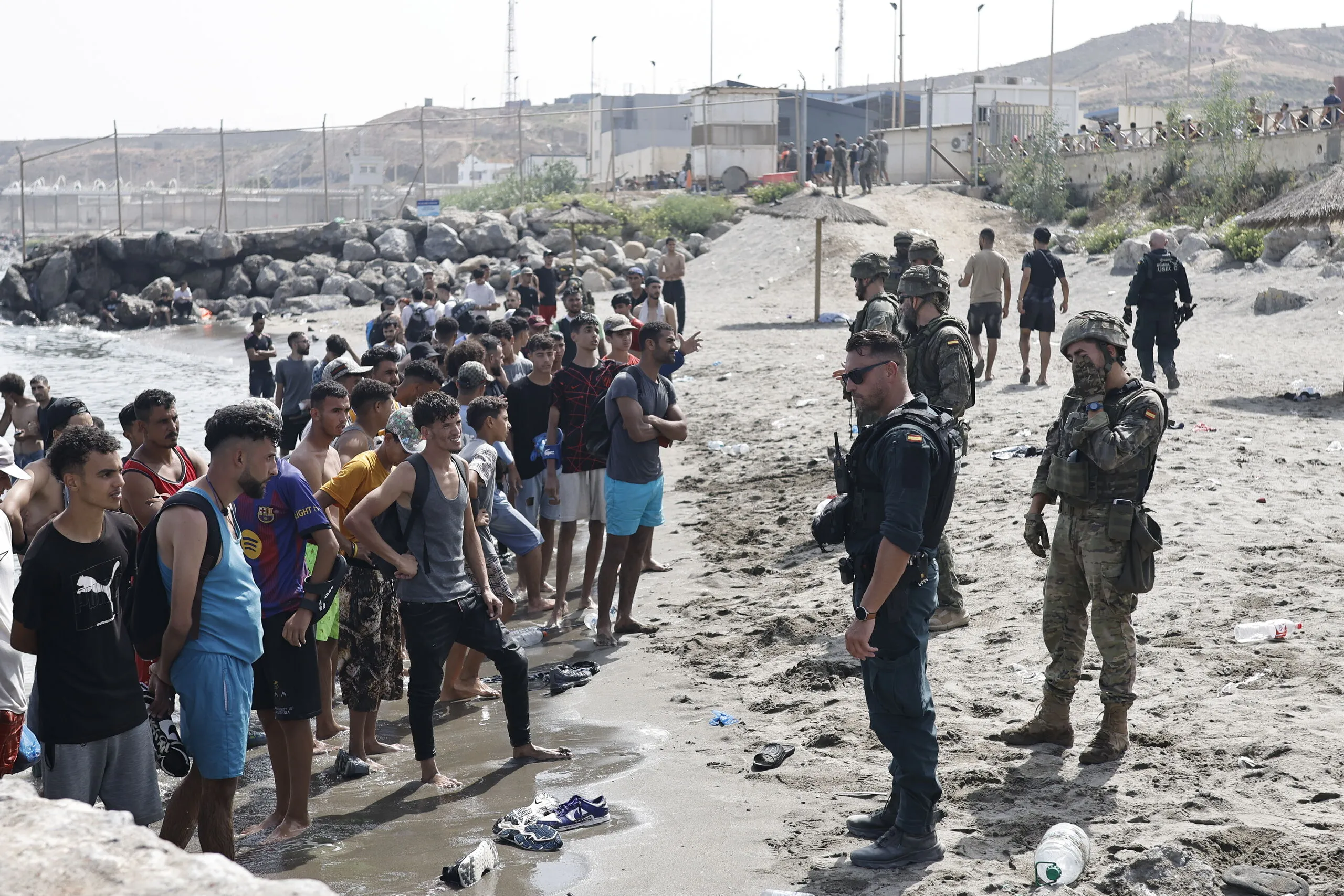
The first level of this hierarchy comprises over 80,000 individuals who crossed the border illegally through the Tarajal Spigots. The report emphasizes that the very dynamics of this mass entry, coupled with the almost immediate return of a substantial percentage of these individuals, unequivocally indicates that the primary intent of most entrants was not migratory in nature. Instead, the vast majority—those who returned shortly after the attack—did not fit the profile of irregular immigrants. In fact, the report asserts that at least 90% of those who crossed the border were motivated by the opportunity to participate in what was perceived as a historic event, rather than an intention to enter Spain for citizenship. It further narrows the genuine 'migratory intent' to a mere 5 to 10% of those who crossed, indicating a small subset with the actual desire to remain in Spain.
The second level is characterized by the so-called 'message dynamizers,' a communication structure responsible for disseminating over 7,500 messages during the week of the assault, with 90% of the phones used bearing Moroccan prefixes. The third level involves the organizers who managed the flow of people on the ground. The report notes that the behavior and progression of approximately 75,000 to 85,000 individuals entering Ceuta without disruptions at access points or public order incidents is incompatible with a spontaneous group lacking internal organization. This level includes both uniformed agents—Moroccan gendarmes directing irregular immigrants—and undercover agents who coordinated the masses from within, masquerading as immigrants themselves.
The Sophisticated Planning and Direction Behind the Assault
The fourth level pertains to the strategic planning behind the assault. A comparison of certain elements between the processes of 2021 and 2024 reveals a structured sequence of events that, by 2026, not only shares the same fundamental characteristics but also exhibits a refined management approach that is significantly more sophisticated and effective than previous instances. This section underscores the logistical support involved, including trucks transporting immigrants to the border, contrasting sharply with the second call on August 15, which agents describe as a 'whitening' and 'artificial' mobilization orchestrated by Moroccan authorities to demonstrate their control over the mass entry of immigrants.
At the pinnacle of this structure lies the leadership level, which cannot be occupied by individuals outside of the regime of Mohammed VI. The report concludes that we are witnessing a planned and executed process through the coordination of influential actors mentioned in the third and fourth levels, necessitating a high level of influence within social networks and connections to Moroccan security forces, as well as individuals or institutions possessing the requisite knowledge and experience to be part of the planning phase of this operation.
As reported by libertaddigital.com.