
Exploring the Legacy of Jurisprudential Thought in Morocco
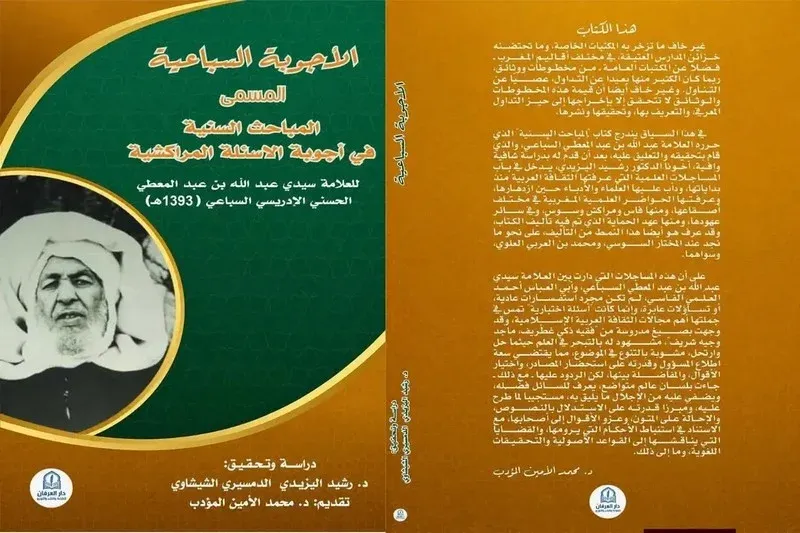
A recent investigation sheds light on a significant aspect of Morocco's jurisprudential thought, specifically through the lens of the responses provided by the esteemed scholar Abdullah bin Abdul Muti Al-Hassani Al-Idrissi Al-Sabahi. This work, published by Dar Al-Irfan, features a comprehensive study and analysis by Rashid Al-Yazidi Al-Damsiri Al-Chiyashawi, with an introduction by Mohamed Amin Al-Muadab. The researcher emphasizes that this precious work, entitled "Al-Mabahith Al-Sunniyya fi Ajwibat Al-As'ilah Al-Marrakshiya," is a valuable contribution to the corpus of Moroccan jurisprudence, consisting of inquiries from prominent scholars of Ibn Youssef in Marrakech. The questions were presented to him by the renowned jurist Sidi Muhammad Al-Ilmi Al-Fassi, who was born in Marrakech. Abdullah Al-Hassani Al-Idrissi responded with the depth and expertise characteristic of a learned scholar in his field. Notably, he eloquently acknowledged his noble lineage, tracing back to the honorable Prophet Muhammad (peace be upon him), and demonstrated his profound scholarly acumen through meticulous documentation and precise responses.
The Significance of Scholarly Dialogues in Arabic Culture
In the introduction to this new publication, Mohamed Amin Al-Muadab highlights the importance of the book "Al-Mabahith Al-Sunniyya," prepared by the eminent scholar Abdullah bin Abdul Muti Al-Sabahi and further annotated by Dr. Rashid Al-Yazidi. This work belongs to the realm of scholarly dialogues that have characterized Arabic culture since its inception. Such dialogues have been a tradition among scholars and writers during periods of cultural flourishing, especially in various Moroccan scientific centers throughout history. Notably, this book was created during the Protectorate era, echoing the scholarly exchanges seen in the works of contemporaries such as Al-Mukhtar Al-Susi and Muhammad bin Al-Arabi Al-Alawi.
Furthermore, Al-Muadab elaborates on the profound nature of the discussions that took place between the esteemed scholar Abdullah bin Abdul Muti Al-Sabahi and Abu Abbas Ahmad Al-Ilmi Al-Fassi. These were not mere casual inquiries but rather 'test questions' that touched upon the core areas of Arabic Islamic culture. They were formulated thoughtfully by a perceptive jurist known for his deep knowledge. The responses provided, while being scholarly, were articulated in a humble tone, reflecting the respect and recognition of the questioner's contributions, showcasing the scholar's ability to draw upon texts, reference sources, and cite opinions while adhering to foundational principles and linguistic investigations.
In recognizing the significance of this manuscript and its utility for Moroccan libraries and Arabic readers, Al-Muadab calls attention to the wealth of manuscripts and documents housed in private libraries and the ancient schools scattered across Morocco. Many of these treasures remain inaccessible to the public and are waiting to be brought into the light of scholarly discourse. Their true value can only be realized through scholarly engagement, dissemination, and publication.
As reported by hespress.com.