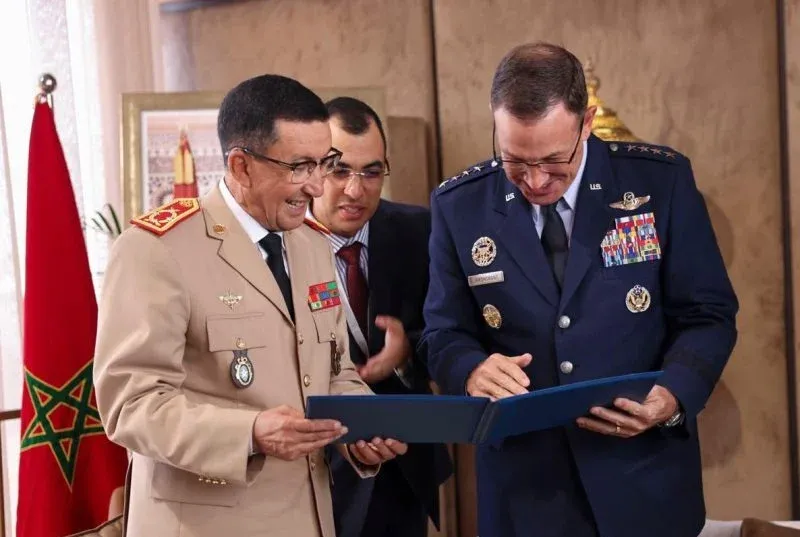

In a significant milestone for military cooperation, two F-35 jets, which are not part of the Moroccan Air Force's fleet, flew over Moroccan airspace for the first time this week, accompanied by Moroccan F-16s. This momentous occasion was highlighted by General John D. Lamontagne, the U.S. Air Force Vice Chief of Staff, who emphasized that the United States is selective about who gets to operate in proximity to the advanced F-35 aircraft. During an exclusive interview with Hespress English, General Lamontagne stated, "Not just anyone gets to fly close proximity to an F-35," showcasing the importance of trust and interoperability between the U.S. and Moroccan air forces.
General Lamontagne, the highest-ranking U.S. officer present at the Marrakech Air Show, noted that his previous visit to Morocco was two decades ago, and he expressed admiration for the training standards of Moroccan F-16 pilots, which align closely with U.S. tactics and procedures. He remarked, "We’re already interoperable," calling the flyover a testament to the growing confidence and collaboration between the two nations' air forces. The U.S. Air Force is also learning valuable lessons from Morocco in terms of operating effectively in diverse and challenging environments, as Moroccan crews have demonstrated their proficiency in flying from various locations.
Morocco's strategic geographical position and its open policies regarding U.S. military operations have been acknowledged by General Lamontagne, who praised the Kingdom's generous access for overflights and basing. The annual African Lion exercise, which involves multiple nations, exemplifies the strong partnership that has developed. Recently, U.S. Africa Command expanded its collaboration with Morocco by adding Tan-Tan as a site for an Africa Multidomain Training and Experimentation Center, a decision that reflects the significance of Morocco in U.S. military strategy in Africa.
The historical ties between the United States and Morocco, dating back to 1777 when Morocco became the first nation to recognize the U.S., were underscored by General Lamontagne. He shared photographs of U.S. air forces operating from Casablanca during World War II, illustrating a long-standing relationship built on trust and mutual respect. While acknowledging Morocco's sovereignty, he clarified that the U.S. is not seeking to establish military bases in the country, despite the changing dynamics in European military cooperation.
Speculation regarding Morocco's potential role as a strategic alternative for U.S. military operations has arisen due to recent challenges faced in Spain and Portugal. General Lamontagne indicated that Morocco remains a viable option for U.S. forces, recalling its historical significance during World War II. The relationship between the U.S. and Morocco is not merely transactional; it encompasses a broader commitment to stability in Africa. General Lamontagne highlighted Morocco's significant contributions to peacekeeping missions and its role as a leading "exporter of security" on the continent, as evidenced by the training of thousands of African officers each year.
As Morocco continues to modernize its military capabilities, including potential acquisitions of F-35s, the partnership with the United States is set to deepen, positioning Morocco as a key player in regional security and defense cooperation.
As reported by en.hespress.com.