
Transformative Design Inspired by Nature
The design of Villa Butterfly, conceived by Moroccan architect Mohamed Amine Siana, draws its essence from the fleeting beauty of a butterfly swarm. While this natural phenomenon was not part of the initial project brief, it became a pivotal source of inspiration as Siana and his client explored the site in the outskirts of Marrakech. "As soon as we saw them, we were immediately inspired," Siana reveals in an interview with SceneHome. This spontaneous moment of inspiration was not just a passing thought; it translated into a profound architectural narrative that mirrors the life cycle of the butterfly—from the coziness of a cocoon to the expansiveness of flight.
The architectural philosophy behind Villa Butterfly is deeply rooted in Siana's early career explorations, where he began to investigate how architecture could harmoniously interact with its environment while utilizing minimal resources. After completing his studies at the National School of Architecture in Rabat in 2004, Siana co-founded a shared studio with two fellow architects, enabling them to collaborate on larger projects while nurturing their individual practices. Their significant breakthrough came when they secured the design competition for the Polydisciplinary Faculty of Taroudant, which allowed them to immerse themselves in the rich cultural and geographical tapestry of southern Morocco, fostering a design approach that emphasized passive strategies and local materials.
Architectural Harmony and Cultural Sensitivity
At first glance, Villa Butterfly presents a façade that is both modest and unassuming. Its exterior, crafted from earth-based materials such as straw, natural pigments, and local soil, reflects a conscious decision to embrace the traditional Moroccan architectural ethos, where privacy is paramount. Siana notes, "Modesty is very important in our culture," highlighting how historical medinas showcased uniform exteriors that concealed the richness within. This thoughtful design choice allows the villa to blend seamlessly into its environment while providing a sanctuary for its inhabitants.
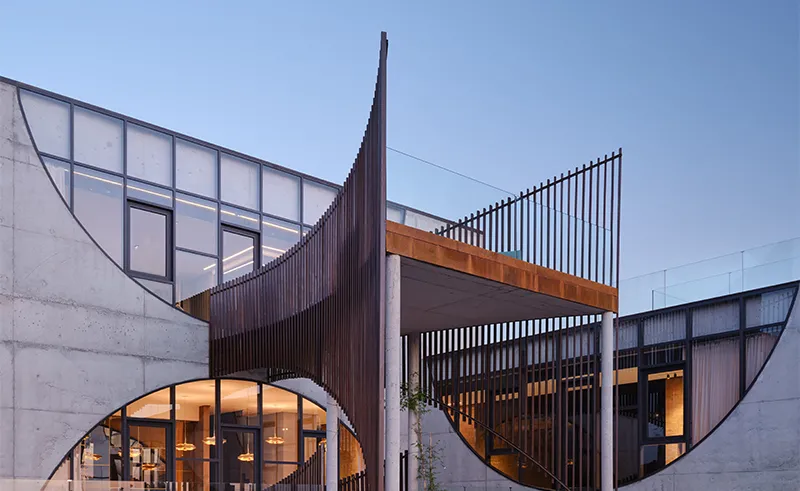
As one moves beyond the villa's protective shell, heavy steel arches act as a dramatic transition into the expansive living spaces, offering breathtaking views of the golf course and the majestic Atlas Mountains. These arches, reimagined from traditional Moroccan designs, are elongated to create a sense of grandeur, measuring approximately nine meters wide and three meters high. Siana explains, "We wanted to redraw the butterfly's life cycle through architecture," emphasizing the journey from intimacy to openness, akin to a butterfly's emergence from its chrysalis. This metaphorical journey culminates at the master suite's terrace, where one can truly experience a feeling of liberation as they gaze toward the Atlas Mountains.
Inside Villa Butterfly, the use of familiar Moroccan materials is both innovative and refreshing. While zellige—a traditional Moroccan tile—adorns various areas of the villa, Siana opts for a simplified color palette rather than intricate patterns. Bright yellow tiles encircle the swimming pool, while bold red and blue accentuate the children's bathrooms. The use of natural, earth-toned zellige further emphasizes the craftsmanship without overwhelming the overall aesthetic. Siana articulates this philosophy succinctly: "We wanted the presence of zellige without making the spaces feel heavy. This is a holiday home where people should be able to relax, so we chose simplicity rather than excessive decoration."
The same design ethos extends to Siana's selection of contemporary materials, which harmoniously coexist with handcrafted surfaces. The villa features exposed concrete, corten steel, terrazzo made from crushed local stone, and locally sourced timber, creating a natural dialogue between the past and the present. Siana insists, "We couldn't combine earth with materials that felt artificial; the dialogue between the traditional and the contemporary had to feel natural and sincere." This seamless integration continues within the interiors, where Siana collaborated with Roche Bobois to curate furniture that endows each room with its distinct character, allowing the villa to unfold as a sequence of diverse experiences rather than a monotonous interior.
Ultimately, Siana’s vision for Villa Butterfly transcends mere aesthetics; it strives to foster a deep connection with the surrounding environment. He asserts, "When we create a project that tells a story, and people can feel that story when they are there, while respecting local architecture, materials, and climate, we allow Moroccan architecture to continue evolving." Thus, Villa Butterfly stands as a testament to the transformative power of architecture, illustrating a journey from enclosure to openness that resonates with both its natural inspirations and cultural heritage.
As reported by cairoscene.com.