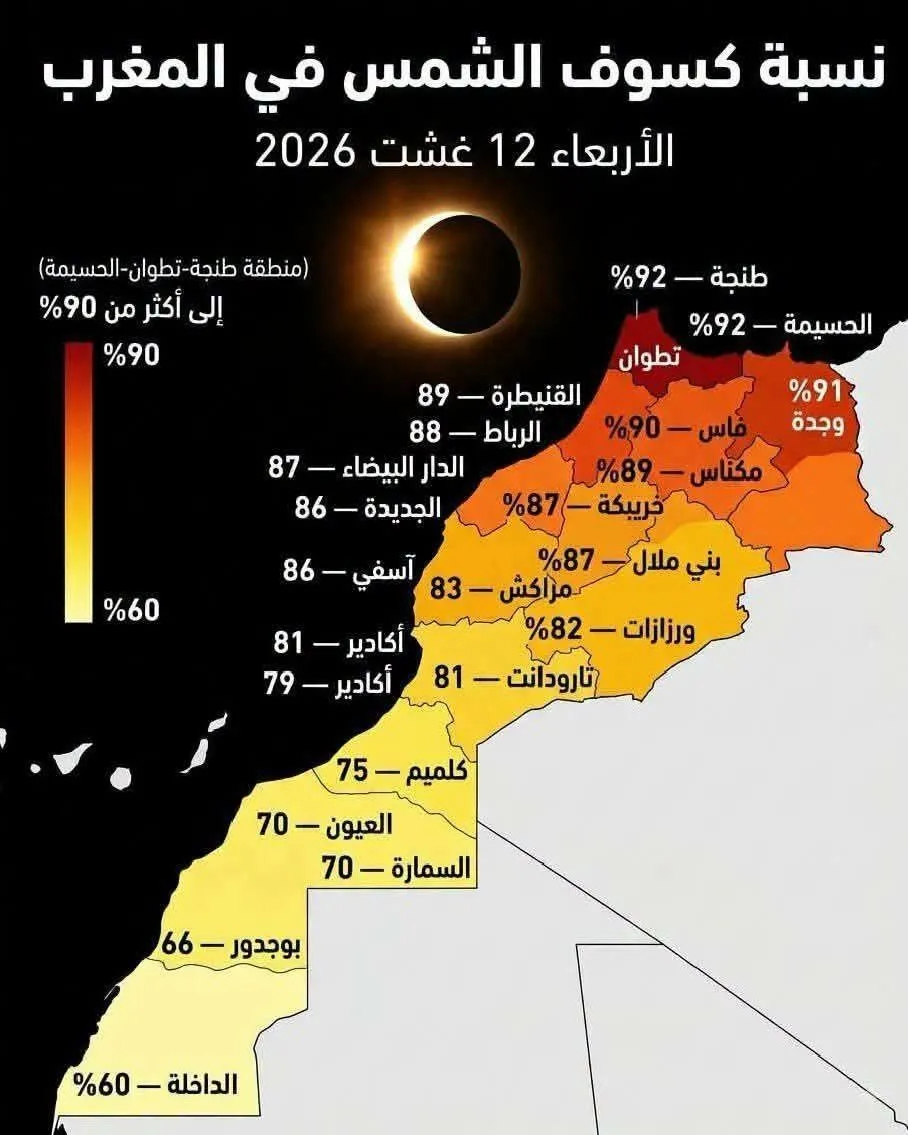

Understanding the Solar Eclipse in Morocco
On August 12, 2026, Morocco will witness a fascinating astronomical event—a partial solar eclipse due to the alignment of the Sun, Moon, and Earth. While a total solar eclipse will be visible in certain parts of the world, including the Arctic and Spain, Morocco will experience a partial eclipse with varying degrees of obscuration. In the northern regions of the country, the Sun will be obscured by nearly 93%, whereas in Dakhla, the obscuration will be around 60%.
This celestial phenomenon occurs when the Moon passes between the Earth and the Sun, resulting in the Moon's shadow being cast on the Earth's surface. The region in which the total eclipse can be observed is known as the path of totality, which will cross several key locations around the globe, including parts of Greenland and Iceland, before concluding above the Mediterranean Sea.
Details of the Eclipse's Visibility Across Morocco
In Morocco, cities like Nador will enjoy the highest percentage of solar obscuration at approximately 92.9%, closely followed by Tangier, Tetouan, and Al Hoceima, where around 92% of the Sun will be obscured. Other cities will experience slightly lower rates, with Fes at about 89.5%, Rabat at 88%, Casablanca at 87%, Marrakech at 83%, Agadir at 79%, Laâyoune at 70%, and Dakhla at 60%.
The eclipse will begin at varying local times between 6:44 PM and 7:06 PM, reaching its peak around 7:40 PM to 8:00 PM, and concluding by approximately 7:58 PM to 8:39 PM. It is essential for observers to be situated in locations where the western horizon is unobstructed to fully enjoy the event.
Moreover, safety precautions are paramount when observing the eclipse, as direct viewing of the Sun can cause irreversible eye damage. It is highly recommended to use specially designed eclipse glasses, available through various organizations in Morocco, to safely enjoy this spectacular astronomical event.
As reported by maroc-hebdo.com.