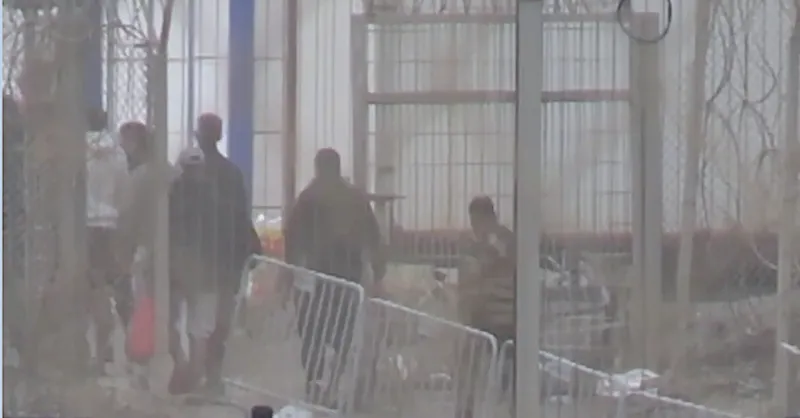

The recent trend of hundreds of Moroccan citizens choosing to voluntarily return to Morocco rather than enter the CATE of Tarajal and undergo identification has emerged as a notable aspect of the evacuation of settlements along the Benítez and Trampolín beaches. During the initial phase of the operation at El Trampolín, police sources indicated that approximately 1,200 Moroccan citizens opted to return to their homeland, making voluntary repatriation one of the primary outcomes of this operation.
Several factors may explain why these individuals prefer to return to Morocco after spending over two months in Ceuta. Analysts and police sources suggest various reasons, which may not apply uniformly to every case.
The Fear of Identification
The most apparent explanation, according to consulted sources, revolves around the fear of police registration. Individuals transferred from Trampolín are taken to the vicinity of the CATE at Tarajal, where they are given the option to enter the identification and reception circuit or to return voluntarily to Morocco. Analysts point out that for some migrants, the identification process could lead to administrative repercussions they wish to avoid. Once documented, their situation becomes official, which could link any subsequent procedures for repatriation, expulsion, or entry bans to their identity.
The structure of the operation itself confirms that there is a choice between these two alternatives, as the Moroccans transferred could either opt for registration and stay in the designated resources or voluntarily return to Morocco.
Reasons for Voluntary Return
Additionally, police sources suggest that among those declining registration, there may be individuals with prior issues with either Spanish or Moroccan authorities, including those with criminal records, expulsion cases, or previous administrative problems. For such individuals, being identified again could be particularly disadvantageous. However, analysts caution that one cannot conclude that those returning voluntarily are necessarily criminals or have prior convictions, as individual identification and police checks would be required to determine such status.
Another explanation relates to the consequences of potential deportation or expulsion. Some migrants may believe that as long as they remain unidentified, they retain the possibility of attempting to enter Spain again in the future. Conversely, once they are registered, any administrative resolution banning their entry could complicate future irregular attempts. Police sources note that awareness of the implications of being registered might be directly influencing the decision to return to Morocco at this time.
Furthermore, some analysts speculate that certain Moroccan citizens still in the settlements might be waiting for an opportunity to continue their journey to the Spanish mainland. Entering the CATE system would alter this scenario, as identification would subject them to relevant administrative procedures and resources specifically established for the migration emergency. For those aiming to reach the mainland, returning to Morocco might ironically seem like a preferable option to being identified and remaining in Ceuta without a clear path to continue their journey.
Many Moroccan citizens are also aware that their chances of obtaining international protection are minimal when their claims are solely based on economic or labor reasons. Thus, some who returned voluntarily did so knowing they could not access international protection. Many immigrants do not wish to be registered due to fears that their asylum requests might be rejected, particularly in cases where Moroccan nationals cite economic or labor-related justifications. For this demographic, remaining in Ceuta could prolong a state of uncertainty without any clear prospects for regularization.
Lastly, there is a possibility that among those who entered Ceuta, some individuals may have prior or current ties to Moroccan security forces or military. If confirmed, this could explain why certain people are particularly keen to avoid identification by Spanish authorities. However, this possibility cannot be generalized to all Moroccans returning home, as there is not enough evidence to assert that returnees are affiliated with Moroccan security forces or military. Any such cases would need to be substantiated through appropriate police and judicial verification.
The pattern observed at El Trampolín largely mirrors the behavior seen days earlier at Benítez beach. During that operation, many Moroccans also chose to return to their homeland instead of entering the registration circuit. This recurring pattern reinforces the notion that registration is a decisive factor in understanding why many Moroccan citizens voluntarily leave Ceuta when evacuated from settlements. For researchers and police officials, registration provides essential information about who these individuals are and their circumstances. Conversely, for many migrants themselves, identification appears to be the crucial point they wish to avoid.
As reported by ceutaahora.com.