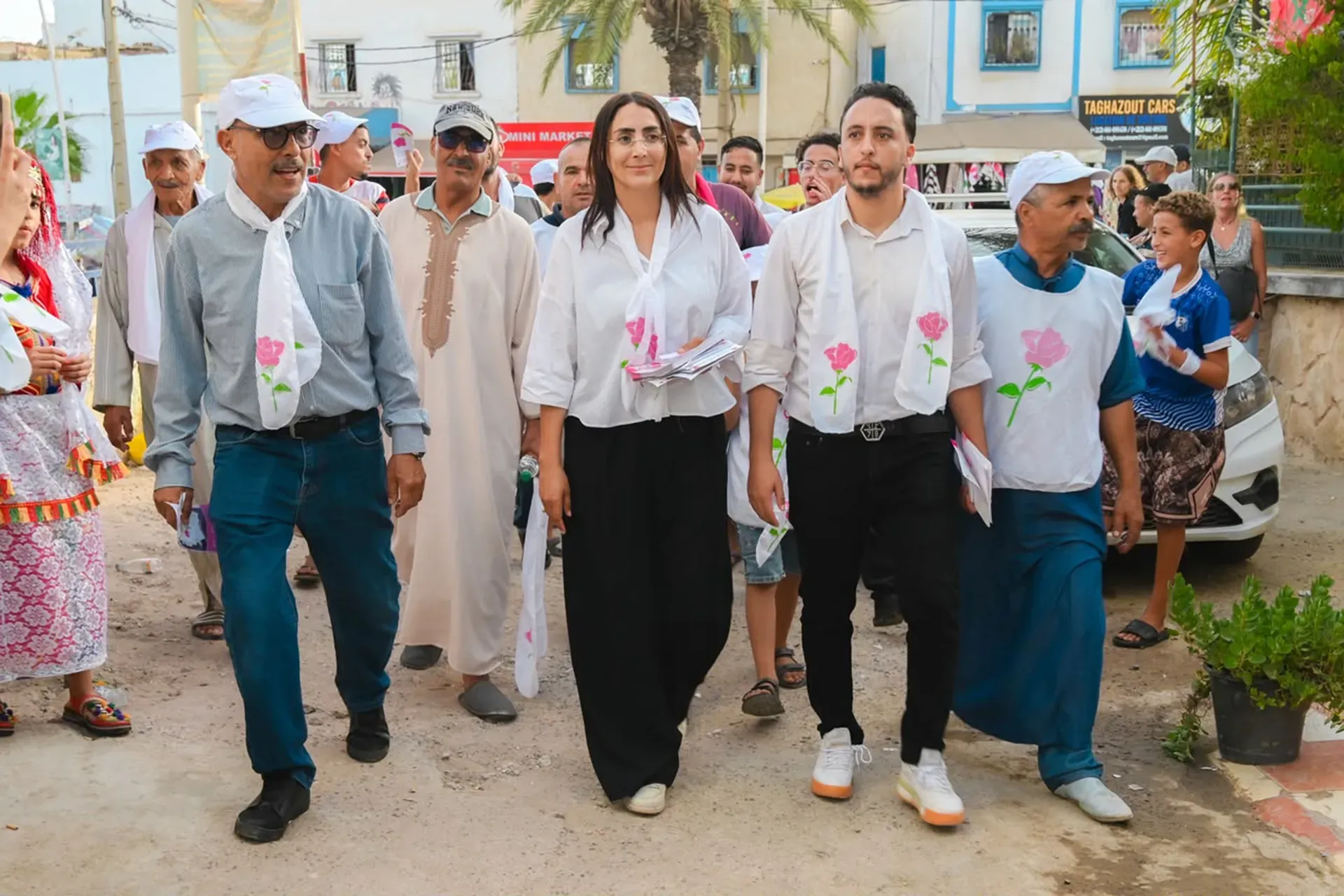

In the highlands of the rural commune of Tehlouante, located in the Essaouira region, candidate Ahmed Ahrachane is actively campaigning for the upcoming legislative elections set for September 23. Dressed in a white jacket adorned with the emblem of the "Hope" party, this thirty-something individual is determined to traverse the vast expanse of his electoral district in his personal vehicle, reaching out to the farthest corners of the community.
For those observing his movements, the scene may appear straightforward, with the chances of securing a seat remaining uncertain. However, he is shifting part of the electoral campaign away from the usual urban platforms and bright lights, bringing it closer to the everyday questions faced by the populace.
Ahmed states to Al Jazeera that he is the only young candidate heading an electoral list in his district, taking on seasoned opponents without any previous seat or electoral experience. His mission is to "instill hope in citizens, especially the youth, for the much-needed change." Official data indicates that the age group between 18 to 24 represents only 4% of the registered voters (approximately 15.8 million), while those aged between 25 and 34 comprise 15%. Notably, individuals aged 60 and above account for over 29% of the electorate.
In this legislative race, 27 parties are competing for 395 seats, with a total of 1,850 candidacy lists featuring 7,288 nominations, averaging more than 18 nominations per seat. Local districts include 1,615 lists with 5,505 candidates.
Empowering Youth in Elections
The electoral framework in Morocco is striving to enhance youth participation through financial support mechanisms for nomination lists that include candidates aged 35 and under. The new regulations stipulate that the financial aid for each seat won by a young candidate in local electoral districts is increased sixfold compared to the amount allocated for other nominations. Despite these incentives, the presence of youth at the forefront of electoral lists remains limited, as observed through candidate testimonies and insights from academics who spoke with Al Jazeera. Although there are no official statistics detailing the youth representation among candidates, many testimonials converge on the notion that their visibility is still constrained, despite the financial mechanisms established by the electoral system.
Political science professor Abdel Hafid El Younsi attributes this gap between incentives and actual representation to broader challenges related to the prerequisites for candidacy. He notes that the presence of youth in local party lists remains weak, even with the financial incentives provided by the regulatory law governing the election of members to the House of Representatives. This observation is echoed in the lists of independent candidates, where youth representation is nearly nonexistent due to what El Younsi describes as "daunting" requirements, including specific numbers and ratios of voter signatures needed to submit a candidacy.
Throughout the Essaouira region, Ahrachane aims to connect with residents in various areas, reflecting on his campaign experience which revealed that "the population yearns for change," despite acknowledging that challenges persist. The Essaouira region comprises 57 rural communes, each with its unique conditions and needs. During his campaign, Ahmed identified the urgent necessity for expanding access to clean drinking water, enhancing healthcare services, and supporting community work. He sees his candidacy as part of the broader need to "youthen the electoral work."
In a parallel narrative, Rajaa Miso, a candidate from the Socialist Union of Popular Forces in the Agadir-Ida Ou Tanane district, emphasizes that her candidacy is not coincidental but rather the culmination of a continuous struggle and a solid organizational dynamic within her party, involving associative and youth work, leading to her current responsibilities in various party and elected institutions. She highlights the challenges faced by youth, including the dominance of local elites and business figures, the high costs of electoral campaigns, and a political culture that often prioritizes seniority and field experience.
Challenges and Aspirations
The discourse surrounding young candidates extends beyond their candidacies to the very essence of the electoral programs and the ways these reach young voters. According to higher education professor Hassan Boulaasir, issues such as youth empowerment and reforms in health and education sectors rank at the top of priority lists in electoral programs. He distinguishes between party approaches that tackle these issues from an investment perspective and those that emphasize social justice and the protection of public services. The implementation of these programs is linked to "democratizing public services" and ensuring "accountability in governance," warning against reducing commitments to mere non-binding statements.
Concerns about purchasing power, rising living costs, and employment issues also dominate the electoral discussions among the youth, alongside the pressing need to listen to their voices. Zakaria, a 29-year-old employee and university student from Settat, underscores his priorities, placing purchasing power and the cost of living at the forefront of his expectations, advocating for greater support for farmers and food security.
Rajaa Miso aims to overcome these obstacles by engaging directly with voters, utilizing social media platforms to disseminate her electoral program and connect with the youth while organizing dialogue sessions in neighborhoods to directly address their demands. She emphasizes the importance of treating youth as "decision-makers capable of enacting change from within institutions," rather than merely as a bloc of voters.
In addition to these candidates seeking trust, young voters exhibit diverse perspectives as expressed in their statements to Al Jazeera. In Al Haouz, trader Ibrahim, aged 22, mentions that his electoral documents are ready, yet he has not decided whom to vote for. He expresses uncertainty, questioning, "Who should I trust?" His hesitance reflects a broader concern about candidates who are not from the region, with some list representatives lacking a local presence.
Conversely, Abdel Ilah, a 35-year-old entrepreneur from Taroudant, considers the elections a "pivotal moment in Morocco's democratic journey," viewing it as an opportunity to correct the course. More optimistically, Wiam, a 21-year-old student from Nador, expresses her anticipation for tangible changes in the daily lives of young people as a result of these elections. These individual testimonies do not encapsulate a unified youth stance on elections; instead, they reveal a spectrum of relationships between young voters and the electoral process.
Since the presence of young candidates on lists does not automatically translate to young voters supporting them, and wavering in party choice does not necessarily equate to a rejection of participation, the stance on elections is influenced by various factors ranging from proximity to candidates, the substance of programs, and the level of trust in institutions, as noted by Boulaasir. Likewise, Ahrab urges voters to choose based on competence and integrity, contributing to the fight against unacceptable behaviors that may taint the electoral process.
As voting day approaches in Essaouira and other regions, the ballots will determine who ascends to the parliament. However, financial incentives alone are insufficient to shape the political presence of youth. The interplay of campaign costs, party structures, candidacy requirements, and local power dynamics will continue to influence the ability of young individuals to penetrate political institutions, contingent upon their positions within political organizations and their capacity to establish trust with voters.
As reported by aljazeera.net.