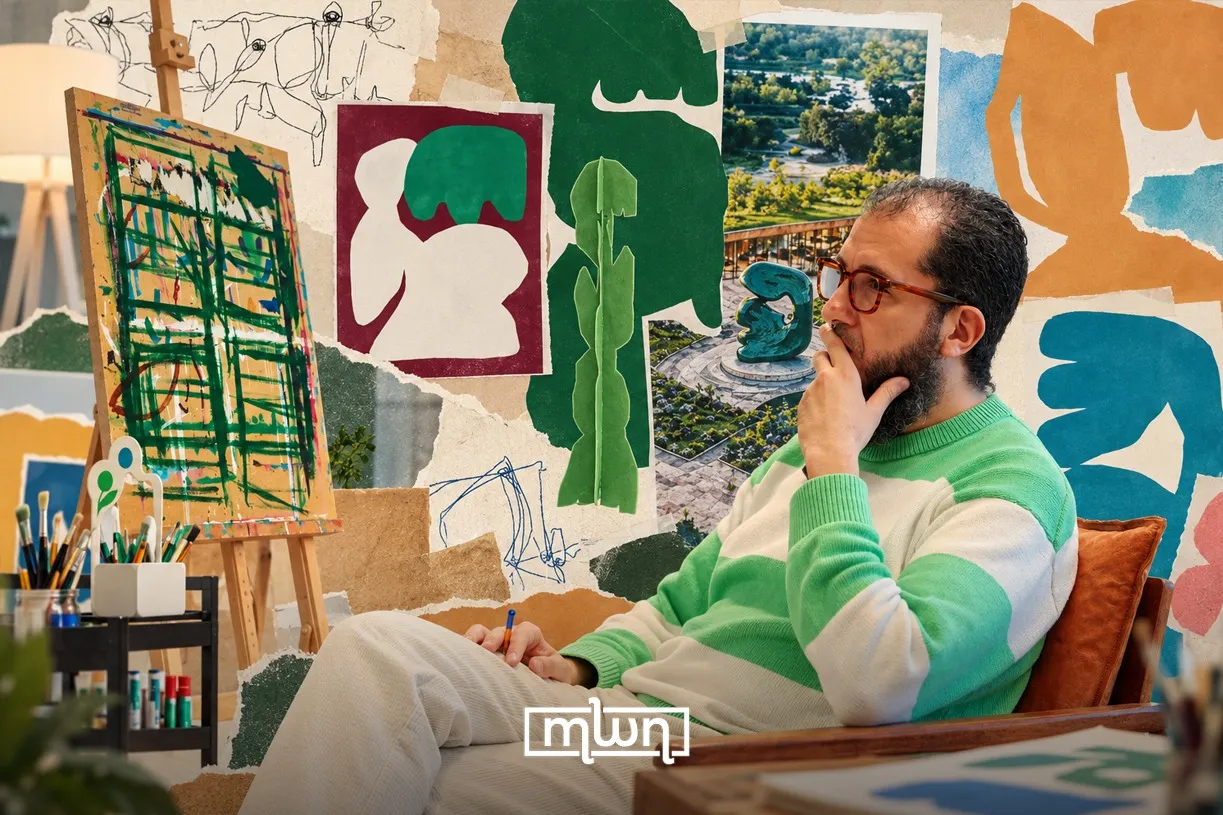
In the vibrant city of Casablanca, Morocco, the journey of Moroccan-Dutch artist Hakim El Amrani unfolds as a fascinating narrative of cultural fusion and artistic exploration. Raised in Amsterdam but deeply connected to his roots in Marrakech, El Amrani is the visionary founder of Studio NousNous, a studio based in the Netherlands that focuses on art, interior architecture, landscape, and urban design. Through his unique approach, he seeks to intertwine nature, spirituality, and the environments people occupy, driven by a profound inquiry into what unites individuals from diverse backgrounds and beliefs.
El Amrani’s exploration of commonality begins with a fundamental connection to nature. "You can have all kinds of people, different colors, young, old, backgrounds, beliefs, religions," he articulated in an interview with Morocco World News. "But believe me, for everyone, grass is simply grass and a tree is a tree." This belief has been a guiding light for him, prompting a deeper investigation into how nature serves as a unifying force among humanity.
Connecting Through Nature: A Shared Reality
His fascination with nature as a common ground has significantly influenced his artistic and design philosophy, especially as he reconciles his Muslim faith with his creative ambitions. After completing his studies in spatial design at the Willem de Kooning Academy in Rotterdam, El Amrani interned at an architecture firm, which focused on a variety of projects, including bars. This experience left him feeling uneasy, as he questioned whether such work genuinely served the community. Consequently, he sought a design philosophy that was both “unifying and timeless,” with nature as its cornerstone. His readings on nature-inspired design revealed numerous references to natural elements within the Quran, including vivid depictions of Paradise, leading him to reflect on the universal human connection to nature.
In his exploration, El Amrani invokes the Islamic concept of “fitra,” which he describes as an innate human nature that everyone shares, despite the diverse ways people may express it. This intrinsic connection to nature, he posits, explains why individuals, regardless of their religious beliefs or understanding of human origins, feel an affinity for the natural world. He believes that Allah created nature as humanity’s original home, and this belief provides a foundation for mutual understanding amidst differing perspectives on existence.
Founded in 2019, Studio NousNous—meaning “half and half” in Moroccan Arabic—reflects El Amrani’s dual heritage and his studio's commitment to integrating the essence of the natural world into interior spaces. The studio specializes in biophilic design, a concept that emphasizes the relationship between people and nature within built environments. El Amrani articulates that their work is grounded in two essential pillars: raising awareness and innovative design solutions.
A Multifaceted Approach to Artistic Expression
Through various engagements, including public lectures and presentations, El Amrani encourages audiences to rethink the significance of greenery in their lives, fostering a deeper understanding that translates into spatial, artistic, or object-related designs. His influential voice has resonated on international platforms such as TEDx and the Stedelijk Museum, catering to an eclectic clientele ranging from individuals desiring healthier living spaces to developers embarking on ambitious urban projects. Each endeavor begins with a fundamental question regarding how best to serve the clients, enhance well-being, and promote environmental health.
This holistic approach is evident in El Amrani's diverse body of work, which spans paintings, sculptures, murals, and architectural designs. He refers to the interconnectedness of these forms as the “green thread,” emphasizing that the transition to greener cities cannot be achieved through isolated practices but rather through an organic, integrative process. His signature motifs, such as the tulip representing the Netherlands and the palm tree symbolizing Marrakech, converge to form abstract compositions that invite viewers to engage with both nature and cultural identity. This duality resonates through his innovative “Zoom In and Zoom Out” technique, where the organic shapes evoke a universal connection to nature while revealing intricate details that celebrate personal heritage upon closer inspection.
El Amrani’s artistic contributions have gained recognition in various prestigious venues, including the Design Museum Den Bosch and the Dutch Embassy in Abu Dhabi, where his works are part of the national art collection. His recent project, a documentary titled The Nature of Art, chronicles his artistic journey and the individuals connected to his work across the Netherlands and the United Arab Emirates, challenging viewers to reflect on whether modern environments genuinely meet human needs or if society has simply become accustomed to spaces that no longer serve them.
Furthermore, El Amrani’s personal narrative intertwines with his professional pursuits, particularly influenced by the memory of his late father, Mohamed El Amrani. His father, a figure of kindness and practicality, instilled in him a unique perspective on creativity and problem-solving. Reflecting on childhood memories, El Amrani recalls how he would assist his father with electronic components, which sparked his imagination and led him to envision miniature cities crafted from small parts. This formative experience has profoundly shaped his artistic identity and commitment to meaningful design.
Ultimately, Hakim El Amrani’s journey as an artist is deeply rooted in gratitude, faith, and an earnest desire to enhance the lives of others. He perceives his creative talents not as personal possessions but as divine gifts, attributing his growth and success to the nurturing influence of his parents and the grace of Allah. His forthcoming ambition includes the design of a mosque, which he envisions as a sacred space, encapsulating his belief in the interconnectedness of humanity and the natural world.
As reported by moroccoworldnews.com.