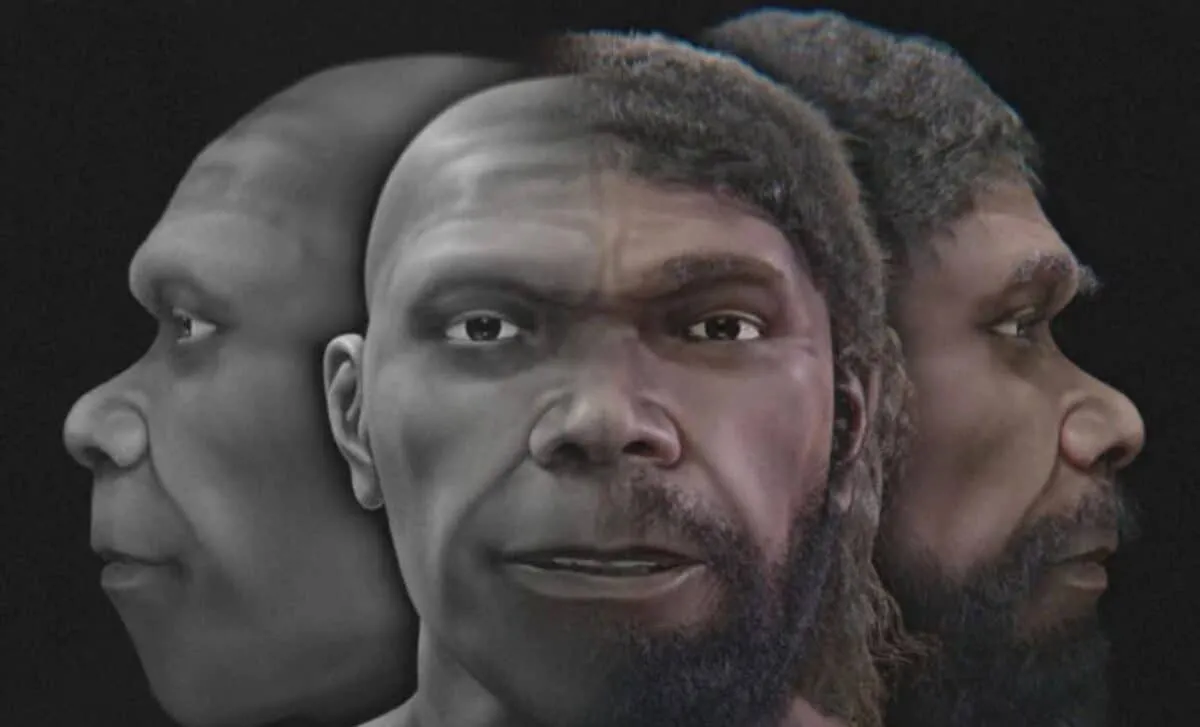
In a groundbreaking achievement, scientists have successfully reconstructed the face of an early Homo sapiens who lived approximately 315,000 years ago, utilizing ancient fossils discovered in Morocco. This remarkable endeavor reveals a surprisingly familiar visage featuring a strong jawline and pronounced facial characteristics, suggesting that our early ancestors may not have looked significantly different from people we encounter today. The fossils, unearthed at the historic site of Jebel Irhoud, have fundamentally altered the scientific community's understanding of human evolution. Initially, when the first skull was discovered in the 1960s, researchers were unaware of the true antiquity of the remains, which would later prove to be pivotal in tracing the origins of our species.
The face reconstruction was the brainchild of Brazilian 3D designer Cícero Moraes, who employed advanced digital technology to breathe life into these ancient bones. This innovative reconstruction provides a closer glimpse at what some of the earliest known members of Homo sapiens may have looked like, despite certain features being subject to artistic interpretation. The significance of the Jebel Irhoud find cannot be overstated; in 2017, studies confirmed these fossils as the oldest known remains of Homo sapiens, with ages estimated to be around 315,000 years, pushing back the timeline of human history by nearly 100,000 years.
The Skull That Redefined Human Origins
The journey began in the early 1960s when a miner at Jebel Irhoud stumbled upon a human skull. Initially, scientists assumed it belonged to an African Neanderthal, dating it to around 40,000 years ago. As researchers continued to excavate the site, they uncovered additional fossils and stone tools that gradually reshaped their understanding of the remains. The 2017 studies revealed that these early humans possessed relatively modern facial features, even though their braincases retained more primitive characteristics. This discovery highlighted the complex evolutionary process that led to the development of traits we associate with modern humans.
Bringing the Ancient Face to Life
Reconstructing the face of this ancient individual was no straightforward task, as the skull used in the project was derived from multiple individuals. Researchers at the Max Planck Institute for Evolutionary Anthropology had previously combined various fossil specimens into a digital model. The skull known as Irhoud 1 provided most of the upper facial structure and braincase, while the jaw and teeth were sourced from other remains found in the same archaeological layer. Moraes noted the impressive fit between these different pieces, stating, "The mandible and teeth, which belong to another individual, fit remarkably well." To create a lifelike model, the team utilized a CT scan of a modern adult's skull, digitally reshaping it to align with the ancient bones and adjusting the surrounding facial tissues accordingly. By employing advanced tools like Blender and OrtogOnBlender, they meticulously refined the model, ensuring it was proportionate and anatomically consistent.
The final reconstruction revealed a cranial cavity measuring 1,364 milliliters, closely matching earlier estimates. While this measurement provided valuable verification of the skull's proportions, it could not definitively confirm the exact appearance of the face. Yet, perhaps the most astonishing aspect of the reconstruction is how recognizable the resulting face appears to contemporary observers. As Moraes expressed, "He might go unnoticed in a crowd, but a closer look would reveal something that sets him apart from the rest – most notably his robust features and a projecting jaw." This realization evokes a profound connection to our distant ancestors, bridging the gap between past and present.
The study, published on dailygalaxy.com, produced two distinct versions of the reconstructed face. One rendition presents a grayscale version devoid of hair, while the other incorporates skin pigmentation, dark hair, and facial hair, resulting in a more lifelike representation. However, it is essential to note that the fossils do not provide definitive clues regarding the individual's skin or hair color, leaving some elements of the reconstruction open to interpretation. Moraes himself acknowledged that the colored version is more of an artistic representation, while the grayscale images focus on features substantiated by anatomical evidence. Ultimately, this reconstruction serves not only as a scientific achievement but also as a reminder of our shared evolutionary journey.