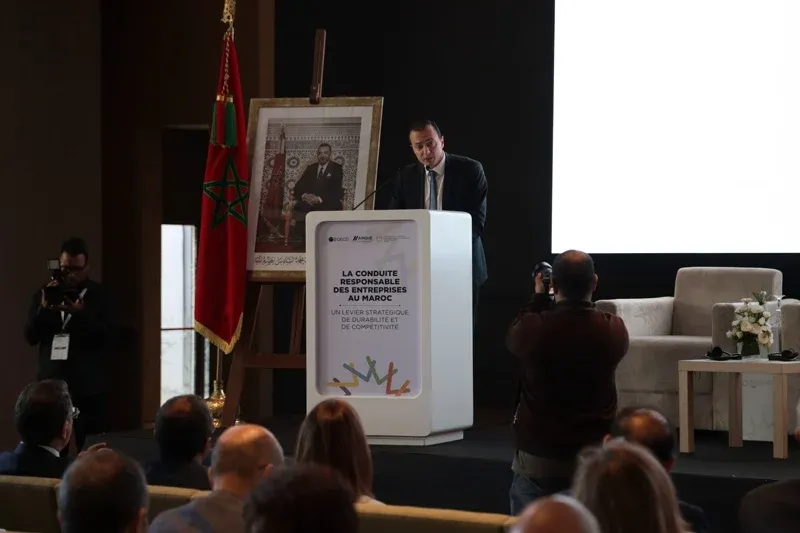
Ali Sadiqi, the Director General of the Moroccan Agency for Investment and Export Development (AMDIE), recently highlighted the rapidly evolving expectations of investors and business partners during a high-level seminar on responsible business conduct held in Rabat. He emphasized that transparency in practices, traceability, and adherence to international standards are increasingly influencing investment decisions and market access conditions. As a result, responsible behavior has become a tangible competitive advantage in today’s economic landscape.
Attracting Quality Investment
In linking this development to the strategic ambitions of the Kingdom, Sadiqi recalled the contents of the royal speech delivered to Parliament on October 9, which reaffirmed Morocco's goal of becoming a reliable and emerging economic power. He pointed out that attracting more foreign investments remains a fundamental objective; however, the quality of those investments holds equal importance. This quality is measured by the contributions they make to job creation, value addition, skill development, and integration into national industrial systems.
The direction of this approach is guided by the national contact point, headed and secretariat by AMDIE, which disseminates the guidelines set forth by the Organisation for Economic Co-operation and Development (OECD), promotes dialogue with stakeholders, and supports companies in their endeavors.
Furthermore, Sadiqi noted that the fiftieth anniversary of these principles, coinciding with Morocco's fifteen years of commitment to them, serves as an opportunity for evaluation and to define the next steps forward.
Global Standards and Market Demands
Meanwhile, Alain Jorgensen, Director of the Responsible Business Conduct Centre at the OECD, emphasized that the regional programme for the Middle East and North Africa, led by Morocco with support from Germany and Switzerland, has reached thousands of stakeholders and hundreds of decision-makers. He referenced the OECD's recent report, which assessed the top 10,000 publicly listed companies worldwide. According to the data presented by Jorgensen, 69% of large corporations, representing 95% of global market capitalization, have made clear commitments to responsible conduct, while 84% of member countries have enacted legislation mandating vigilance and transparency in supply chains.
In the Moroccan context, Jorgensen reminded the audience that four out of six agreements signed by Morocco since 2020 include provisions in this domain, most notably the African Continental Free Trade Area agreement. He cautioned that the challenges of practical implementation could deprive lagging companies of opportunities in sustainable markets. He also pointed out potential opportunities linked to international standards in sectors such as automotive, aviation, manufacturing, agriculture, renewable energy, and critical raw material supply chains.
Tarik Hattab, a representative from the National Agency for Strategic State Contributions and Monitoring the Performance of Public Institutions and Enterprises, explained that responsible behavior has transitioned over the past fifteen years from mere declarations and intentions to contractual conditions imposed by international markets, donors, and investors. He elaborated that companies are now required to provide tangible evidence of compliance with standards at all stages of production and supply chains.
In an international context marked by geopolitical tensions and rising protectionist sentiments, Hattab presented Morocco as a reliable partner that meets its commitments. He argued that responsible behavior is no longer merely a cost of entering markets; rather, it has become a criterion that influences partners' choices for Morocco in the reshaping of global value chains. He justified the central role of public institutions and enterprises in this initiative for two primary reasons: first, their direct service to citizens, which includes water, electricity, transportation, and infrastructure, where responsible behavior manifests through service quality, fair pricing, safety at worksites, and transparency in contracts. Secondly, they represent the major public buyers in the national economy, interacting with thousands of small and medium-sized enterprises, making their standards a national benchmark.
Hattab mentioned that the state's contributions policy has adopted an environmental, social, and institutional charter aligned with the principles of the OECD.
The seminar, taking place over two days on October 20 and 21, 2026, coincides with the fifteenth anniversary of the Moroccan national contact point and the fiftieth anniversary of the OECD's guidelines. During the event, five memorandums of understanding were signed between the agency and various organizations, including the National Integrity Authority, the National Agency for Strategic State Contributions, the General Confederation of Moroccan Enterprises, the Moroccan Association of Textile and Clothing Industry, and the National Federation of Food Industries.
As reported by hespress.com.