Concerns Over Moroccan Aquaculture Near Spanish Sovereignty
Situated a mere 700 meters from the Congress Island—one of the three islets of the Spanish archipelago known as the **Chafarinas Islands**—a series of marine cages dedicated to the farming of squid and bream have emerged from the waters. At first glance, this commercial aquaculture facility, owned by the Moroccan company **Mediterranean Aquafarm S.A.**, may appear to be just another fishing establishment in the Alboran Sea. However, it represents a crucial link in a strategic framework of hybrid warfare maneuvers and established facts aimed at undermining Spain's territorial integrity in North Africa. This situation raises significant concerns regarding national sovereignty and ecological safety in the region.
Back in November 2021, this Moroccan enterprise had already established 16 marine cages over an operational area of up to 62 hectares. The Spanish company **Morenot**, based in Amposta (Tarragona), supplied and installed these cages. On November 24 of that year, Spain's Ministry of Transport, Mobility, and Urban Agenda initiated actions against Morenot, informing them that they had 20 days to dismantle the cages installed without Spanish authorization, under the threat of potential penalties. While the outcome of this issue remains unclear, the cages are still intact.
When the aquaculture cages were installed near the Chafarinas Islands in 2021, Mørenot was a Norwegian group; as of 2023, it has been incorporated into the Icelandic business group **Hampiðjan Group**, which generates approximately 360 million euros annually.
Legal and Environmental Implications
The Spanish educational system primarily focuses on local geographical features, often at the expense of a broader understanding of national and international geography in an interconnected world. Located 3.3 nautical miles off the coast of **Cabo del Agua**, the Chafarinas Islands remain largely unknown, despite enjoying the legal status of Spanish sovereign territory. According to International Maritime Law, these islands are entitled to territorial waters extending up to 12 miles, or, alternatively, the median line with the Moroccan coastline. The establishment of fish farms just 700 meters from the archipelago represents a direct intrusion into Spanish sovereign waters.
This violation of Spanish sovereignty is compounded by a severe ecological threat that has not raised alarms among environmental organizations. The Chafarinas Islands are recognized as a **National Game Refuge and Special Conservation Area** within the Natura 2000 network, hosting highly vulnerable habitats and critically endangered species, such as the marine limpet _Patella ferruginea_. Continuous discharges of feed, aquaculture waste, and pharmaceutical treatments from the Moroccan fish farm, located perilously close to the islands, pose a grave risk to the delicate protected marine ecosystem.
The official diplomatic response from the Spanish government at the end of 2021 was limited to delivering a verbal protest note to the **Embassy of Morocco in Madrid**, denouncing the illegal occupation of maritime space and the violation of navigation safety regulations. However, after more than four years of complaints, the traditional diplomatic route has proven to be completely ineffective. The facilities remain operational and have even proposed expansions, taking advantage of the effective inaction. This situation has led to discontent among various political and military sectors regarding the perceived lack of transparency in managing this matter from the Ministry of Foreign Affairs, which has avoided escalating the bilateral dispute at the cost of national sovereignty. Particularly vocal in this issue have been **Fernando Gutiérrez Díaz de Otazu**, a PP deputy for Melilla, and **Yolanda Merelo**, a VOX senator for Ceuta.
One of the first to notice this Moroccan violation was General **Miguel Ángel Ballesteros**, former director of the National Security Department in the early cabinets of Pedro Sánchez. His analysis suggests that Moroccan actions are part of a comprehensive hybrid pressure strategy aimed at destabilizing Spanish and European presence in North Africa.
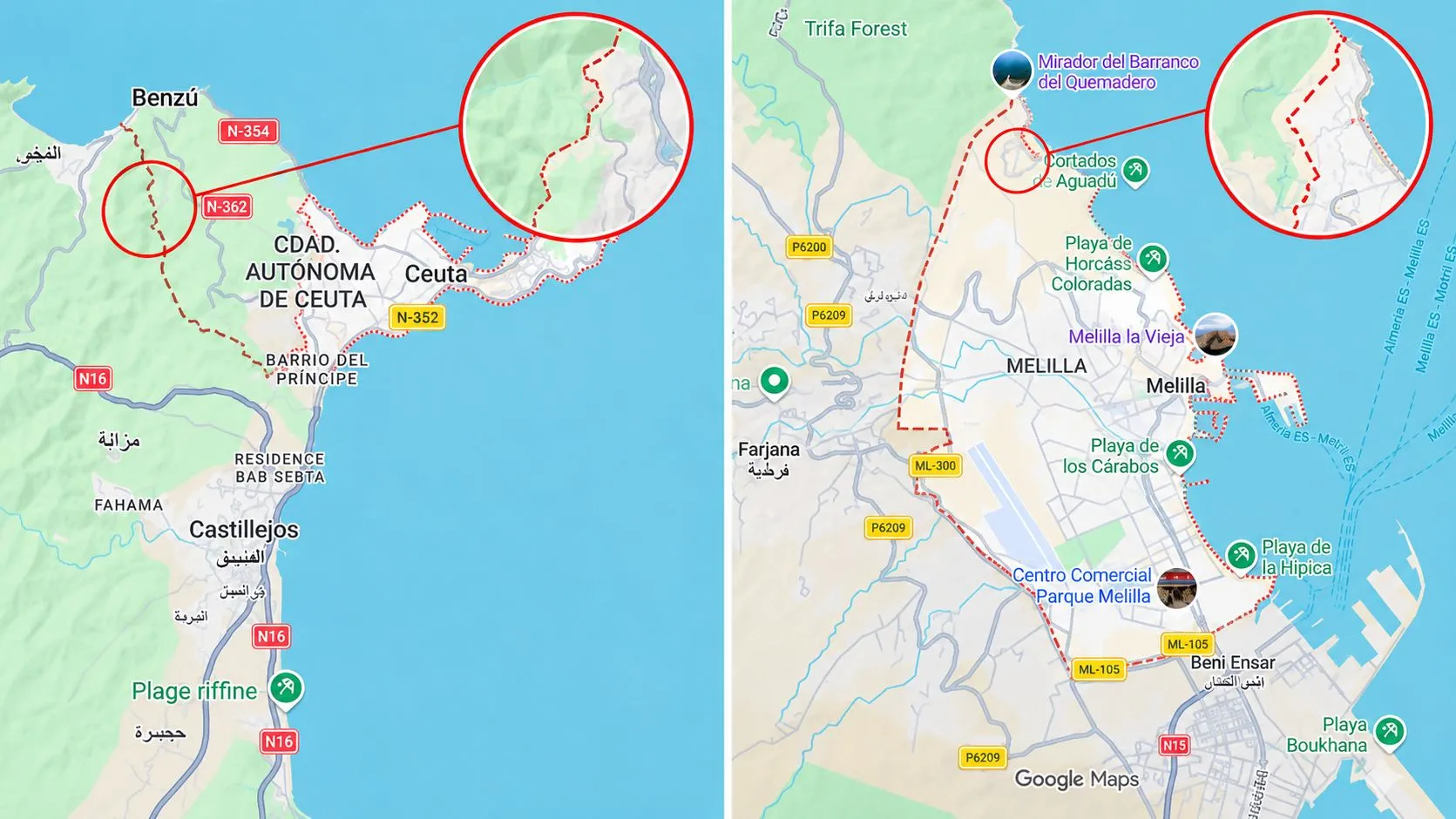
In agreement with Ballesteros's analysis, which I have had the opportunity to discuss recently, there are three coordinated strategies employed by Morocco. The first is the **gradual occupation of territorial waters**. By imposing non-military facts on the ground, such as marine farms or the unilateral delimitation of exclusive economic zones, Morocco seeks to compel Spain to accept de facto sovereignty over these waters. The second strategy involves economic and commercial strangulation, particularly through the unilateral closure of the historic customs of **Melilla** and systematic blockades and delays at the commercial customs in Ceuta. The final strategy is deterrence and demographic change through persistent migration pressure, delegitimizing Spanish institutional management before international bodies, and dynamics of sociocultural Moroccanization.
Beyond the invasion of Ceuta on July 30 and 31, Morocco's next target for its ambitions will likely be the Canary Islands. To dismiss the situation surrounding the Chafarinas Islands as merely a triad of islets with only a handful of soldiers stationed there would be akin to a naive interpretation reminiscent of **Chamberlain** in the lead-up to **World War II**. The case of the illegal fish farm at Chafarinas highlights the limitations of Spain's reactive diplomacy toward Morocco. The absence of a robust response and the retreat before the policy of facts on the ground establishes another dangerous precedent.
If Spain and the European Union do not solidify a firm stance in defending their external and insular borders, the geopolitical landscape of the western Mediterranean will continue to tilt towards a slow but steady erosion of national sovereignty.
As reported by eldebate.com.