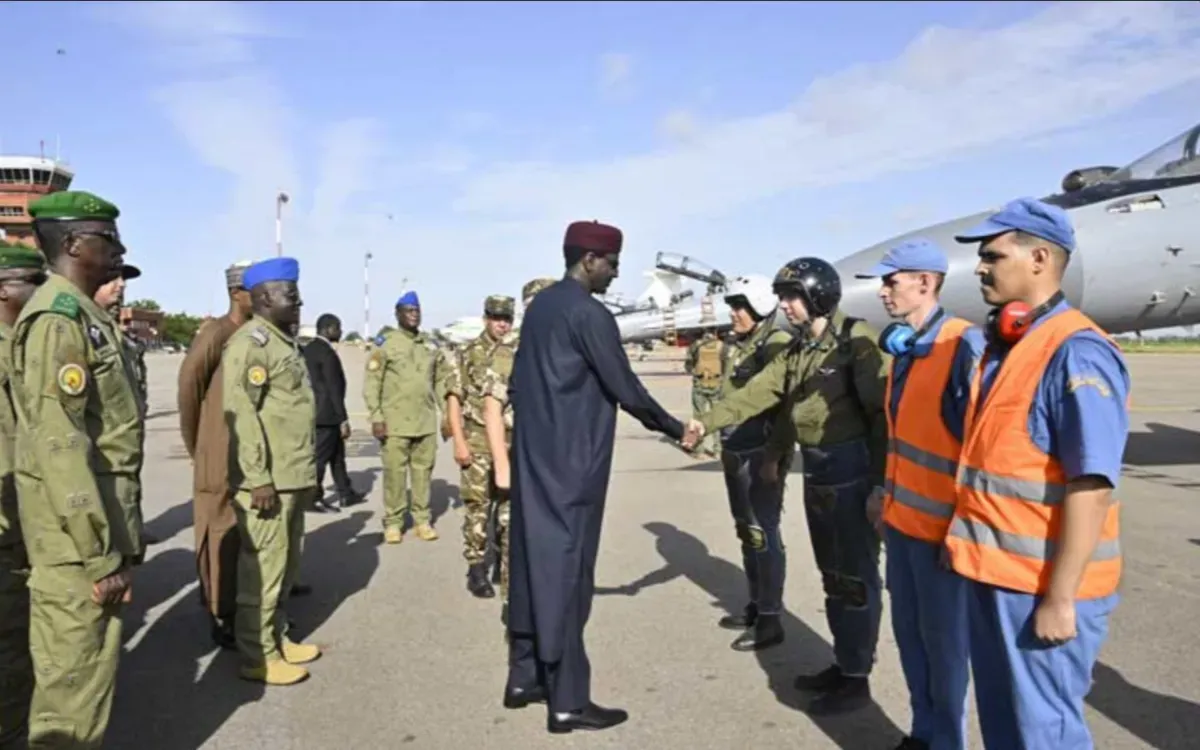

In a significant departure from its traditionally cautious military stance, Algeria has deployed four Su-30 fighter jets to Niger, signaling a new phase in its approach to regional security and influence in the Sahel. This strategic maneuver comes at a time when Algeria is keen on reclaiming the influence it has lost in the region, particularly in light of Morocco's growing assertiveness.
On August 30, four Algerian Sukhoi Su-30 combat aircraft, accompanied by an Ilyushin Il-76 military transport plane and an Il-78 refueling aircraft, made their way to Niamey. This deployment marks a pivotal shift in Algeria's military doctrine, as it actively engages beyond its borders. The Algerian Ministry of Defense, in an official statement, explained that the deployment was made at the request of Niger's authorities to provide "support" to the Nigerien military amidst recent instability attempts.
Interestingly, when the Algerian jets arrived, the mutinous military forces had already been defeated, hence the Su-30s did not participate in any combat. However, the highly visible nature of this deployment, coupled with the organized communication surrounding it, signifies that this operation extends far beyond mere military assistance. The Nigerien News Agency praised Algerian President Abdelmadjid Tebboune's historic decision and the exceptional deployment of Algerian aircraft in Niamey, underscoring the operation's importance.
For Algeria, this move is primarily about demonstrating its capacity to intervene directly outside its borders when it perceives its regional interests to be threatened. The context of this deployment is critical, as Morocco has been making inroads in the Sahel, particularly in Mali, where relations between Algeria and Mali have become increasingly strained. In April 2025, tensions escalated to the point where Bamako, Niamey, and Ouagadougou recalled their ambassadors from Algeria following the destruction of a Malian drone by the Algerian military.
The dynamics of influence in the Sahel are shifting. Morocco has been actively building relationships with Sahelian countries, including military cooperation, where Malian soldiers have received training in Morocco. In contrast, Algeria is seeking to re-establish its foothold in the region, with Niger serving as its most accessible partner within the Sahel States Alliance. The stakes involved extend beyond military matters; Algeria is also keen on advancing the trans-Saharan gas pipeline project that aims to connect Nigeria to its own territory through Niger. This initiative faces competition from Morocco's Atlantic Africa gas pipeline project with Nigeria.
Therefore, the stability of Niger is of strategic importance to Algeria. Security expert Akram Kharief suggests that the gas interests likely influenced Algeria's swift decision to support Nigerien authorities following the destabilization attempts. However, this military demonstration raises questions regarding constitutional adherence in Algeria. The 2020 constitutional revision opened the door for external interventions, legally breaking from decades of non-interventionist policy, allowing the president to deploy the National People's Army abroad after obtaining a two-thirds majority approval from both chambers of Parliament.
Nevertheless, according to reports, Algerian lawmakers were not consulted prior to the Su-30’s deployment to Niger, although a post-facto approval could still be sought. Thus, this operation serves multiple signals: to Niamey, it shows Algeria's readiness to defend its new partners; in the Sahel, it reflects Algeria’s determination to reclaim lost ground; and against Morocco, it highlights that the rivalry for influence between the two neighbors is now extending beyond diplomatic and economic arenas, as Algeria is willing to directly leverage its military capabilities.
As reported by bladi.net.