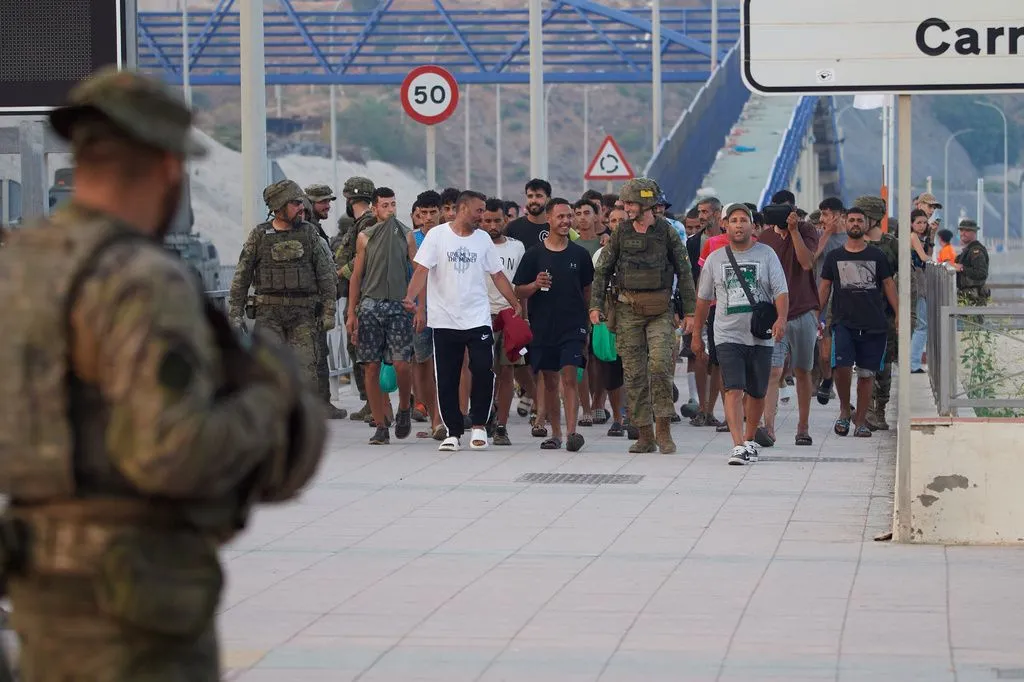

The recent surge of migrants into Ceuta has once again thrust this unique border into the spotlight, highlighting the ongoing and complex historical conflict between Morocco and Spain. Located on the North African coast, directly across from southern Spain via the Strait of Gibraltar, Ceuta, along with Melilla, forms the only land borders between the European Union and Africa. Both cities are integral parts of Spain, where residents participate in national elections, utilize the euro, and possess European passports. However, Morocco disputes Spanish sovereignty over these territories, referring to Ceuta as ‘Sebta’ and Melilla as ‘Melilia’, categorizing them as occupied Moroccan land.
This territorial contention is rooted in contrasting interpretations of history. Ceuta was captured by Portugal in 1415 before it came under Spanish rule, whereas Melilla was taken by Spain in 1497. The Spanish government asserts that these cities have been under Spanish control for centuries, predating Morocco's independence in 1956. Conversely, Morocco views Spain's claim as a remnant of colonialism, asserting that the country’s relinquishment of its protectorate in northern Morocco was incomplete as it retained control over various territories, including Ceuta and Melilla, as well as smaller military outposts along the Moroccan coastline, such as the Chafarinas Islands and the Peñón de Vélez de la Gomera.
The Peñón de Vélez de la Gomera, a small fortified position that has been under continuous Spanish control since 1564, exemplifies the tensions surrounding these territorial disputes. Similarly, Perejil Island, known in Morocco as Leila Island, nearly sparked a military confrontation in 2002 when Moroccan personnel landed and hoisted their flag, prompting a swift response from Spain's special forces to reclaim the island without casualties. Although the standoff lasted only a few days, it underscored how these small territories serve as potent symbols of national pride and sovereignty.
The most significant territorial contention between the two nations, however, lies in Western Sahara. Spain's colonial rule over this territory began in the late 19th century. As colonial authority waned, Morocco asserted claims to Western Sahara based on historical ties, while the Polisario Front sought an independent Sahrawi state. In 1975, the International Court of Justice acknowledged that some Sahrawi tribes had historical affiliations with Morocco but affirmed their right to self-determination. This led to King Hassan II's mobilization of the Green March, involving approximately 350,000 Moroccans into the territory, after which Spain withdrew as it transitioned to a new political era.
Currently, Morocco controls most of Western Sahara, while the Polisario Front, backed by Algeria, continues to advocate for independence. A ceasefire supported by the United Nations was established in 1991, intended to pave the way for a referendum that has yet to materialize due to disagreements over participant eligibility and the independence option. Morocco's proposal for autonomy under its sovereignty is at odds with the Polisario Front's insistence on maintaining full independence as a viable option. Moroccan officials claim that nearly 120 countries support their autonomy proposal, though these endorsements vary significantly and do not universally equate to recognition of Moroccan sovereignty.
The complex relationship between Morocco and Spain has been tested by various crises. A notable incident occurred in 2021 when Spain clandestinely admitted Polisario Front leader Brahim Ghali for medical treatment, prompting a furious response from Morocco that resulted in around 8,000 migrants entering Ceuta following relaxed border controls. Spain reacted by deploying military personnel and accused Morocco of leveraging migration as a tool for diplomatic pressure. Relations only improved after Spain aligned its position closer to Morocco's stance on Western Sahara in 2022.
Large-scale crossings into Ceuta and Melilla are not unprecedented; migrants have historically attempted to breach border fences, swim around barriers, or exploit periods of diminished enforcement. These attempts have led to security challenges and have occasionally escalated diplomatic tensions between the two nations. The relationship is characterized by a cycle of cooperation, pressure, and reconciliation, as both countries recognize the necessity of collaboration amid unresolved territorial disputes.
As the 2030 FIFA World Cup approaches, which will be jointly hosted by Morocco, Spain, and Portugal, the complexities of their relationship will likely become even more pronounced. Teams and supporters will traverse the same Strait of Gibraltar that has long divided Morocco and Spain, all while navigating the backdrop of contested cities and ongoing migration challenges.
As reported by i24news.tv.