The management of the migration crisis in Ceuta has come under intense scrutiny, with significant criticism directed at Prime Minister Pedro Sánchez from his coalition partners. Progressive factions within the Spanish political landscape argue that the government must immediately abandon its "policy of appeasement" toward Morocco, which they claim is directly responsible for the increased pressure at the border observed in late July. They demand that the government expedite the transfer of individuals detained in the autonomous city to the mainland, even if this results in potential tensions with the European Union. This criticism also extends to the Popular Party (PP) and Vox, with accusations of inciting racism and fostering violent behavior, particularly concerning the destruction of makeshift camps created by migrants on Ceuta's beaches.
These concerns were not presented as isolated grievances; rather, they formed a comprehensive critique during the first parliamentary session after the summer break, where multiple speakers outlined a coordinated disapproval of the government's handling of the situation. Enrique Santiago, leader of Izquierda Unida and deputy spokesperson for Sumar, initiated the dialogue by stating that the government had acted "too late" by relying heavily on "voluntary returns" as a solution. This approach has been deemed absurd, given that the thousands of individuals still present in Ceuta lack a safe place to return. Aina Vidal, also from Sumar, echoed these sentiments, asserting that "too many lines have been crossed" in a crisis that is "brutal" and cannot be managed in isolation by the autonomous city.
Both Santiago and Vidal emphasized the urgent need to alleviate the situation by redistributing adults and minors to the mainland, calling on the PSOE to take decisive action regarding the adults. However, Sánchez has maintained that no transfers will occur until all necessary paperwork has been processed, challenging the PP to stop yielding to Vox's demands and to accept their fair share of responsibility for the reception of unaccompanied minors. Members of Sumar expressed disappointment that Sánchez's address failed to provide the necessary solutions, especially given that Ceuta has effectively become the "backyard" of Brussels due to the externalization of borders and the decision to keep migrants in new reception centers until the immigration services determine their individual futures. This has fostered a sense of "loss of control" and a perception that the government has arrived at the crisis "too late and poorly," a sentiment shared by Néstor Rego (BNG) and Águeda Micó (Compromís). Mertxe Aizpurua (EH Bildu) criticized Sánchez for not adequately addressing a threefold crisis—humanitarian, social, and diplomatic—that remains unresolved a month later.
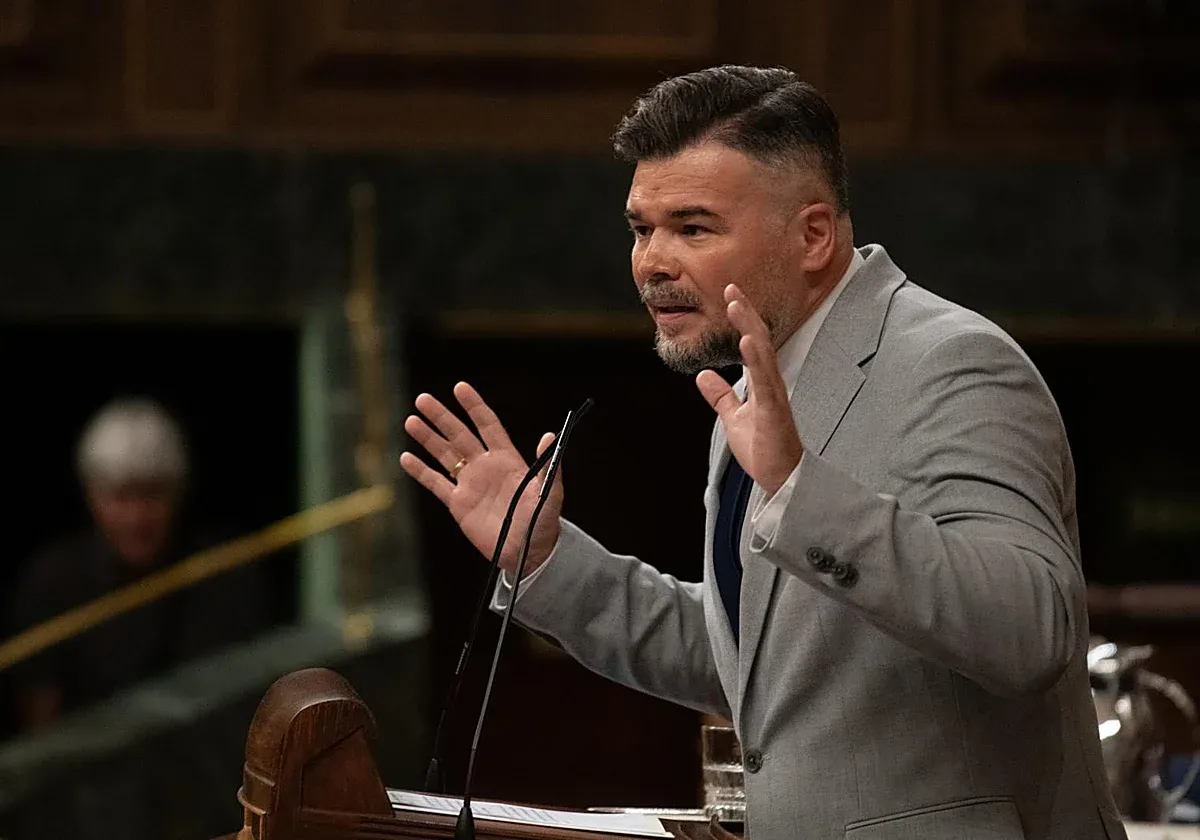
However, the diagnosis of government paralysis ventured further into the geopolitical realm. Following calls for rapid action to assist and protect migrants "regardless of their identity," Esquerra Republicana spokesperson Gabriel Rufián highlighted Sánchez's "timid" response to Morocco. He found it perplexing that the government has taken a low-profile stance, especially after reports indicating that Moroccan agents facilitated mass entries in late July, a move he described as a deliberate attempt by Morocco to undermine the Spanish government with assistance from Washington, Israel, and the far-right.
Rufián asserted that the PSOE's lack of transparency in its dealings with Morocco could have dire consequences for the government, arguing that "governments do not fall due to mistakes, but rather due to lies." This perspective was echoed by Podemos Secretary General Ione Belarra, who drew parallels between the current situation and the PP's narrative management after the 11-M attacks. Belarra condemned Morocco as a "totalitarian regime" and criticized the president for his "capitulation" to Mohammed VI in pursuit of geopolitical interests, insisting that the government should sever diplomatic ties with Morocco until it ceases using people as mere pawns. Aizpurua reiterated that "no one is naive enough" to believe the migrant entries were spontaneous, calling on the president to "recalibrate" his stance toward Rabat and amend his approach to the Sahara.
In addition to direct criticism aimed at the Prime Minister, coalition partners united to denounce the positions taken by the PP and Vox. They unanimously agreed that both Alberto Núñez Feijóo and Santiago Abascal are exploiting the Ceuta crisis "irresponsibly" for their political gain while promoting "racist" slogans. The spokespeople reprimanded the PP for its lack of patriotism in "fanning the flames of Vox for a few votes," highlighting the irony that the same parties now invoking national sovereignty previously supported the externalization of border control to Morocco.
The repeated use of the term "invasion" by the PP and Vox became a focal point for criticism. Aina Vidal did not hesitate to label opposition groups as a "band of arsonists and purveyors of hate," arguing that describing vulnerable individuals as "soldiers or invaders" is a deliberate tactic to dehumanize them and justify illegal measures such as mass returns without due process. Gabriel Rufián echoed this sentiment, ironically noting that those who now promote militaristic rhetoric are the same individuals who sought extensions to avoid military service, warning of the dangerous social consequences this type of discourse can have when it resonates in the streets. Ione Belarra added that "people in flip-flops sleeping on the beach are not a threat."
The coalition partners also focused their speeches on the PP-controlled regions' obstruction of the territorial distribution of unaccompanied minors. Enrique Santiago dismissed the proposed solutions from the PP and Vox for Ceuta as a "lie"—specifically their suggestion to return all migrants at once—and accused the regional government in Ceuta, led by the popular Juan Jesús Vivas, of delaying the allocation of reception spaces to the detriment of social cohesion. Ione Belarra characterized the opposition's stance as part of an "explicit racism" that conflates national security with xenophobia, concluding that "Feijóo and Abascal care about Ceuta and its people exactly as much as Mohammed VI cares about Moroccan citizens."
As reported by elcorreo.com.