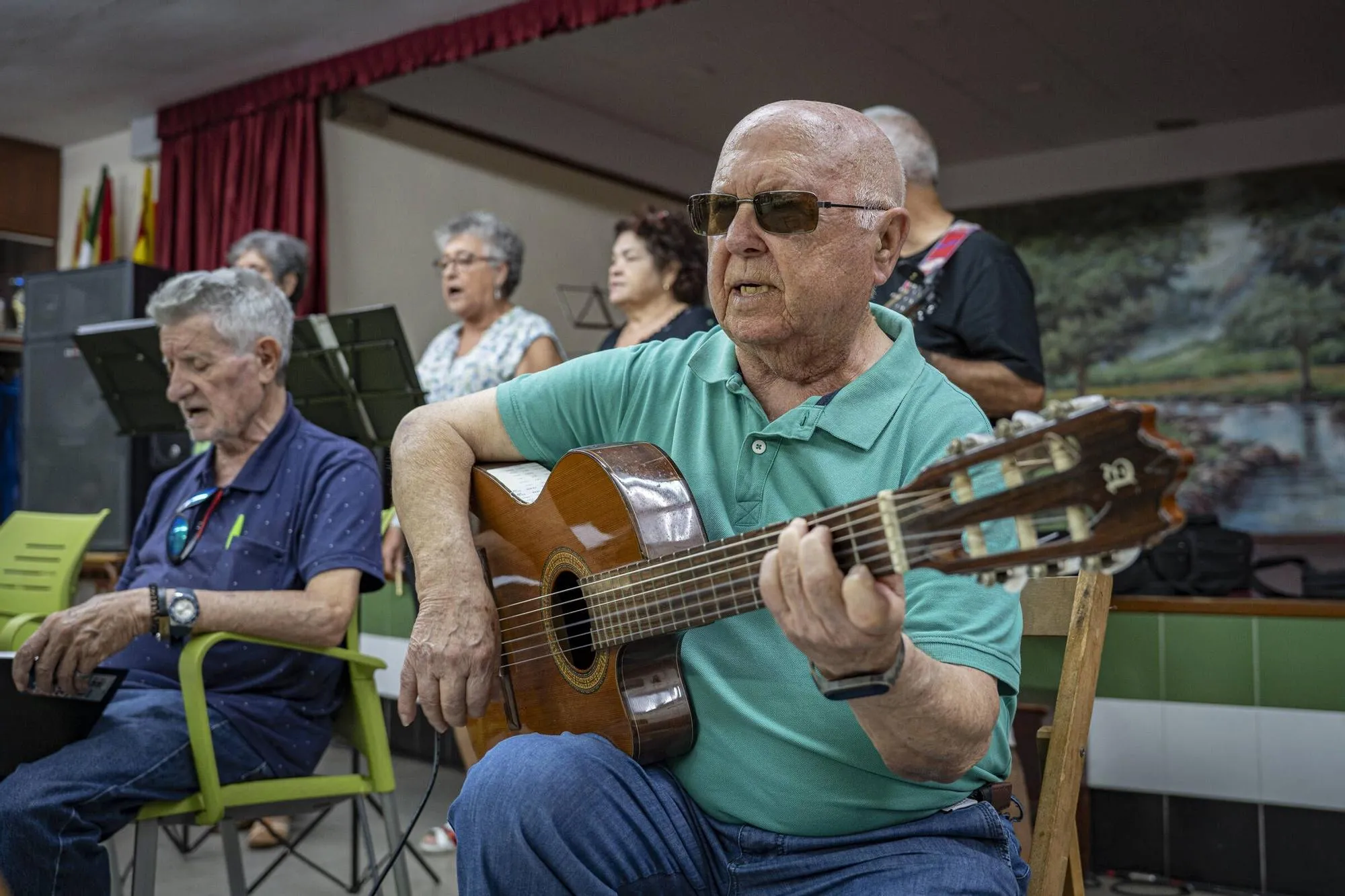

As the clock strikes 6:30 PM on September 10th, the members of the **Unión Extremeña de L’Hospitalet** gather for a rehearsal at their headquarters. With less than 24 hours until their performance at the Bellvitge neighborhood festivities, the group prepares to sing **seven songs**, including local favorites like ‘La jota de Bellvitge’ and ‘La uva’, which pays homage to the beauty of the **girls from Olivenza**, a town in the Badajoz province. However, on this particular Thursday, only six members are present for the rehearsal. Although attendance is expected to increase on Friday, the end of summer vacations and family obligations have hindered wider participation from the group members.
Andrés del Barco, the president of the Unión, reminisces about the past when the organization boasted nearly **400 members**. Nowadays, the number has dwindled to around 70 to 80, most of whom are either retired or approaching retirement. Tragically, the organization recently mourned the loss of two of its members. Andrés, who hails from Mirabel in Extremadura, moved to Catalunya at the age of 24, a transition that was often dictated by circumstance. He recalls, “We were tenants. But the sixties were a disaster. They brought meat and grain from outside. You worked tirelessly, yet you were not compensated.”
Initially settling in Can Vidalet in Esplugues, Andrés shared a room with three or four others. After his sister’s marriage, he moved in with her in the Pubilla Cases neighborhood and later with his wife to Bellvitge. As they embraced their new life in Catalunya while longing for the land they left behind, individuals from Extremadura and Andalusia, among others, founded associations to preserve their ancestral traditions. The Unión Extremeña de L’Hospitalet was established in 1991 following a split from an earlier organization and initially resided in Can Serra before relocating to Bellvitge.
The Legacy of Migration
It is well-known that the working-class neighborhoods of Barcelona and its metropolitan area became the primary destinations for the massive waves of migration that swept into Catalunya during the latter half of the 20th century. Beyond fostering a network of associations or addressing community needs, many newcomers contributed to the very construction of these neighborhoods, either through self-built homes or by working as laborers in housing developments. Areas such as **Gavarra and Ciudad Satélite** (later renamed **Sant Ildefons**) in Cornellà, **Torre Baró** in Barcelona, **Bellvitge** in L’Hospitalet, and **Casablanca** and **Ciutat Cooperativa** in Sant Boi are just a few examples of this phenomenon.
The Catalan government plans to hold the **Diada** events in Extremadura in 2026, which were previously hosted in Madrid, as part of an initiative to strengthen ties with regions that have significantly shaped contemporary Catalunya. Manuel Guerrero, president of the **Federation of Extremaduran Associations in Catalunya** (FEAC), expressed gratitude for this decision during an event on **Extremadura Day** at the Saló de Cent in the **Barcelona City Hall** on September 9th. “We recognize the significance of this event in Extremadura as a tribute to those of us who once left our homeland in search of a better future for ourselves and our families,” Guerrero stated, a resident of Sant Boi. He further added, “I am convinced that those of us who feel as Catalan as we do Extremaduran—or as Extremaduran as we do Catalan—are extremely pleased with this decision.”
The Changing Landscape of Identity
According to the latest data from **Idescat**, Catalunya was home to **98,000 individuals born in Extremadura** as of 2025. This figure represents a significant decline from **175,000** in **1986**. Between 1940 and 1991, approximately 26,000 Extremaduran people settled in Barcelona alone, while census data from 1991 indicated around 13,000 in L’Hospitalet de Llobregat and about 6,000 in Sant Boi. Despite the efforts of various regional associations in the 70s, 80s, and 90s to promote distinct national identities, the generational shift has diluted these affiliations, particularly among those who have spent most of their lives in Catalunya. Many younger individuals, whether they feel a connection to their grandparents’ homeland or not, tend to prioritize other pursuits over cultural heritage.
Even though these organizations continue to organize activities that extend beyond traditional Extremaduran culture—having hosted a cycling club and a futsal team, among others—Andrés del Barco notes that “the youth no longer engage.” He warns, “Several entities have already disappeared, and more will follow.”
**Joaquín Chica**, president of the **Cultural Recreational Center of Extremadura 'La Segarra' in Cornellà**, describes his organization as “the only” non-federated Extremaduran entity in Catalunya. Founded in 1987, it originally did not carry the Extremaduran label, which was added in 1994 following a decision by the predominantly Extremaduran members. “We function more as a neighborhood association, organizing cultural and sports activities while ensuring the neighborhood remains orderly,” explains Chica. While the center promotes Extremaduran culture, he admits that “the enthusiasm for Extremadura is waning.”
Chica emphasizes that his son’s continued involvement in the association stems not from a love for popular culture but from a sentimental attachment to the organization. He reflects on the challenges faced by previous generations, drawing parallels between the current influx of Ecuadorian migrants seeking work and the experiences of his own parents, who moved from Málaga to Cornellà. He highlights the persistent issues of **housing precariousness and the increasing trend of renting rooms** in many neighborhoods, noting that what was once a migration from other areas of Spain is now a global phenomenon. Of the **8.1 million inhabitants in Catalunya in 2025**, approximately 1.1 million hailed from other Spanish communities, while another two million were of foreign origin.
As reported by elperiodico.com.