
From Marathon Dreams to Desert Adventures
In the late 1980s, the vibrant, colorfully dressed joggers who appeared in a small town in southern Morocco near the Sahara seemed like aliens to local teen Lahcen Ahansal. While he was fascinated by these runners, he couldn't help but wonder why they traveled such a distance to do what he considered an everyday activity: traversing long distances on foot under the blazing sun. These athletes were participants in the 'Marathon des Sables', an extreme endurance race that remains one of the most renowned marathons in the world. Covering approximately 250 kilometers over several days, competitors must carry their own supplies and water through the vast desert, much like Lahcen did during his own treks.
At 17 or 18 years old, Lahcen was convinced he could also conquer this challenge, though he initially neglected to gather any gear, training, or even a race number. When the starting gun fired for the first stage, he simply joined the group, and the organizers initially thought nothing of it—until Lahcen approached the finish line and had to be stopped to allow a registered runner to win the stage. This unexpected moment marked the beginning of a remarkable athletic career for Lahcen. French organizer Patrick Bauer recognized his potential, and by the 1990s, Lahcen had won the Marathon des Sables ten times, earning him the status of a national hero in Morocco.
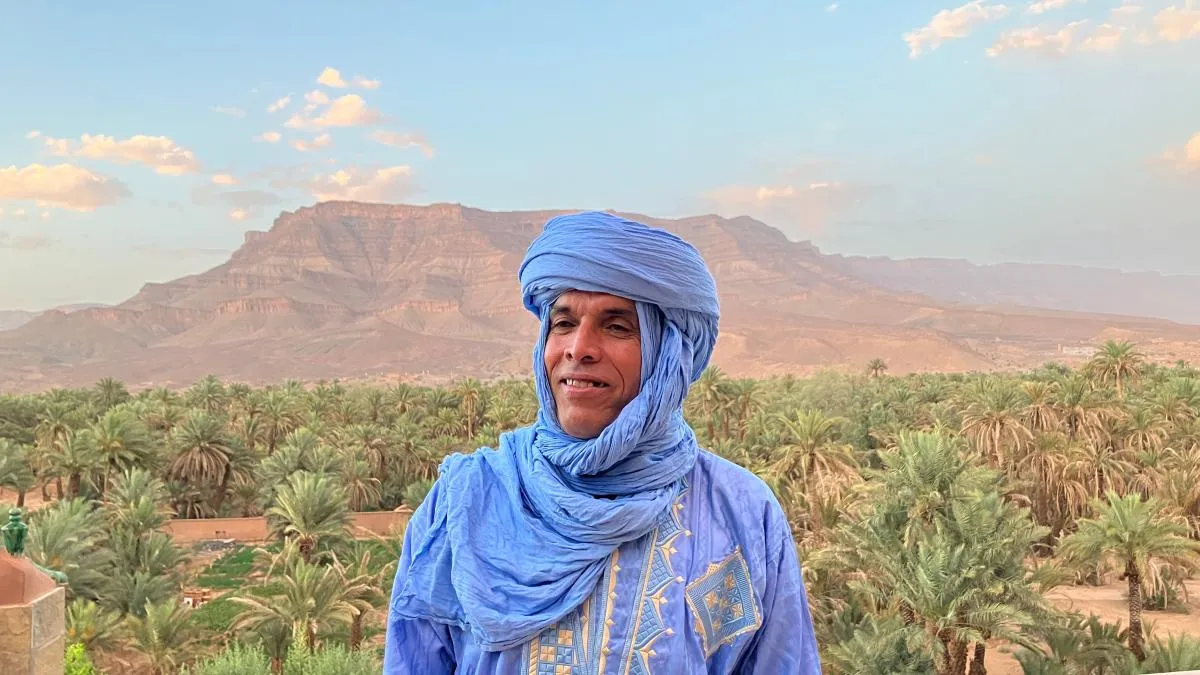
Now at the age of 55, Lahcen has participated in numerous prestigious races around the globe and achieved many top placements. However, the Marathon des Sables continues to hold a special place in his heart. In recent years, he has guided blind athletes safely through the desert and has even inspired his younger brother, Mohamad Ahansal, who has followed in his footsteps and won the extreme race multiple times.
Experiencing the Wonders of the Sahara
Lahcen has remained loyal to his hometown of Zagora, Morocco, where he still resides at the 'Gateway to the Sahara'. Historically, this town was the launching point for grand camel caravans, as indicated by a historic sign on the outskirts that reads, '52 Days to Timbuktu'. Today, this arduous journey is no longer undertaken, as even the slowest extreme runners cover shorter distances. However, tourists can still experience the Sahara through shorter tours or day trips, whether by traditional camel caravan or via comfortable jeeps.
The breathtaking scenery is sure to leave visitors in awe. The vastness of the desert, the towering dunes, the sunny skies by day, and the starlit nights create a spectacular backdrop. Riding a swaying camel over the crests of the dunes is a fantastic experience, enhanced by the guides who know the best spots for sunset photography, ensuring that those back home can share in the adventure. As stories of the desert are shared around the campfire later in the evening, it feels like an adventure from the tales of 'One Thousand and One Nights'. Fortunately, this journey does not involve running shoes or stage goals, as the return to 'civilization' quickly highlights the challenges of desert racing.
Traveling through the desert requires neither tents nor provisions, as southern Morocco is no longer a blank spot on the tourist map. The region boasts modern city hotels, bungalow resorts, and charming accommodations within historic buildings. After a meal, one can stroll through the bustling city market or take a leisurely walk through the Palmeraie, the expansive palm garden on the edge of the oases. The towns and attractions along the Draa River resemble a string of pearls, with not all being famous, but detours from the main road often prove worthwhile, especially on market days.
The weekly markets defy the oriental stereotype of artfully arranged fruit pyramids and spice mountains; they are loud, dusty, and can be quite pungent near the goats. Traditional souvenirs are often hard to find, but these markets provide a glimpse into authentic Moroccan rural life. For many residents, tourist groups at the Tansifte weekly market appear almost as alien as the joggers did to young Lahcen Ahansal.
In Ouarzazate, running plays a minor role, where amidst the Moroccan desert, a Tibetan monastery stands beside an Egyptian temple, and just a few meters away, a medieval tavern seems as if the innkeeper just stepped out for market supplies. Yet, those hoping for a cool respite within the thick stone walls will be disappointed; the rocks are made of fiberglass, the Buddha statues are crafted from foam, and the sarcophagus lid can be moved with one hand. We find ourselves in the Atlas Film Studios in Ouarzazate, where numerous blockbusters have been produced since the 1980s.
It is the light, the landscape, and the people that have made the Ouarzazate area a popular filming location, as tourist guide Abderrazak Ait el Kharaz explains. The region features a mix of desert, mountains, steppes, and historical sites, with generally favorable weather and clear air facilitating filming. Schools for mask and costume design have been established in the city, and small extra roles are in demand among locals.
The oriental marketplace from 'Prince of Persia' appears so authentic that only a thump test reveals its true nature: the hollow sound of resin. Only the onion braids and the vendor are real, along with the smile of the man who still finds amusement in successfully deceiving visitors. Studio tours allow guests to explore the Persian market, the Colosseum's cellar, and parts of the Via Dolorosa. Visitors can sit in Cleopatra's litter or, much less comfortably, in the nearly scrap bus from 'Prison Break'. Guide Abderrazak is well-versed in the history and knows where each actor has tread and quickly captures little videos with guests' smartphones, which are ready in 20 seconds and have a good chance of becoming classics in their video collections.
Of course, the city also has a true core without resin and fiberglass. In the main square, a band plays traditional music spontaneously in the evenings while children kick a ball nearby. Those who wish can sit in one of the many teahouses and watch the scene unfold in a relaxed manner.
While much of southern Morocco may appear traditional, the future has long begun here as well. A solar facility known as 'Noor', which spans nearly 3,000 hectares, is harnessing solar energy through thousands of parabolic mirrors to produce green hydrogen and generate electricity. Many German companies have invested in this facility, recognized as one of the largest in the world and a showcase project for the energy transition. According to the Federal Ministry for Economic Cooperation and Development, 'The solar complex in Ouarzazate already provides sustainably produced electricity to more than 1.3 million people.'
Recently, the road network has been significantly expanded to improve access to previously remote areas in southern Morocco. There are also ongoing developments in the railway network throughout Morocco. Northern and western cities like Tangier, Rabat, and Casablanca are already connected by TGV, with additional stations planned—not just to facilitate exploration beyond Marrakech and Agadir.
For those who still prefer to run through the desert, the next 'Marathon des Sables' is scheduled for April 2027.
Travel Information: Ouarzazate can be reached most quickly from Germany via Royal Air Maroc through Casablanca. Marrakech also serves as a good starting point for journeys into the Draa Valley. For those who prefer to travel independently without an organized tour, the well-developed long-distance bus network in southern Morocco or a rental car is a viable option.
Best Travel Time: Spring and autumn are the most pleasant times for excursions into the Sahara. By May, temperatures can become quite high, and many hotels and camps close during the peak summer months, while winter nights can be cold.
Accommodation: Hotels, guesthouses, and other private accommodations across all categories can be found through the usual booking portals.
Excursions: Most hotels can organize short trips and guided tours at short notice. For those interested, 'glamping' in the desert offers a chance to stay overnight in comfortable tents.
General Information: For more information about the travel destination Morocco, visit the official website of the state tourism office at visitmorocco.com.
As reported by augsburger-allgemeine.de.