The Metal Chronicles of Western Sahara's Struggle
In Rabuni, the administrative heart of the Sahrawi refugee camps located in Algeria's Tindouf province, the prolonged conflict of Western Sahara is narrated through an impressive display of military artifacts. At the Popular Liberation Army Museum, a facility constructed amidst the arid desert landscape, decades of warfare are encapsulated in the form of mortars, armored vehicles, and remnants of ammunition. For the Polisario Front, this museum serves not only as an exhibition but as a political and military archive chronicling their ongoing struggle against Morocco. Each piece on display, seized by the Sahrawis over the years, has its own story, with many originating from Europe, including Spanish weaponry.
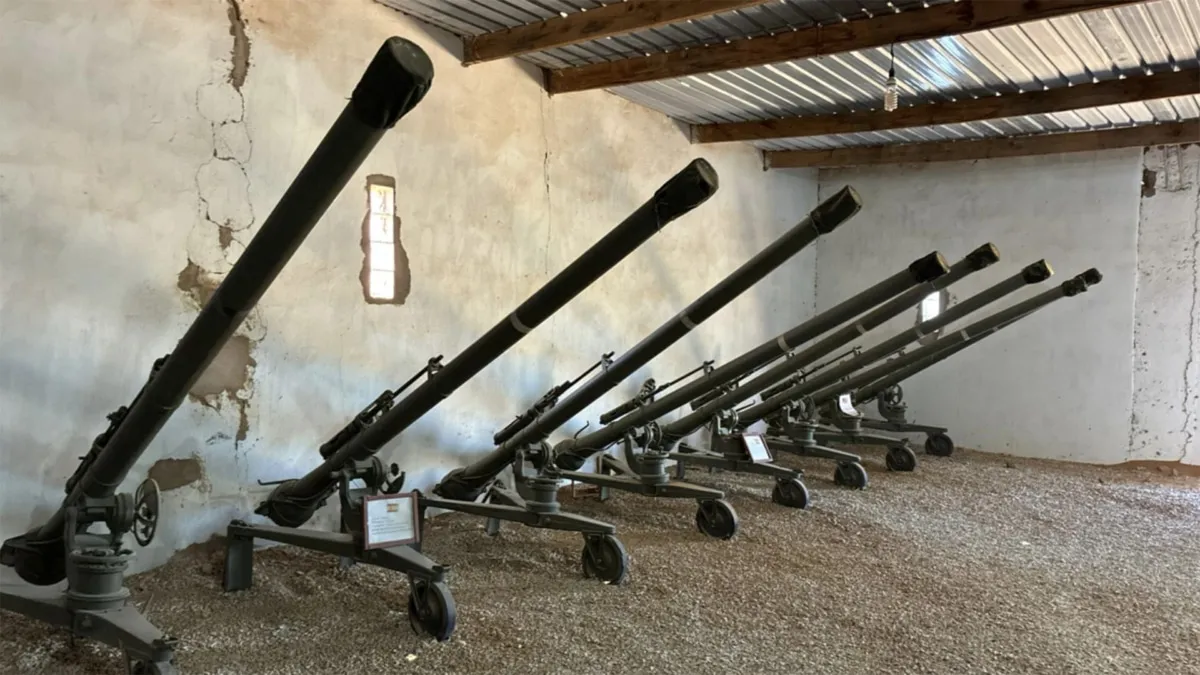
The journey through the museum begins almost seamlessly, with rows of captured weaponry that starkly illustrate who has been arming Morocco for decades. There are no sophisticated display cases or conventional museum labels; instead, the focus is on the arms themselves, coupled with a powerful message. "Here they are. These are from the Spanish Army," states one of the Sahrawi military officials, gesturing towards several mortars lined up in one of the rooms. "All of this was taken from Morocco." This sentiment resonates throughout the visit, with each piece meticulously pointed out, explained, and contextualized, revealing not just their origins, but also their significance and use in combat scenarios.
Among the displayed materials, a variety of artillery can be found, ranging from heavy 120mm mortars to armored vehicles and pieces of field artillery, as well as remnants of ammunition systems employed in battlefield operations. The arrangement is not done in a classical manner; rather, it is a deliberate accumulation intended to leave a lasting impact on visitors. The weapons are contextualized not through extensive explanatory panels but through the direct narratives of Sahrawi commanders, who reconstruct the origins and battlefield utility of each piece, highlighting the diverse sources of their armament. In one particular room, metal tubes resting on their bases draw special attention—these are 120mm mortars. "These are Spanish mortars," the officials explain, pausing momentarily for emphasis. The identification of origin is a central theme of their discourse. Surrounding them, other similar pieces showcase variations in design, caliber, and finish, reflecting the distinct origins of each.
The Implications of Captured Weaponry
The tour continues just a few meters further, where the mosaic of captured armaments expands. "These are French... these American... and these others are of common manufacture from Austria, Germany..." they enumerate almost without pause, pointing out cannons, firing mechanisms, and metal structures that might appear similar to untrained eyes but represent different trajectories within the same conflict. The diverse arsenal displayed allows the Polisario to reconstruct what they describe as the flow of weaponry to Morocco over the decades. It is not a singular supplier or historical moment but rather a cumulative supply chain encompassing various countries and timeframes.
In another section of the museum, a larger weapon disrupts the monotony of the mortars: a 105mm cannon. Its more robust structure and greater range classify it differently on the battlefield. "It's British," they explain, but they quickly clarify that it did not arrive in Morocco directly from the United Kingdom. According to Sahrawi narratives, its acquisition occurred through NATO-linked channels, reinforcing the notion of indirect involvement from Western allies in the ongoing conflict. The exhibition not only showcases conventional armaments but also serves as a political narrative, where each weapon is presented not merely for what it is but for what it represents—a supply chain, an international alliance, or a political decision made far from the desert.
"All of this was taken from Morocco," they repeat multiple times throughout the visit. This refrain serves as a common thread. The museum does not exhibit purchased armaments but rather captured ones, a crucial distinction in the Polisario's narrative. They explain that many of these pieces were "recovered in direct confrontations," during operations behind the wall or following the destruction of Moroccan positions. The foundation of the Sahrawi arsenal, as they recount during the tour, has not been based on purchasing weapons from the international market but on capturing them in the battlefield. This logic permeates the entire discourse of the Polisario and largely explains the heterogeneous composition of the materials currently on display in Rabuni. Nevertheless, they openly acknowledge that currently, their primary external support comes from Algeria, their key ally in the region.
During the most intense years of the conflict, especially throughout the 1970s and 1980s, the forces of the Sahrawi Popular Liberation Army developed a strategy based on direct attacks, mobility in the desert, and strikes on Moroccan positions that enabled them not only to resist but also to resupply. "Over 16 years of struggle, we captured around 4,000 Moroccan soldiers and officers," they explain. This figure is presented not just as a military statistic but as evidence of the intensity of the confrontations. Alongside the prisoners, they assert, vehicles, artillery pieces, ammunition, and military documentation were progressively integrated into their structure.
This logic of "war spoils" is not confined to the past. Although the conflict has altered in form and visibility, the Polisario insists that military activity continues. "Since April 13, 2020, about 4,000 military missions have been carried out against the Moroccan army," they assert. The museum also showcases remnants of ammunition, including metallic fragments, opened casings, and scattered small devices associated with cluster bombs. "They are completely illegal," they emphasize firmly. Unlike mortars or cannons, the focus here is not on caliber or range but on effects. The Sahrawi commanders take time to explain their operation in detail. "A single device can disperse hundreds of submunitions." The concern, they underline, is not just the immediate impact but what occurs afterward. "Some do not detonate immediately and remain active for hours or days," posing a significant risk to civilians, especially considering that this type of ammunition affects large areas without distinguishing between military targets and regular transit zones.
The wall that divides the territory—extending over 2,700 kilometers—serves as a central structure in this defensive system. It is not merely a physical barrier but a complex defensive framework. "Every 10 to 15 kilometers, there is a large base and several smaller ones," they explain, outlining a continuous line of surveillance and control throughout the desert. In between these positions, the land is marked by another constant element: mines. They are unseen but condition everything. "It is a completely mined area," they summarize. The consequence is a space where movement is restricted even in the absence of active combat. This reality also influences daily life. "Civilians entering liberated areas do so without cars," they explain, noting that the reason is not solely the challenging terrain but the risk of being detected and attacked. "Because if they see a car, they bomb it with drones."
Beyond the metal, calibers, and artillery pieces, the Rabuni museum reserves a less prominent but equally significant space for documents. Folders, typewritten sheets, reports bearing official stamps, and timeworn papers contribute a different dimension to the conflict. "Here, the planning of the invasion is documented even before Spain's departure," they explain while showing several reports dated in 1974. This date is significant. For the Polisario, it places the planning of the Moroccan entry into Western Sahara before the Madrid Agreements, reinforcing their thesis that the occupation was not an impromptu reaction but rather a premeditated operation. The documents, many of them typewritten, include references to troop movements, unit organization, and operational forecasts according to their interpretation. These are not documents intended for public consumption but rather internal records. Alongside these reports, the museum houses other types of materials seized from the Moroccan army, including arrest orders, administrative lists, military communications, and records related to territorial management. Together, these documents allow for the reconstruction of not only the strictly military dimension but also the structure of control deployed on the ground.
Some documents are written in French, others in Arabic, reflecting the different administrative levels and influences within the Moroccan military organization. Many bear seals, signatures, or annotations that, as they explain, allow for tracing their origin and authenticity. The museum tour is underpinned by a constant accusation directed at Spain and other EU countries regarding their involvement in supplying arms to Morocco to fight against the Polisario. In Spain's case, the accusation is not only historical but also pertains to its current stance. The Polisario asserts that "Spanish governments have never changed their position" and claim that "they have allowed the invasion, facilitated exile, and aided Morocco in its war." The presence of Spanish weaponry in the museum reinforces this narrative. "This was Spanish," they repeat throughout the visit, not as a mere technical detail but as a political reproach.
As reported by elindependiente.com.