Revisiting George Orwell's Observations on Morocco and Their Relevance Today
Imagine if George Orwell, the renowned British author, were given the opportunity to revisit the Arab world nearly ninety years after his insightful journey to Morocco in 1938. What might he observe in the contemporary landscape, and which observations would he meticulously document in his notebooks? While this idea may seem whimsical given that Orwell departed from this world over seven decades ago, literature possesses a unique power: it allows us to summon the voices of the past to reflect upon the present.
To engage with this thought experiment, we must turn to Orwell's Moroccan notebooks, where he recorded observations that resonate with greater significance today than they did during his lifetime. His notes should not be viewed as a definitive sociological analysis or a comprehensive historical judgment on Moroccan society; rather, they serve as a compelling testament from a visitor who arrived with preconceived notions, only to confront a reality far more intricate than he had envisioned.
Orwell noted that Moroccan women, while donning the traditional veil, navigated the souks and public spaces with remarkable freedom, and that the garment did not impede their participation in community life. He also observed a striking absence of the tension or discomfort between men and women that Europeans often attribute to Islamic societies. Interactions such as handshakes and casual mingling occurred without the moral panic that currently characterizes many Western debates surrounding these issues.
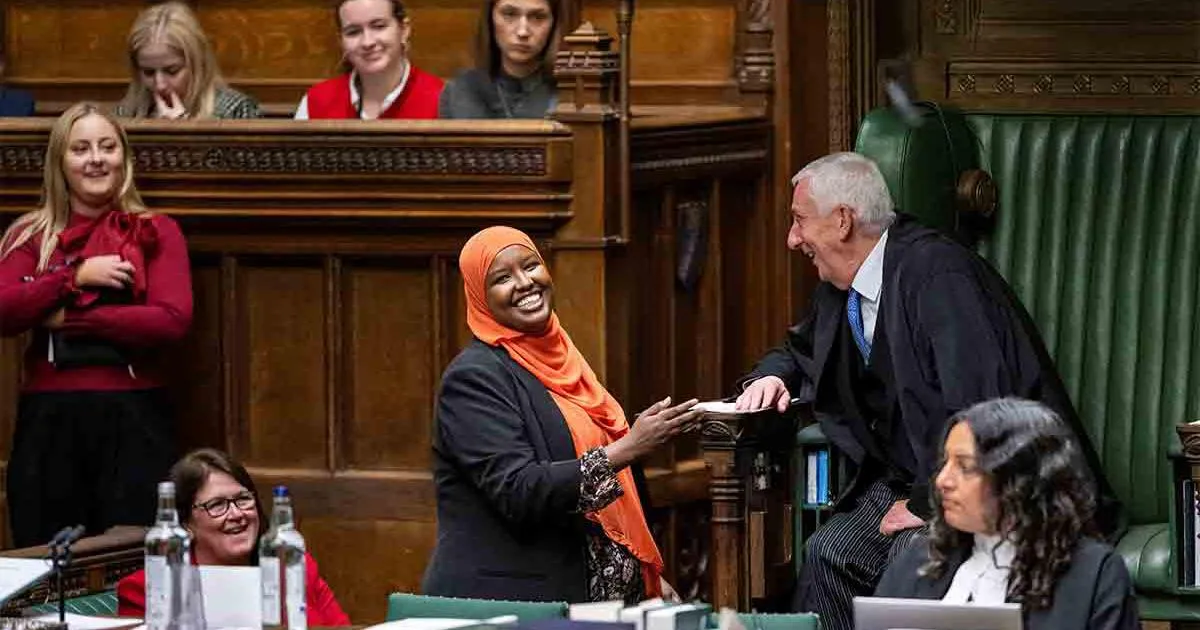
This reflection on Orwell's diary draws a parallel to a contemporary figure, Sagal Abdi-Wali, who recently took her seat as a Labour Member of the UK Parliament. Adorned in a traditional headscarf and Somali attire, she stands unashamed of her roots, embodying a cultural identity that challenges the prevailing narratives of integration and belonging in the West. In that singular moment, an invisible connection appears to bridge the Morocco that Orwell encountered nearly a century ago with modern-day Britain, emphasizing that the essence of the connection lies not in the headscarf itself, but in the fragility of the preconceptions surrounding it.
The Evolution of Cultural Identity and Tolerance
Orwell's observations in Morocco starkly contrasted with the stereotypes he brought with him, while Sagal Abdi-Wali embodies a similar defiance against entrenched norms in Western discourse regarding cultural identity. The dilemma they both represent is less about the empirical reality of their circumstances and more about the inherited biases that shape our perspectives. Abdi-Wali did not enter the House of Commons as a diluted version of her identity; rather, she did so as a full British citizen who embraces her Somali heritage. Her presence serves as a powerful reminder that integration does not necessitate the erasure of one’s cultural background, and that citizenship does not require the renunciation of one’s roots.
The true significance of Abdi-Wali’s parliamentary entry extends beyond her attire; it conveys a profound message about the essence of cultural pluralism. Orwell’s jottings, at first glance, may seem like fleeting impressions from an inquisitive British traveler, yet their real value lies in their origin: a European perspective laden with preconceived notions about the "Muslim Orient," which had to be reassessed in light of a social environment far more complex than anticipated. His writings reflect an honest attempt to capture the reality he witnessed rather than to serve as an apology for Arab societies.
As we revisit these historical observations, we are confronted with a pressing question: what has transpired on both sides—East and West? Since the 1970s, many regions of the Arab world have gravitated toward more rigid interpretations of gender relations and social conduct, while parts of the West have mirrored this trajectory. In several European nations, the headscarf is increasingly viewed not as a symbol of personal autonomy or a manifestation of individual conscience, but as a target of suspicion or an indictment of perceived failures in assimilation. Ironically, societies that have historically championed individual liberties now find themselves embroiled in contentious debates over what a woman can or cannot wear.
If Orwell were to return today, his focus would likely shift from the garment itself to the anxieties surrounding it. In 1938, he witnessed veiled women engaging in public life without any apparent contradiction, whereas today, the veil has become an ideological battleground, interpreted variously as a sign of religious piety or a challenge to civic life. In this conflict, the individual—the woman who possesses the right to determine how she expresses her faith and identity—is often overlooked.
Orwell did not observe an idyllic Morocco; he experienced only a fragment of its diverse social fabric, shaped by the conditions of a French protectorate. Nonetheless, the value of his insights lies in their ability to challenge entrenched stereotypes and illuminate the complexities of societal perceptions. Sagal Abdi-Wali's journey resonates beyond the walls of Westminster, reminding us that vibrant societies do not shy away from differences, nor do they require a homogenized identity to maintain national unity. The strength of a democracy is not solely measured by its proclamations of freedom, but by its capacity to embrace pluralism at the highest echelons of governance.
Were Orwell to traverse the landscapes of Casablanca and London today, he would likely discern that the fundamental struggle is no longer delineated along the lines of East versus West, as his generation perceived it. Instead, it manifests as a conflict between those who champion the right of individuals to define their identity and those who seek to impose conformity in the name of collective ideals. He would recognize that true tolerance is not the exclusive domain of any one civilization, and that prejudice can arise in any culture. The real danger emerges when clothing overshadows humanity, symbols eclipse freedom, and identity takes precedence over citizenship.
The remarkable lesson that links the Morocco Orwell encountered to the Parliament Sagal Abdi-Wali entered is that tolerance does not demand uniformity; rather, it entails granting individuals the right to differ. Progress is not measured by laws, monuments, or technology, but by a society's ability to coexist with those who are different. As eras pass and regimes change, the desire to dictate how others should live persists, proving more enduring than the ideologies that once assumed permanence. As reported by middle-east-online.com.