
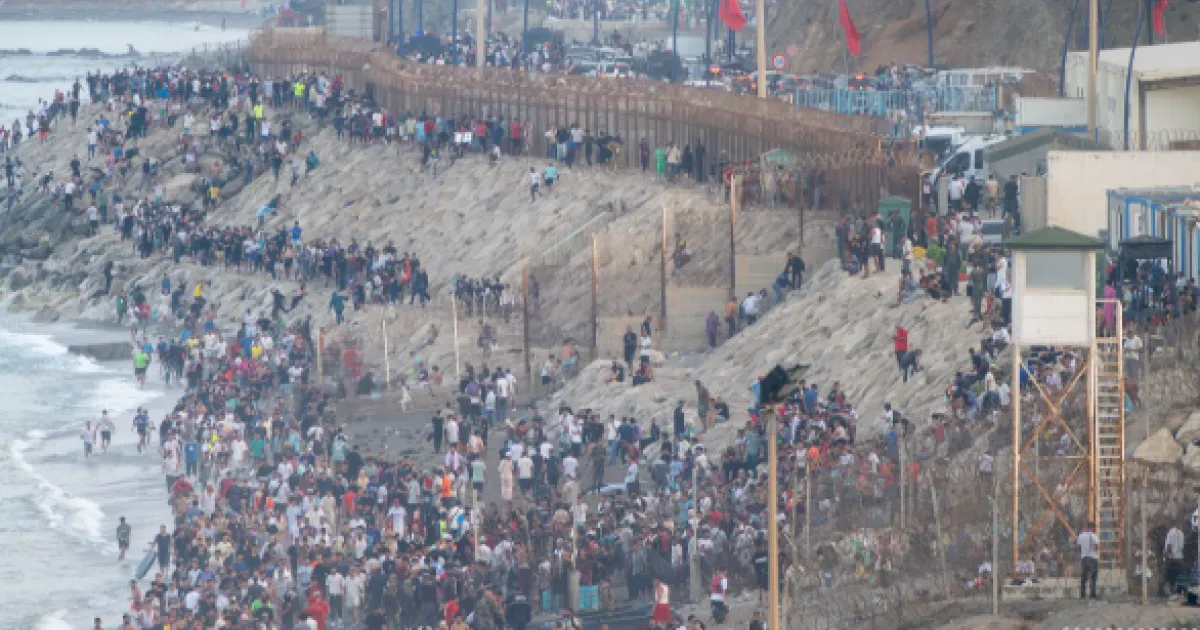

Recent reports from Spanish media have shed light on the escalating social discontent in Morocco, driven by deteriorating conditions within the country, rampant corruption, and widespread poverty. This dire situation has prompted tens of thousands of Moroccans to embark on a mass exodus towards the Spanish city of Ceuta, particularly noted in late July. A comprehensive investigation published by the Spanish Radio and Television (RTVE) highlights the increasing unrest in Morocco, set against the backdrop of severe economic and social crises impacting the kingdom. This report coincides with the recent migration crisis in Ceuta, raising pressing questions about the future of the Moroccan regime in light of the rising anger among its populace.
The investigation emphasizes that the crisis in Ceuta, which saw the arrival of tens of thousands of individuals to the city, has once again brought to the forefront the manifestations of social discontent within Morocco, especially among the youth. Factors contributing to this unrest include high unemployment rates, social inequality, soaring inflation, and a lack of job opportunities. Furthermore, the images captured just a week prior in Ceuta, illustrating this influx of people, have effectively undermined the narrative propagated by the Moroccan regime for over a quarter of a century.
The report includes a statement from Moroccan investigative journalist Hicham Mansouri, currently residing in exile, who asserts that the recent migration crisis has completely dismantled the regime's narrative. He notes, "The images speak for themselves: children, elderly individuals, minors, and even infants have found themselves caught in this situation. This has led to the collapse of all the propaganda disseminated by the regime through its media outlets." He further indicated that the regime had exploited this tragic reality to leverage pressure on Spain, but it appears that the situation has escalated beyond what the regime initially intended, spiraling out of its control.
In addition, Moroccan historian and university professor, Maati Monjib, remarked that the events in Ceuta serve as a widespread expression of public dissent against a profoundly corrupt socio-economic system and an elitist, authoritarian regime that disregards the common people. The investigation also reflects on the wave of protests that have swept across Morocco in recent years, from the Hirak movement in the Rif region to various professional and youth protests, culminating in the youth uprising that emerged in September 2025, demanding improvements in the healthcare and education sectors as well as measures to combat unemployment and corruption.
Moreover, the source notes that Moroccan authorities have responded to these protests with a repressive crackdown, resulting in the arrest of thousands and the issuance of prison sentences for over two thousand individuals, while several youths remain subject to ongoing legal scrutiny. The report also relays an analysis from economic expert Fouad Abdelmoumen, who stated that the mass exodus towards Ceuta at the end of last month is a direct consequence of the growing public dissatisfaction.
As reported by entv.dz.
