
Iustitia Europa Urges European Institutions to Investigate Migratory Crisis
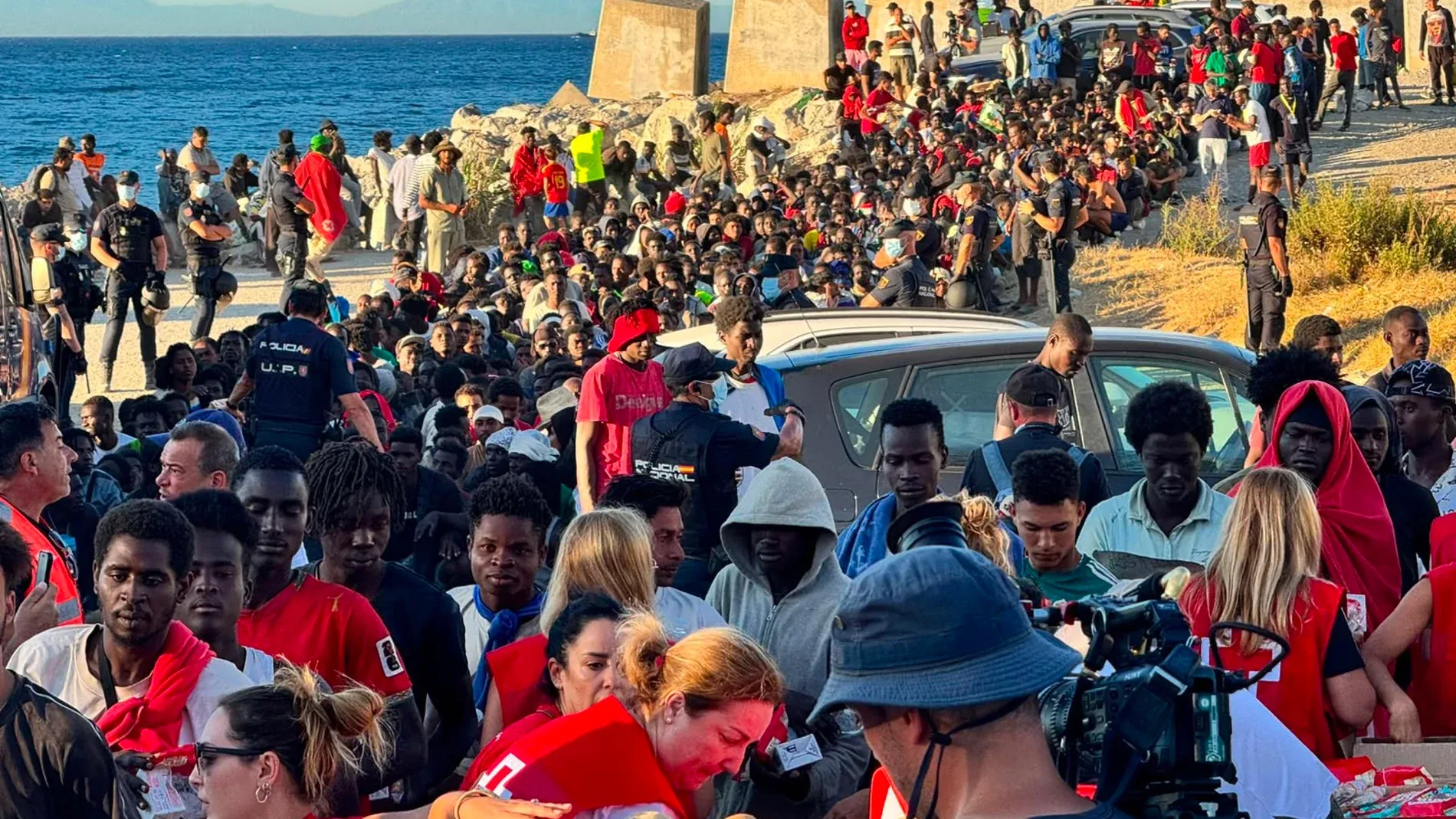
Iustitia Europa, a political organization acting as a public prosecutor in judicial cases involving the government of Pedro Sánchez, has formally lodged a complaint with European institutions to investigate the massive influx of migrants into Ceuta and the response from community institutions and various member states. The organization claims that Spain was the victim of a "hybrid aggression" orchestrated by Morocco. The complaint is directed at the European Commission, the European Council, the Council of the European Union, and the European Parliament, emphasizing the need to analyze the "possible responsibilities arising from the use of migratory flows as a political pressure instrument against a member state, as well as the responses offered by European institutions and national governments.
The aim of this complaint, as detailed in the document accessed by LA RAZÓN, is to ensure that "no external border of the Union can be used again as a tool of political coercion against one of its member states." Luis María Pardo, the president of the organization, also pointed out that the initiation of proceedings by the National Court "highlights the extraordinary severity of the events in question." Judge María Tardón has, in fact, ordered the police to prepare a report to determine whether the situation was a "concerted action" led by a criminal organization, given the indications of offenses against the peace and independence of the state.
Concerns Over Security and Political Coercion
Iustitia Europa argues that the arrival of approximately 70,000 individuals into the autonomous city in a short time frame cannot be considered a "spontaneous" migratory phenomenon but rather an organized act that jeopardized the security of an external border of the European Union. According to the document, the scale of the events makes it difficult to assert that they occurred without the knowledge or intervention of Moroccan authorities. "Morocco controls its roads, access points, police forces, and borders. It also oversees the movements of large human concentrations in a strategically sensitive area. The sudden disappearance of these controls facilitated the mass entry into Ceuta. Morocco used its population as a pressure tool against Spain," the document elaborates.
In this context, Iustitia Europa highlights that the letter sent by governments explicitly acknowledges that the events in Ceuta constituted an "attack," suggesting that they were aware of the true "nature" of what transpired. Furthermore, they criticize Italy for opting to impose restrictions on Spain rather than demanding accountability from the Kingdom of Morocco. They argue that these decisions contradict the principle of European solidarity, asserting that it is the state that faced migratory pressure that ultimately bears the political and economic consequences of the crisis.
"Rather than penalizing the country that suffered the events, the European response should focus on clarifying responsibilities and reinforcing the effective protection of the EU's external borders [...]. Italy's stance is disloyal, unjustified, and politically spurious," they explain. The organization also condemns any European government that uses Pedro Sánchez's actions to justify measures against Spain, arguing that such actions deliberately confuse the government with the state. They assert that "no decision made by the Spanish government authorizes Morocco to open its controls and use civilian population against Spanish territory. Pedro Sánchez is merely the excuse. The harm falls on Spain," they state.
In their document, Iustitia Europa also criticizes the actions of European institutions, accusing them of applying a "double standard" towards Spain. According to the party, the European Union demands member states to cede sovereignty and comply with numerous obligations but fails to respond decisively when one of them faces threats to its territorial integrity. "It legislates on the daily lives of Europeans with increasing intensity, yet it fails to meet the primary obligation of any political structure: to protect its citizens, their borders, and their security," they assert.
As reported by larazon.es.