
According to a report from the Spanish police, Moroccan security forces exhibited a level of "total permissiveness" during an unprecedented influx of migrants into Spain's North African enclave of Ceuta in late July. This finding, revealed by AFP, poses a potential embarrassment for Spain's leftist government, which has been cautious in attributing blame to Morocco amidst ongoing efforts to maintain diplomatic relations with Rabat.
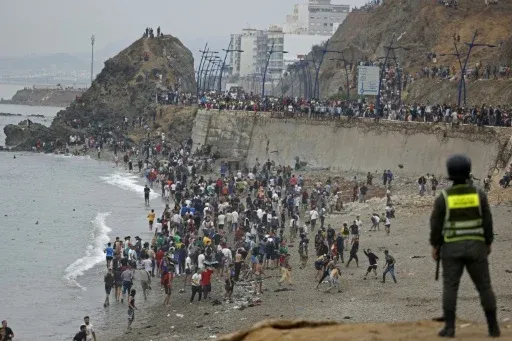
On July 30 and 31, over 70,000 migrants crossed the border from Morocco into Ceuta, leading to tragic outcomes, including numerous drownings as individuals attempted to navigate around a breakwater to reach safety. The report issued by Spain's National Centre for Immigration and Borders (CENIF) expressly noted that the response from Moroccan authorities was far from adequate, stating that their actions amounted to "total permissiveness, to say the least." It highlighted that Moroccan police made no substantial attempts to manage the large crowd or to disperse individuals from the border area.
Eyewitness accounts from a diverse group of migrants indicated that the police presence was significantly diminished compared to usual levels. Furthermore, satellite imagery taken on July 30 showed an absence of police or military forces at key locations such as the beach or breakwater, as well as on adjacent roads. Testimonies from migrants involved in the investigation suggested a consistent theme: not only did Moroccan police maintain a passive stance during the attempted crossings, but they also appeared to provide guidance to facilitate entry via water.
The report further detailed the presence of "non-uniformed individuals" who seemed to be orchestrating the movement of migrants, sometimes directing them toward the breakwater. This chaotic situation has ignited a debate within the European Union regarding migration policies and responses.
In the aftermath of the influx, a Moroccan source refuted claims of any relaxation at the border, attributing the surge to the "malicious exploitation" of social media and the dissemination of misleading information. Meanwhile, the Spanish interior ministry issued statements denying any responsibility on Morocco's part, despite initial reports from the right-leaning online publication El Espanol which brought the CENIF findings to light.
Following these developments, Spain's socialist Prime Minister Pedro Sanchez dismissed Moroccan culpability, emphasizing the importance of collaboration with Rabat, which has since repatriated a significant number of migrants. The opposition, particularly from right-wing factions, has been vocal in its criticism of Sanchez's management of the crisis, questioning Morocco's role throughout the events.
Ceuta, along with Melilla, constitutes the only land borders between the European Union and Africa, a status that has historically complicated relations between Spain and Morocco. Morocco asserts its sovereignty over both territories, and analysts have suggested that the recent migrant surge may have been strategically utilized as a means of political leverage against Spain, particularly following Sanchez's visit to Algeria, a historical adversary of Morocco, in July. Additionally, the ongoing dispute over Western Sahara remains a contentious issue between the two nations, with Morocco maintaining control over the previously Spanish-colonized region, which is claimed by the Algerian-backed Polisario Front.
As reported by modernghana.com.