Massive Investment Aimed at Water Sustainability in Morocco
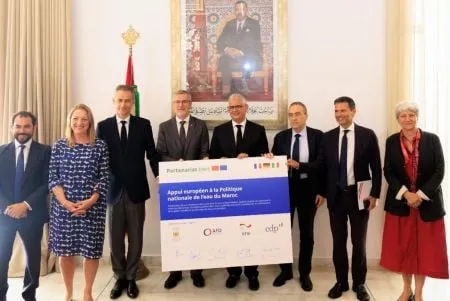
Morocco has emerged as one of the African nations most vulnerable to water stress, a situation exacerbated by consecutive years of drought. To tackle this pressing issue, the Moroccan government, in collaboration with the European Union (EU) delegation, and the German, Italian, and French embassies in Rabat, has launched an ambitious program worth 3.7 billion dirhams (approximately $402 million). This initiative is specifically designed to finance the National Water Policy (PNE) and aims to alleviate the country’s water challenges.
According to a statement released by the Moroccan Ministry of Equipment and Water on June 2, the program is structured around four key priorities to enhance water governance in the Kingdom. These priorities include improving knowledge of water resources, optimizing management of extreme phenomena, and strengthening the institutional capacities of stakeholders in the water sector. Furthermore, the program will provide technical assistance and facilitate the exchange of experiences between Moroccan and European institutions.
The financial package features a contribution of 514.4 million dirhams from the EU, in addition to three loans totaling around 3.2 billion dirhams sourced from European financial institutions. Nizar Baraka, the Minister of Equipment and Water, emphasized the significance of water conservation, stating that "water is a heritage that must be preserved for future generations and represents one of the foundations of national sovereignty." He further noted that the Kingdom has adopted a proactive approach to managing its water resources.
Desalination: The Heart of Morocco's Water Strategy
Faced with increasing water scarcity, driven by climate change, rising water demand, persistent drought, and significant rainfall deficits, Morocco has entered its seventh consecutive year of drought as of 2025. This unprecedented situation threatens not only the nation’s water resources but also its entire economic framework.
In response to these challenges, the Moroccan government has initiated several projects aimed at securing water access. These projects include the construction of dams, the development of hydraulic interconnections, the reuse of wastewater, and the implementation of water-saving programs in drinking water supply and irrigation networks. Additionally, Morocco is heavily investing in seawater desalination as a strategic solution to bolster its water security. This approach aims to fulfill over 50% of the country's drinking water needs by 2030 and to irrigate extensive agricultural areas, thus contributing to strengthening national food security.
As reported by agenceecofin.com.