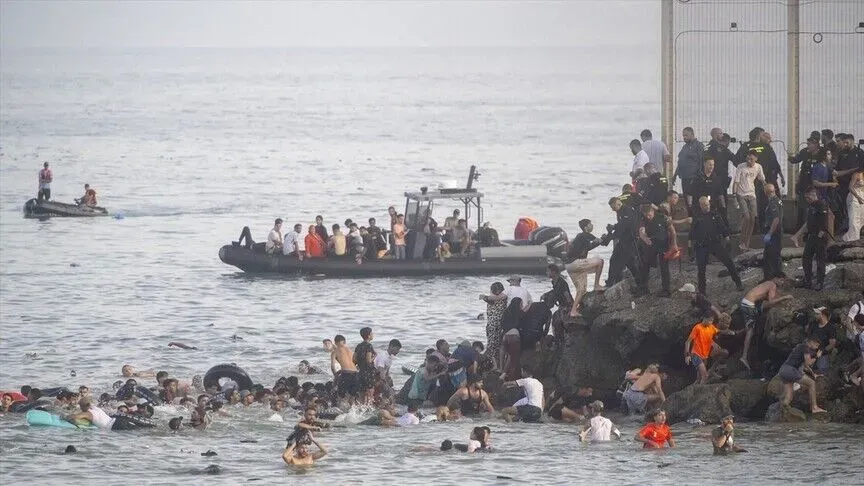
On September 10, Morocco officially rejected any allegations linking it to the influx of migrants into the Spanish enclave of Ceuta at the end of July, asserting that it will not serve as a "scapegoat" for political reckonings in Spain. This statement marks the first public response from Rabat since the dramatic events of July 30 and 31, when over 70,000 migrants reportedly crossed the border into Ceuta, either by foot or by swimming. This enclave, alongside Melilla, represents one of the only two land borders between the European Union and Africa.
The chaotic surge of migrants resulted in numerous fatalities and many more missing individuals. In an official communication disseminated by the MAP news agency, the Moroccan Foreign Ministry emphasized that “no data, facts, or reports establish any involvement of Moroccan authorities” in this crisis. Furthermore, the ministry insisted that Morocco will not be used as a pawn in pre-election political strategies, nor will it accept being blamed for political disputes.
Challenges Faced by Migrants in Ceuta
While many of those who successfully crossed the border returned shortly thereafter, thousands remain in Ceuta. Estimates suggest that approximately 5,000 migrants, according to the Spanish Prime Minister Pedro Sanchez's government, or at least 10,000 according to local Ceuta authorities, are still in the enclave, many of whom are forced to sleep on the streets or beaches. This statement from the Moroccan Foreign Ministry comes at a time when suspicions regarding Morocco's potential involvement in the crisis have intensified, especially following the leak of a police report alleging the “permissiveness” of Moroccan security forces during this unprecedented situation.
Prime Minister Sanchez has repeatedly stated that he has “no evidence” of Morocco's involvement in the migrant arrivals, a stance that has faced significant criticism from various members of the Spanish opposition. Moreover, the question of Morocco's role has also been scrutinized by Spanish intelligence services, which declassified several reports warning of the risk of “massive influxes” of migrants into Ceuta, primarily consisting of young Moroccans. One such document, issued by military intelligence on July 30, suggested that while it is “highly probable” that Moroccan authorities are not actively encouraging the migration wave, they have thus far acted with negligence and passivity.
Calls for Accountability and Cooperation
In light of what it describes as an “indictment against Morocco,” the ministry called on Spanish authorities to clarify their handling of the crisis: “Why are illegal migrants not being turned back when the Moroccan government has officially committed to readmitting them? Why are unaccompanied minors being kept away from their families when Morocco has urgently requested their return?” The ministry firmly stated that answers to these questions lie not within Morocco but rather with the relevant Spanish actors.
Rabat characterized the crisis as “regrettable,” asserting that it necessitates a thorough examination to define the circumstances, identify any external interferences, expose manipulations, and, crucially, ensure that such events do not recur in the future. Furthermore, the ministry highlighted the significance of its relationship with Madrid, reaffirming Morocco's commitment to fostering a relationship characterized by geographic proximity, political understanding, economic partnership, and security cooperation.
As reported by france24.com.