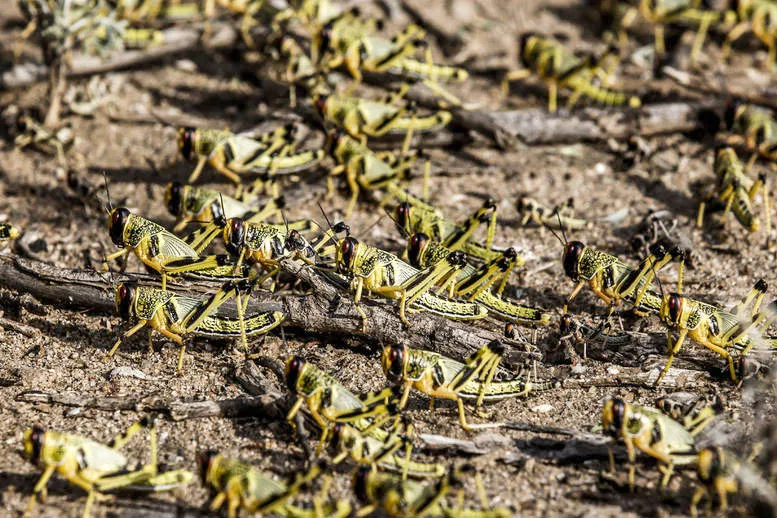
In recent weeks, Morocco has significantly strengthened its response to the advance of the desert locust, one of the world's most destructive pests, by spraying pesticides over more than 39,000 hectares of land to curb its spread. While official sources indicate that the situation is under control, international attention has been drawn to the locust's rapid propagation capabilities and its potential impact on nearby regions, such as the Canary Islands.
The desert locust, classified by the FAO as the most devastating migratory pest, can multiply at an alarming rate when conditions are favorable. A single swarm can contain millions of locusts, consuming food equivalent to that of thousands of people in just one day, posing a direct threat to crops and pastures. Additionally, these insects can travel significant distances, covering up to 150 kilometers in a day propelled by the wind, which complicates control efforts immensely.
Reports indicate that the outbreak has primarily affected southern areas of Morocco and Western Sahara, progressively extending northward. In March, an increase in reproductive activity was observed, with groups of nymphs and swarms noted in regions near Agadir, Errachidia, and Guelmim. Experts attribute this surge to exceptional rainfall in the region, creating ideal conditions for locust proliferation, including the growth of vegetation that serves as food and facilitates their reproduction.
Despite these challenges, authorities in Rabat assert that the situation is manageable due to prompt interventions and the deployment of resources to contain the outbreak. Morocco has implemented pesticide treatments across tens of thousands of hectares, a common measure in such crises, although this practice raises concerns regarding its potential effects. The use of these chemicals raises questions about human health, environmental impact, and food security, particularly when applied on a large scale.
In light of these concerns, international organizations recommend exercising extreme caution and advocating for more sustainable solutions, such as the use of specific biopesticides that target these insects without significantly harming other ecosystems. As the outbreak evolves, the Canary Islands have come under increased observation. Isolated instances of locusts have been detected in the archipelago, especially during episodes of calima, confirming that some individuals have managed to travel from the African mainland.
However, authorities maintain that this does not constitute an invasion, but rather isolated cases that do not pose an immediate risk. The crucial factor will be determining whether these insects can reproduce within the territory. If they cannot, their presence may remain a temporary occurrence without further implications. The FAO forecasts that locust activity could persist in the coming weeks, with potential movements toward northern Morocco and Algeria. Increased reproduction could lead to new concentrations of insects, necessitating ongoing vigilance and control efforts to prevent the situation from escalating into a larger infestation.
In this context, the speed of detection and response remains essential to minimize damage. Although Moroccan authorities insist that the situation is under control, the extent of the infestation and the measures taken have raised concerns about its potential impact on agricultural production. The combination of swarms capable of devastating crops and the intensive use of pesticides highlights the need to focus on food safety while balancing crop protection with environmental preservation.
For now, the situation remains under close observation, but experts and international organizations agree that the developments in the coming weeks will be crucial in assessing the real extent of this episode.
As reported by elfarodeceuta.es.